
 Gaby
Gaby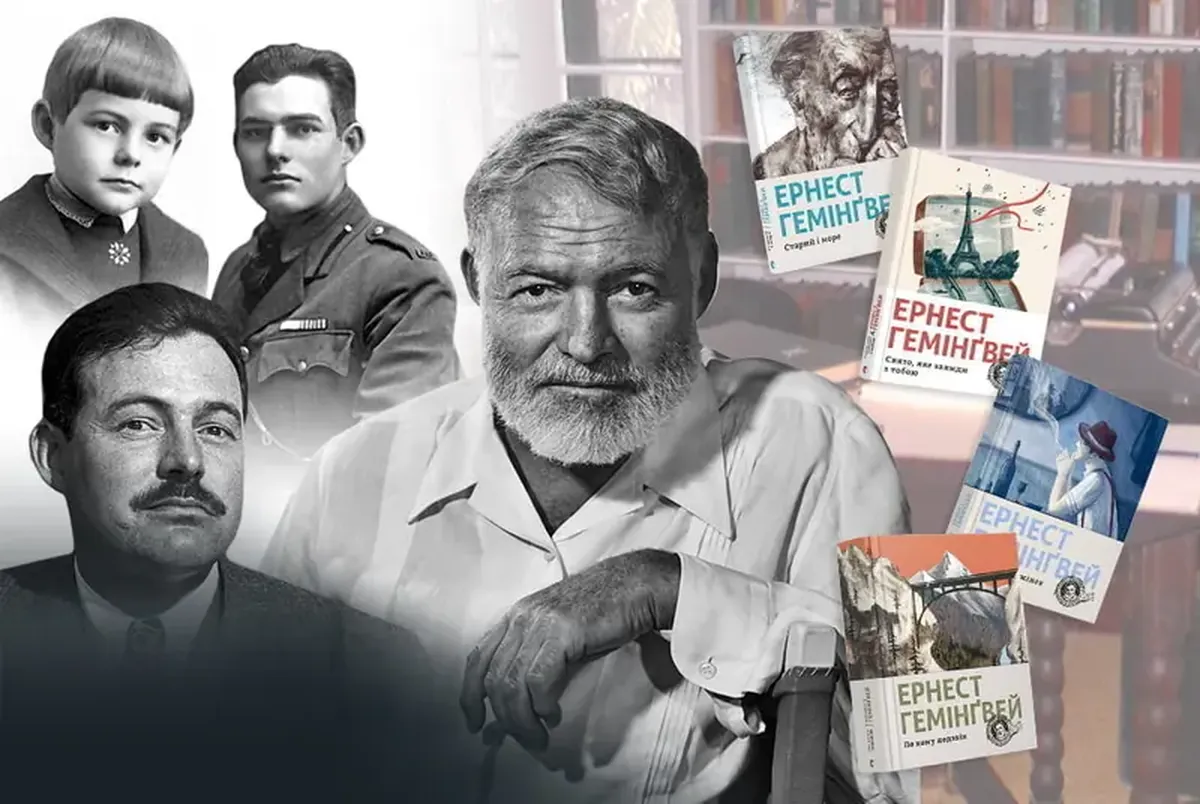
Hemingway’s spare, stark prose grew out of extreme personal experience. Boxing, war, hunting, close calls, brushes with intelligence agencies, and suicide all shaped the life of an unrepentant adventurer and forged his singular voice.
From “Dolly” to Manhood
Ernest Hemingway disliked his own name, though he adored the grandfather who gave it to him. He associated the name with a naive character from a well-known English play, while his maternal grandfather won his respect by giving the 12-year-old a real rifle. He was the second of six children and the eldest son of a doctor and an opera singer, and he learned to handle guns alongside music lessons. By age four, he was already hunting, fishing, and building shelters in the woods. His artistic mother dressed him in girls’ clothes and didn’t cut his hair until he was six, nicknaming him “Dolly,” while his stern father taught him to track game and use a spear and bow.
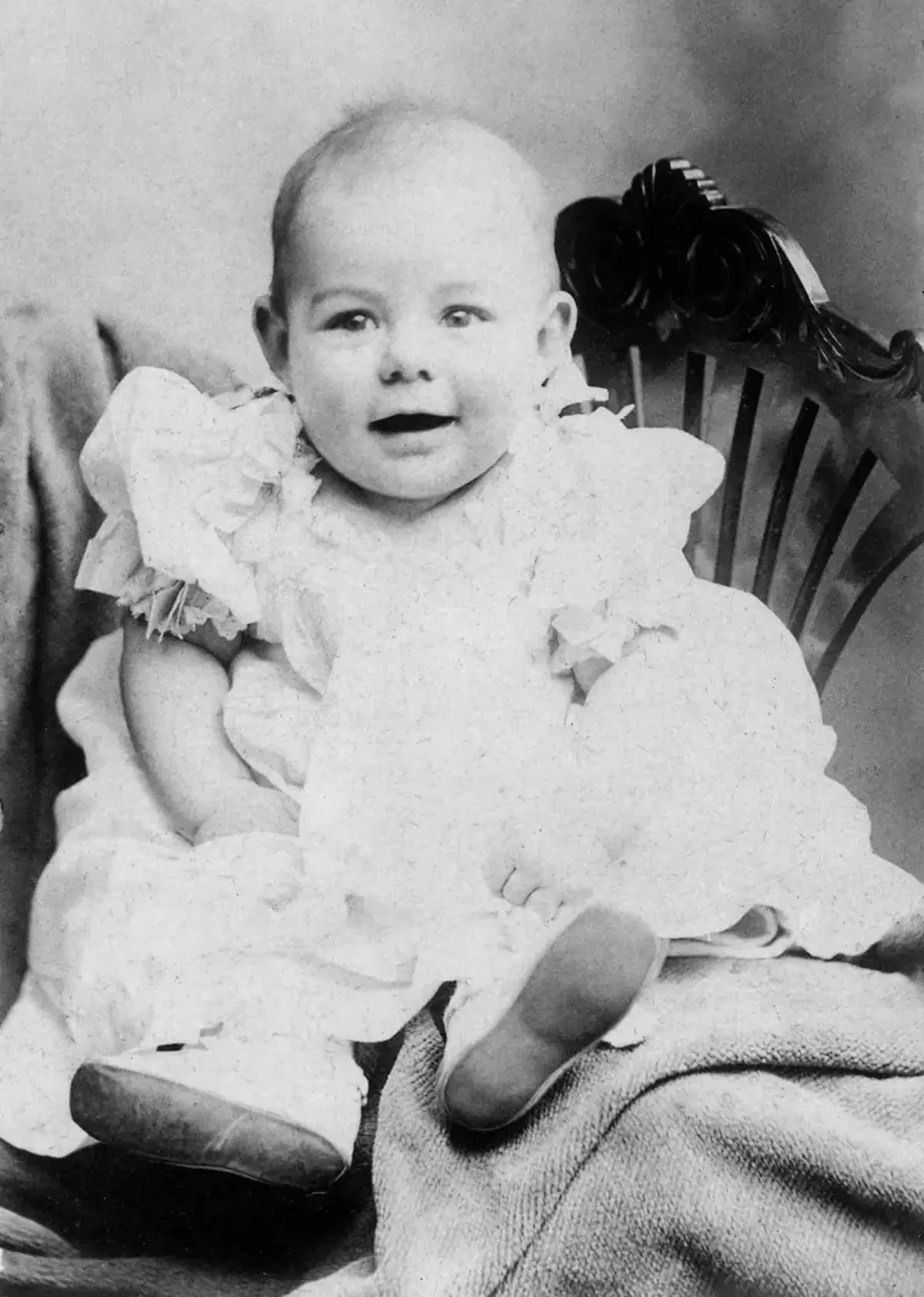
Ernest Hemingway, 1900
Escaping from cello lessons into the wild was easy thanks to the family’s summer cottage on the shores of Michigan. The seven-room house, with a music studio and a doctor’s office, served as a vacation retreat from their Oak Park, Chicago, home. Time spent with neighborhood Indian children and early survival lessons in the woods sparked Ernest’s taste for adventure and a hunger for travel.
Hemingway later credited his music lessons with influencing his prose: counterpoint became a hallmark of his phrasing. Boxing in school taught him to “get back up after taking hits and attack like a bull.” Later, as a fan of bullfighting and safaris, he would figuratively “attack” lions, sharks, and German submarines.
The Illusion of Immortality
Working as a reporter for The Kansas City Star taught the literary-minded young man to be at the center of events and to explain things simply. It made his reactions quick, his thoughts concise, and his words precise. Journalism also gave him professional courage.
Although a teenage injury to his left eye kept him from being drafted, Hemingway found another way into World War I: he volunteered as a driver for an American Red Cross unit. On his first day in Milan he helped recover human remains after a factory bombing. While trying to carry a wounded soldier out of danger, the 18-year-old recruit was hit by mortar fire. On July 8, 1918, Hemingway sustained severe injuries, spent five days in a field hospital and six months in medical care. Surgeons found more than 200 wounds and removed 26 pieces of shrapnel. The serious damage to his legs required urgent surgery, and a badly damaged kneecap was replaced with an aluminum prosthesis.
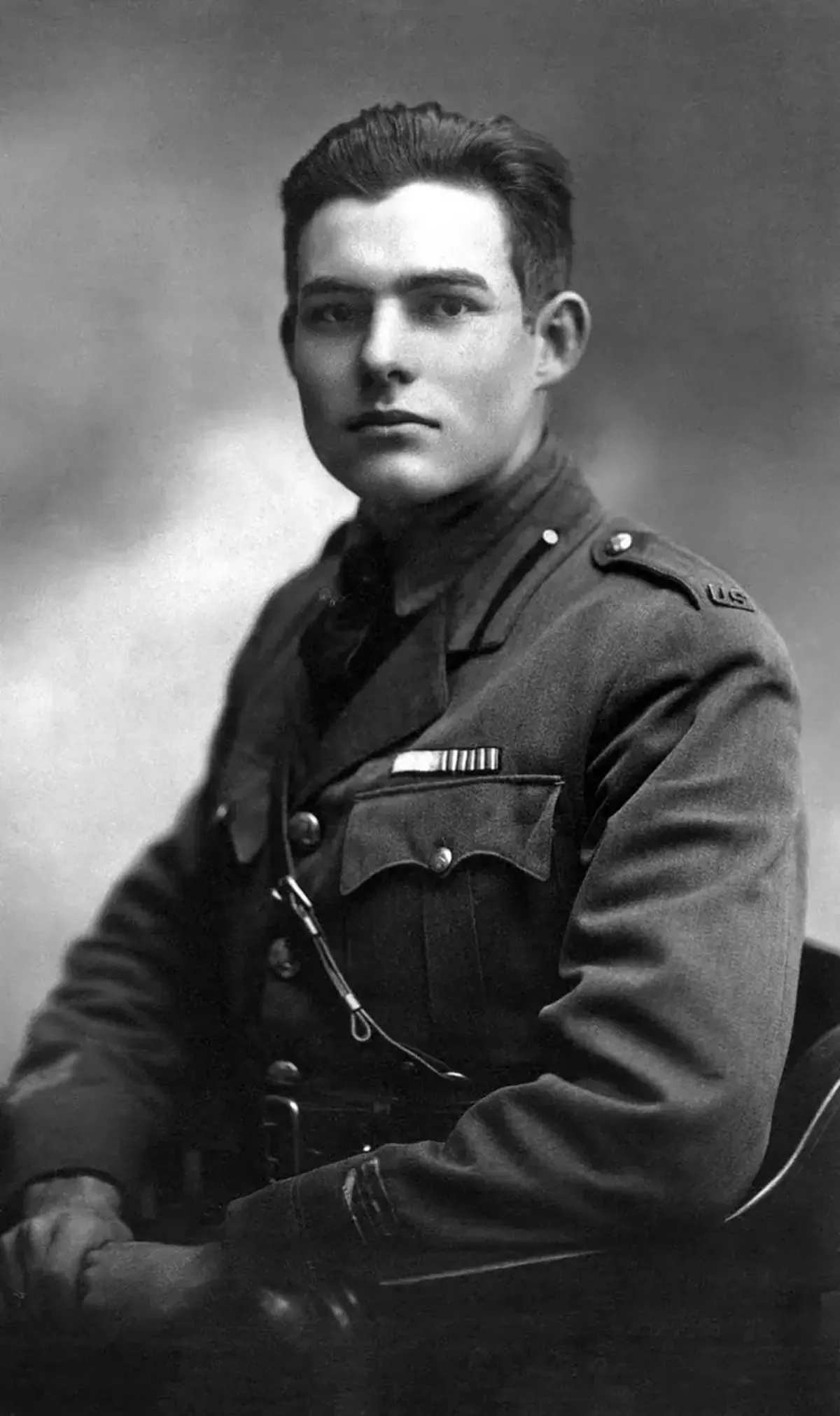
Ernest Hemingway in military uniform, 1918
“When you go to war as a boy, you have the illusion of immortality,” the author of A Farewell to Arms later wrote. “But everyone is convinced of their invulnerability only until the first wound. Then you learn that it can happen to you too.”
“A Celebration That Stays With You”
Like fellow veteran-writer Erich Maria Remarque, the 20-year-old Hemingway returned forever changed. His wounds, both physical and emotional, ached. His first love collapsed when Agnes von Kurowski, the Red Cross nurse he intended to marry, announced her engagement to an Italian officer. Devastated, he resolved psychologically to leave women before they could leave him.
In Paris, working as a foreign correspondent for the Toronto Star, he found companionship with pianist Hadley Richardson, who resembled Agnes. Friends described his first wife as “a tall, brown-eyed, rosy-cheeked beauty with a square chin and a soft voice.” That marriage helped him recover from his emotional wounds.
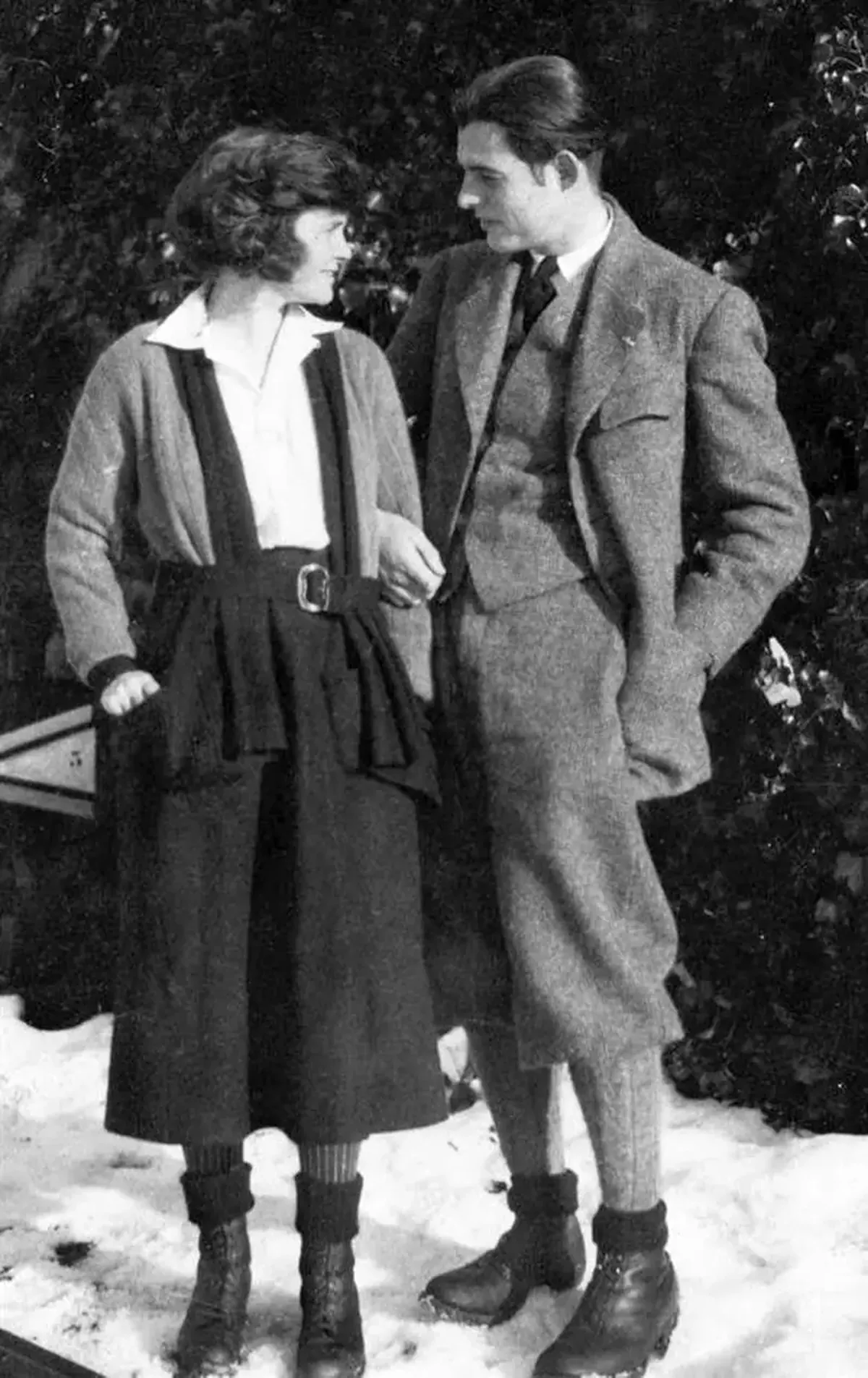
Ernest Hemingway and Hadley, 1922
Hemingway’s literary world widened along the Seine, where he met “the most interesting people in the world”: Pablo Picasso, Gertrude Stein, F. Scott Fitzgerald, James Joyce, and Ezra Pound. In Paris he published his early books, including the breakthrough novel The Sun Also Rises, about the members of the “lost generation” stranded between the two world wars.
“Asynchronous Love”
Hemingway married four times. After divorcing Hadley, he wed her friend Pauline Pfeiffer. He had three sons across his first two marriages, and his third and fourth wives were both journalists, Martha Gellhorn and Mary Welsh.
With his high-octane lifestyle, Hemingway cultivated an “alpha male” image: “What hinders a writer? Drinking, women, money, and ambition. And also the absence of all these things.”
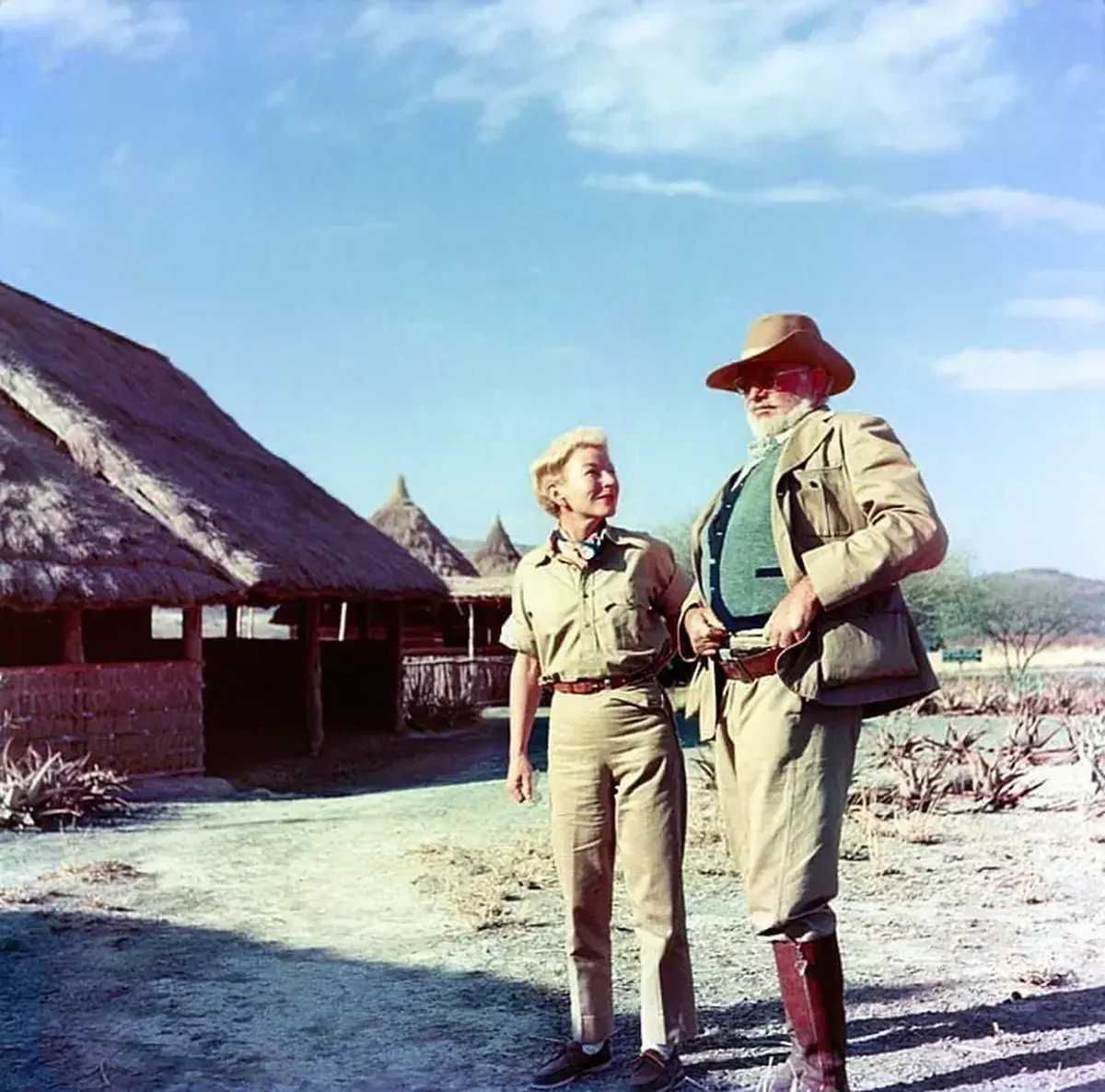
Hemingway and Mary Welsh in Africa
Stories circulated that his trophies included Mata Hari, Ingrid Bergman, the wife of an African chief, and a Greek princess, and that Hemingway often boasted about his conquests. People also knew about the many local prostitutes he encountered on his travels, since he rarely shied away from the cameras.
An exception was a 12-year platonic relationship with Marlene Dietrich. Hemingway called the arrangement “asynchronous love,” a secret bond between kindred spirits. He nicknamed the movie star “Cabbage,” and she called him “Daddy.” Their devoted epistolary friendship lasted until his death in 1961. The correspondence was made public in 2007 after the John F. Kennedy Presidential Library released the Dietrich family archive at the request of her daughter, Maria Riva. One letter contains Hemingway’s line: “When I hold you, I finally feel at home.”
On the Edge of Collapse
Hemingway rushed at life and habitually risked his safety. In 1937 he went to the Spanish Civil War with a war correspondent’s credential and money for the Republican side, gathering material for For Whom the Bell Tolls. In the 1940s he lived in Cuba (he would later buy a house near Havana that his widow gifted to the Cuban people), installed equipment on his boat, and hunted German submarines in the Caribbean. He was in China during the Sino-Japanese conflict and later covered World War II: he flew on British bombers, reported on the Allied landings in Normandy, and entered Paris in 1944 with American troops. He received a Bronze Star, but he was also investigated for leading a French self-defense unit in Rambouillet, since journalists were not supposed to take part in combat under the Geneva Convention.
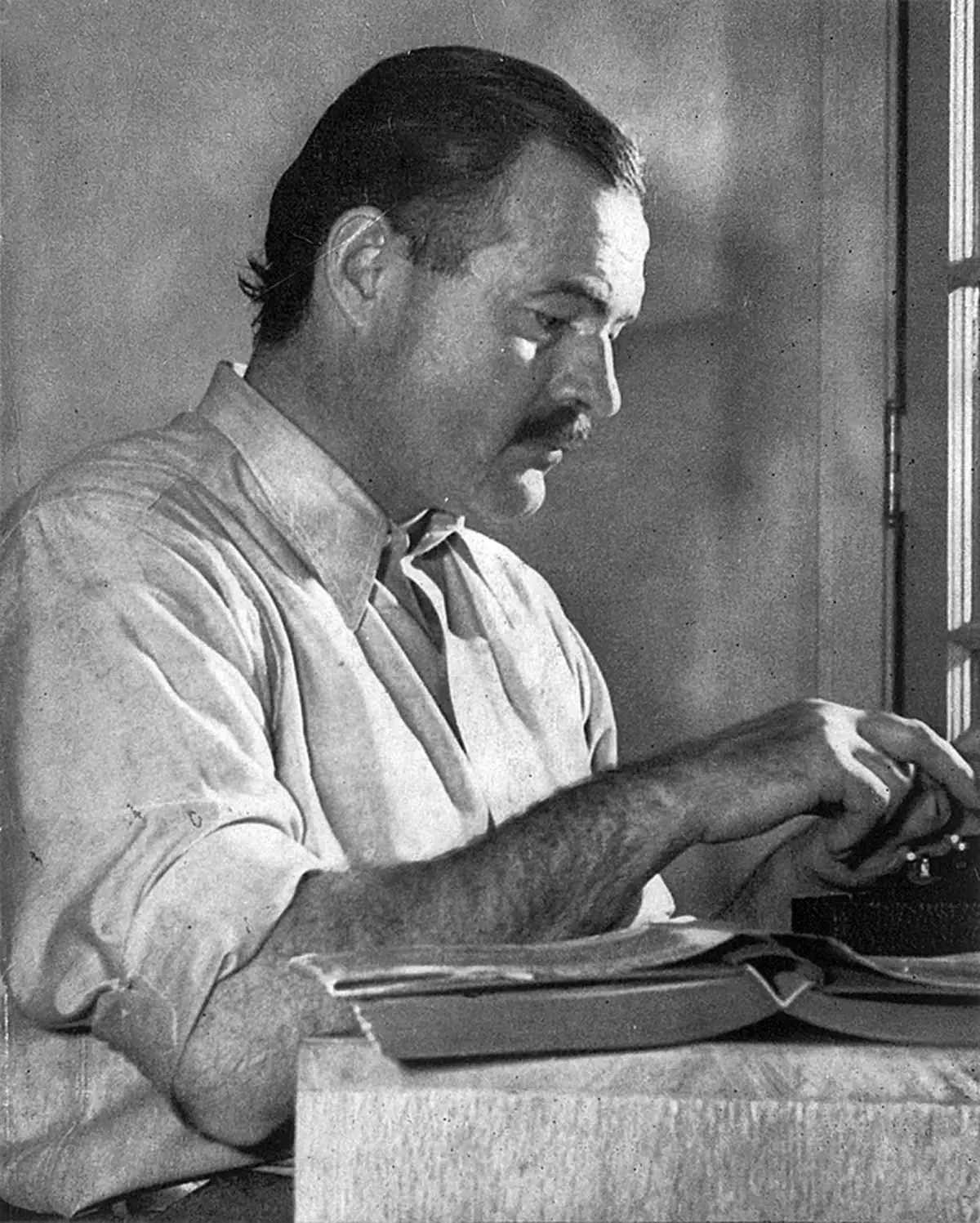
Ernest Hemingway, 1939
When not at war, Hemingway “refueled on adrenaline” through hunting. In 1953 a safari in Africa nearly killed him: the bald-headed Hemingway, wearing a loincloth and carrying a spear, escaped a confrontation with animals only to be badly burned when the plane he was in caught fire on landing. With a bandaged head and internal injuries, he was flown to Nairobi for treatment, where he even helped fight a forest fire and suffered fresh burns.
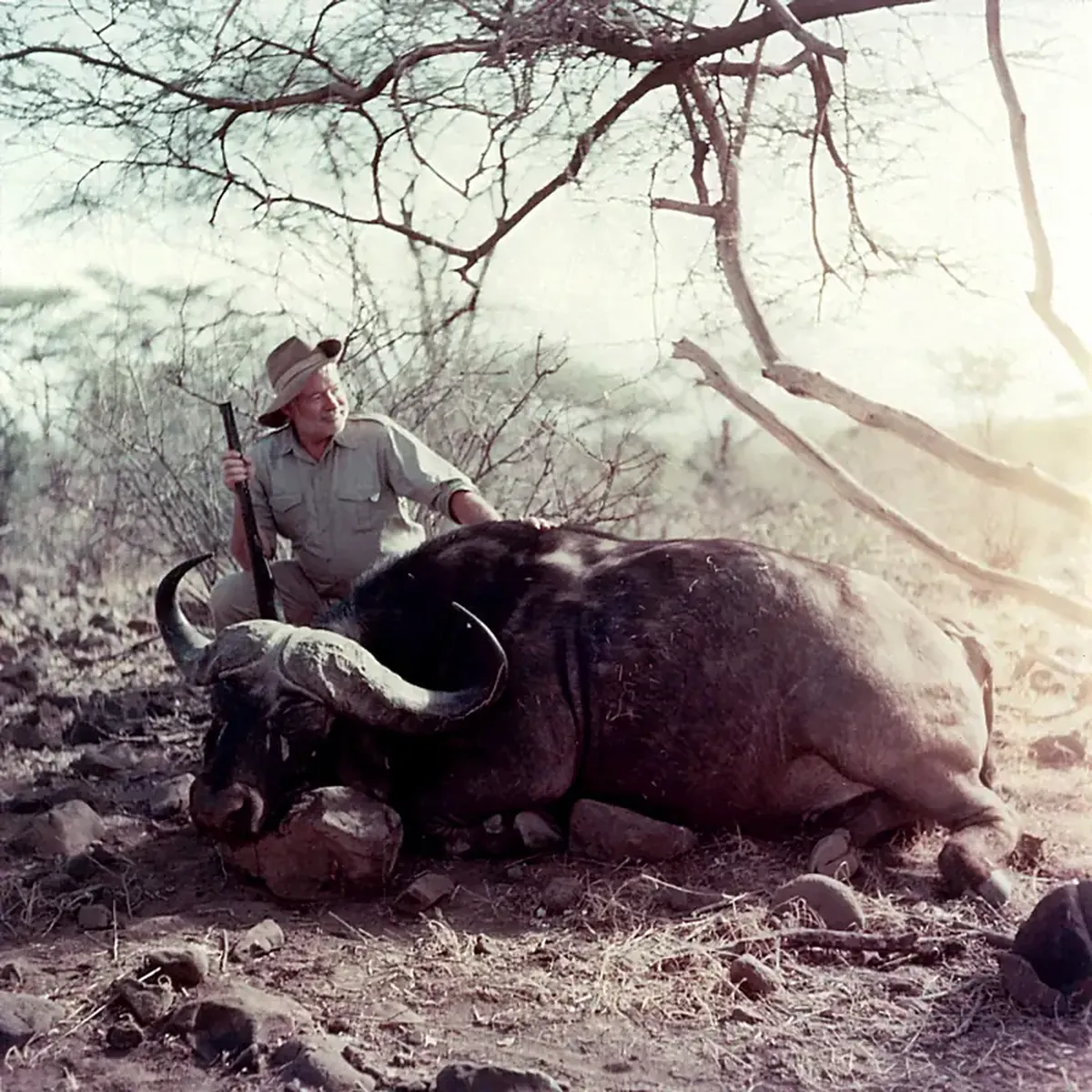
Hemingway on a hunt
A Man Doesn’t Die in Bed
In 1952 Life published his lyrical tale of an old fisherman who loses the great catch of his life. The Old Man and the Sea became Hemingway’s greatest literary success, earning him the Pulitzer Prize and the Nobel Prize. He skipped the Nobel ceremony in 1954, referring to the honor as “the Swedish thing,” citing health problems.
In his final years, diabetes and liver disease combined with nervous breakdowns and panic attacks. During a flight to Minnesota he tried to open the hatch and jump out, and at another stop he had to be pulled away from a spinning propeller.
“A real man doesn’t die in bed,” Hemingway once wrote. “He must die in battle or put a bullet in his forehead.” His father chose that last option in 1928, shooting himself with a hunting shotgun that Hemingway’s mother later sent to her son. Ernest would later take his own life by shooting himself in the mouth. In subsequent years his younger brother and a granddaughter, an actress, also died by suicide.
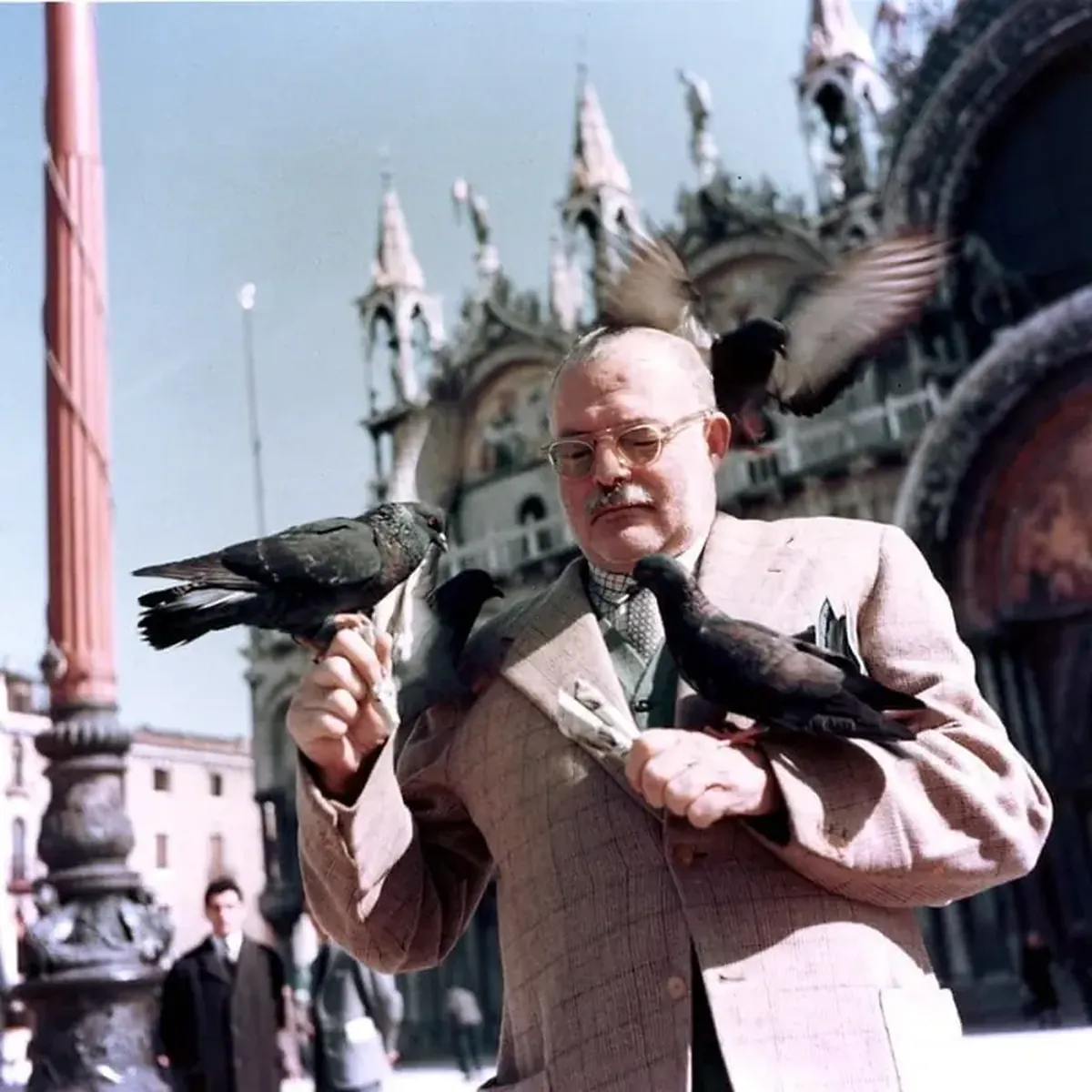
Ernest Hemingway, Venice, 1954
The Intrigue of Mystery
In April 1961, when his wife found him with a gun, she realized he needed urgent help. A year earlier Hemingway had moved from Cuba back to the United States. In his dark Idaho home he seemed like a prisoner in a fortress: depressed, with failing eyesight that increasingly prevented him from writing. At age 60 he began to cry often and complained of being followed. He feared someone was trying to push him off a cliff, that poverty awaited him, and that intelligence agencies were watching him.
With growing paranoia, he was placed in a psychiatric hospital in 1960 and treated with electroconvulsive therapy. The ECT at the Mayo Clinic in Rochester damaged his memory. “Doctors don’t understand writers,” Hemingway complained. “Let psychiatrists try to write a literary text. Can this be done with a wiped memory and a ruined brain? Why did they take away my capital and throw me on the roadside of life?”
Back home in Ketchum, on June 2, 1961, Ernest Hemingway took his own life. The family kept the suicide secret for five years. Even after that, his death continued to attract questions. Two decades later, 127 pages of his case files were declassified, and rumors about FBI surveillance stopped sounding fanciful.
Hemingway, a master of open-ended endings, left a life that reads like a story cut short. That final ambiguity only deepened the public’s fascination: people are unsettled, and therefore fascinated, by mysteries.
