
 Carlos Solis
Space fans have plenty to look forward to. Artemis II marked a historic milestone: astronauts flew to the Moon for the first time since the Apollo 17 mission in 1972. A crew of four astronauts orbited our nearest celestial neighbor and returned home safely.
That success paved the way for Artemis III, scheduled for next year. It aims to put the first woman on the Moon.
But there are plenty of other spectacular space adventures ahead — BBC Science Focus highlights several of them.
Chang’e 7 Will Hunt for Water at the Moon’s South Pole
In August, China’s National Space Administration (CNSA) will send the automated interplanetary mission Chang’e 7 to the lunar surface.
Its instruments will search for water at the Moon’s south pole. That region drew major interest after signs of water ice were found in deeply shadowed craters. That ice has remained untouched for billions of years, and studying it will help researchers learn, among other things, what the young Solar System was like.
What to know about the mission:
- It will carry several spacecraft — an orbiter and a lander, plus a solar-powered rover and a hopping mini-probe.
- Chang’e 7 will land on the rim of Shackleton Crater, near the Moon’s south pole.
- There it will deploy a rover to explore the area for signs of water.
- The hopping probe will make short flights into the crater’s shadow to search for water using a molecular analyzer.
The mission will also study:
- the Moon’s magnetic field
- the composition of lunar soil
- thermal properties
- the condition of the lunar surface
This lunar project is more complex than earlier missions because it combines orbital observations with detailed surface surveys by specialized probes.

Nancy Grace Roman Telescope Will Join Hubble and Webb
This year, joining NASA’s Hubble and the James Webb Space Telescope (JWST), a new observatory will arrive: the Nancy Grace Roman Space Telescope, which NASA plans to launch after September.
This next-generation NASA flagship observatory is designed to study dark energy and to search for exoplanets.
The telescope is similar to Hubble in many ways: it uses the same 2.4-meter mirror and is about the size of a bus. But the new observatory will survey regions of sky 100 times larger at the same resolution as Hubble.
Instruments on the new telescope:
- Wide Field Instrument: a 288-megapixel camera for wide-field surveys.
- Coronagraph Instrument: a device that blocks starlight to help directly image faint planets near those stars.
What the mission will study:
- Dark energy and dark matter: studying the accelerating expansion of the Universe and mapping billions of galaxies.
- Exoplanet hunting: discovering thousands of new worlds using innovative techniques, including gravitational microlensing.
- The structure of our galaxy, plus searches for rogue planets and black holes.
The telescope is named for Nancy Grace Roman (1925–2018), NASA’s first woman executive and the agency’s first Chief Astronomer.

ESA’s PLATO Aims to Find Earth‑Like Worlds
Over the past 30 years, astronomers have discovered more than 6,000 exoplanets — planets beyond our Solar System. But no one has yet found a true Earth analog. The European Space Agency’s PLATO (Planetary Transits and Oscillations of Stars) mission is designed to help fill that gap. It’s scheduled to launch at the end of the year.
The PLATO spacecraft, to be launched aboard an Ariane 6 rocket:
- Will search for and study Earth-like exoplanets orbiting stars similar to the Sun.
- Will assess those planets’ habitability.
- Will use 26 cameras working together to scan for dips in a star’s brightness when a planet transits across it.
- Will detect small rocky planets orbiting Sun-like stars.

Japan’s MMX Will Bring Back Samples from Phobos
In November 2026, the Japan Aerospace Exploration Agency (JAXA) will launch the Martian Moons eXploration mission (MMX). Its goal is to solve the origin of Mars’s natural satellites.
Mars has two moons — Phobos and Deimos — and planetary scientists still aren’t sure how they formed. Were they asteroids captured by Mars’s gravity, or did they form after a giant impact on Mars?
What MMX will do:
- Arrive at Mars in 2027 and enter orbit around Phobos, the larger of Mars’s two moons.
- Land on the moon and collect soil samples.
- Conduct remote observations of the smaller moon and monitor Mars’s climate.
- Return Phobos soil samples to Earth in 2031.
Japanese scientists will carry out the mission in collaboration with NASA, ESA, France’s CNES, and Germany’s DLR.

ESA’s Hera Will Inspect the DART Impact
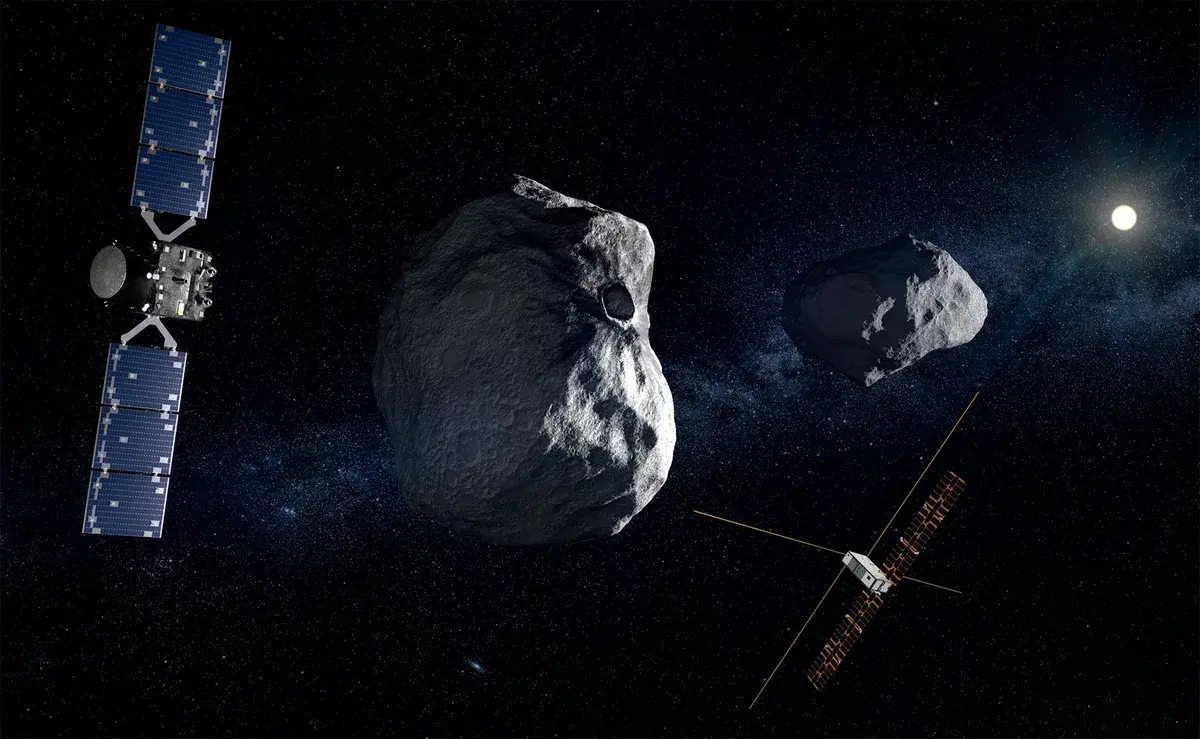
In 2022, NASA proved that humans can alter an asteroid’s path to protect Earth from a potential impact. The DART (Double Asteroid Redirection Test) spacecraft deliberately crashed into Dimorphos, changing its orbit around its partner asteroid Didymos. That was the first planetary defense experiment.
In November 2026, ESA’s Hera will arrive at Dimorphos to assess the scale of the damage. Scientists will determine the asteroid’s composition and map its internal structure.
Mission objectives:
- Determine how the DART impact altered the asteroid.
- Figure out where and how hard to strike an asteroid to shift it onto a desired trajectory.
- Predict where the asteroid might travel afterward.
BepiColombo Arrives at Mercury for a Deep Dive
BepiColombo is a joint ESA and JAXA mission designed for a detailed study of Mercury. Mercury, the planet closest to the Sun, remains the least-explored of the Solar System’s planets.
On November 21, 2026, the BepiColombo spacecraft will arrive at Mercury after an eight-year journey. It will then split into two separate scientific orbiters:
- Mercury Planetary Orbiter (MPO), built by ESA to map the surface and study the planet’s composition.
- Mercury Magnetospheric Orbiter (Mio), built by JAXA to study Mercury’s magnetosphere.
According to ESA, researchers plan to focus on:
- The origin and evolution of Mercury: how did a planet form so close to the Sun?
- The magnetic field: why does Mercury have a magnetic field while Venus and Mars do not?
- Ice reserves: studying ice in craters at the poles that never see sunlight.
- Geology: investigating mysterious hollows and depressions on the surface.

BepiColombo aims to improve our understanding not only of the Solar System but also of the thousands of known exoplanets that orbit close to their stars.
