
 Gaby
Gaby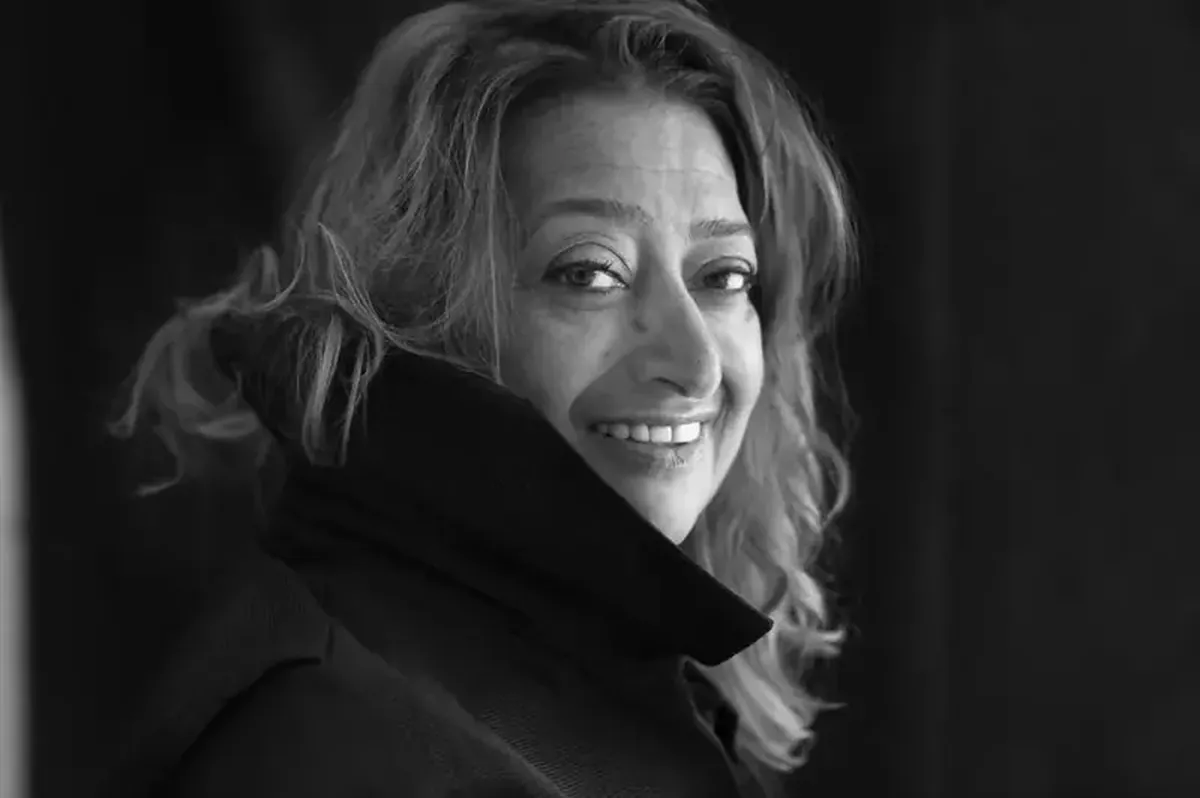
Her “cosmic” projects—earning her the nickname “destroyer of geometric laws”—look like objects from an extraterrestrial civilization. Her revolutionary approach to building transformed architecture around the world. Her career and achievements as the first Arab woman to win the Pritzker Prize—the architecture world’s “Nobel”—echo her name: Zaha means “pride” in Arabic.
The Monumental Mesopotamian
The Guardian called the Iraqi-born British architect a “liberator of geometry.” But Hadid was such an extraordinary personality that gendered labels felt insufficient—and she probably wouldn’t have liked them. Her life story shows that uniqueness. Coming from a culture that traditionally discouraged female independence, she broke free of those constraints and pushed architecture beyond its stereotypes. She began fascinated by Constructivism and by Kazimir Malevich’s “Black Square,” and went on to become a leading figure in Deconstructivism.

Beijing Daxing International Airport
Dubbed the “Queen of Distorted Perspective” by the press, she championed warped planes, curved or broken lines, and sharp angles—liberating space and giving it new expressiveness. The Mesopotamian-born architect had the toughness to withstand criticism, defend her innovations, carve a path in a male-dominated field, and become a major figure at the turn of the 21st century. She became a foreign member of the American Philosophical Society, was the first woman to receive the Royal Institute of British Architects’ Gold Medal, and was named a Dame Commander of the Order of the British Empire. She said the title of “Dame” made her uncomfortable: “there’s nothing feminine except the skirt,” she quipped.

“I can’t even cook,” Hadid confessed, noting that her London home lacked a kitchen: the spartan layout of her old residence on Courtfeld Gardens simply didn’t include one. In the room where a hearth might have been, she put a massive drafting table and worked there instead. She lived near her office, spent little time at home, drove a dependable BMW to get around, and met friends in London restaurants. Her personal life was devoted to her work: she never married and had no children, saying that her “children” were her completed projects and her family was her architectural firm.
How to Become an Architect
The future superstar was born on October 31, 1950, in Baghdad, to Muhammad al-Hajj Hussein Hadid, a co-founder of the National Democratic Party, and artist Wajihah al-Sabunji. The famous models Gigi and Bella Hadid are not related to her; Zaha had two older brothers, Haytham and Fulat (the latter was a scientist). Their children would eventually inherit her estate: £67 million was to be distributed between a trust managing her international business and several nieces and nephews, one of whom, Rana, would also become an architect.
Her decision to become an architect came after a childhood visit to ancient Sumerian ruins—her first encounter with extraordinary buildings. Magazine photos of Frank Lloyd Wright’s work also inspired her: the open plans of the American master of “organic architecture” captivated the artist’s daughter. After asking her parents what the people who design such things were called, the fascinated girl announced she wanted to be one of them. As a child she also toyed with ideas of becoming a fashion designer or an astronaut, ambitions she later channeled into design and imagination.

40-story hotel. Macau, China
Futuristic design and complex engineering became Hadid’s signature—she wasn’t afraid of bold fantasies or heavy calculations. Though she had a natural gift for drawing, she studied mathematics at the American University of Beirut. Her entrepreneur father, a London School of Economics graduate who later served as finance minister after the 1958 overthrow, supported her education and helped send her to top schools. Leaving Iraq in 1968, Hadid would not return for another 40 years. After Beirut she moved to London to study at the Architectural Association School of Architecture.
The Inventor of 89 Degrees
Her teacher was Dutch architect Rem Koolhaas—one of Deconstructivism’s theorists—who helped shape her thinking, only to be surpassed by his student. For each project Hadid produced multiple sketches that avoided right angles (which earned her the playful label “inventor of 89 degrees”). She fragmented buildings into shards, prompting comparisons to broken ice, mountain cliffs, tectonic shifts, and solidified lava. “Her projects are the least like the result of human activity,” Koolhaas said when he invited her to work in his office. “This is a unique phenomenon, a planet moving in its own orbit.”

Guangzhou Opera House
Recalling her student days, Hadid described her fascination with Kazimir Malevich’s avant-garde, even titling her thesis “Malevich’s Tectonics.” In a proposed populated bridge over the Thames she experimented with projection methods; as a student she imagined a high-rise hotel on London’s Hungerford Bridge turned “upside down.” Later she inverted skyscrapers and designed an unconventional club on a mountaintop. By breaking rules, Hadid built a practice around movement and the deformation of architectural conventions, giving glass and concrete a dynamic impulse and proving that rectangular shapes are not the only way to organize space.

Fire Station
Her logic didn’t win instant acceptance. After founding Zaha Hadid Architects in 1980, she spent 10 to 15 years on routine tasks, enduring hundreds of lost tenders and surviving on small commissions. That grind would have defeated many, but Hadid persisted, continually proposing ideas clients weren’t yet ready for. Her breakthrough came with a fire station for the Swiss furniture company Vitra, shaped like a stealth bomber. She went on to design contemporary art centers in Cincinnati and Rome and an office building for BMW AG’s new factory in Leipzig—where the building famously placed the car conveyor above the administration rather than below.

BMW AG Factory Building in Leipzig
Museums Yes, Prisons No
Some of Hadid’s most significant buildings include the Heydar Aliyev Center in Baku (which won the British Design Museum’s best design award), the Sheikh Zayed Bridge in Abu Dhabi, the Guangzhou Opera House, the Innovation Tower at the Hong Kong Polytechnic University, the Galaxy SOHO complex in Beijing, the London Aquatics Centre, the Riverside Museum in Glasgow, the Library and Learning Center at the Vienna University of Economics and Business, the Port Authority Building in Antwerp, and the University of Michigan Museum of Art. In exploring new forms, Hadid studied living organisms, wave motion, and melting ice. She drew inspiration from natural shapes—mountain ridges and dunes, clouds and leaves, droplets and streams. She refused to build prisons, no matter how attractive the offer.

Galaxy SOHO Urban Complex. Beijing.
Beyond large buildings, Hadid designed exhibition installations, stage sets, paintings, furniture, interiors, jewelry, custom accessories, and designer shoes. She created art objects for Louis Vuitton and pieces for Swarovski, and collaborated with brands like Georg Jensen, United Nude, Stuart Weitzman, Lacoste, Nicholas Kirkwood, and Neil Barrett. By the early 2000s her smaller works reached institutions such as MoMA in New York and the German Architecture Museum in Frankfurt. Her lectures and master classes drew audiences worldwide, and her London office expanded into neighboring spaces, hiring several hundred employees and planning work years in advance.

Zaha Hadid’s design lamp for Sawaya & Moroni
“My architecture has no nationality, just as there is no longer a country where I was born,” Hadid said, a Western-educated architect with Muslim roots. She followed events in war-torn Iraq with deep pain. “The Iraqis did not deserve the horror they found themselves in,” she said. “The country, divided into parts, lies in ruins. The war has brought much sorrow, but the embargo is the worst disaster. We need to start building something there to instill hope in people.” That was her answer when asked why she agreed to design a new building for the Central Bank of Iraq (CBI).
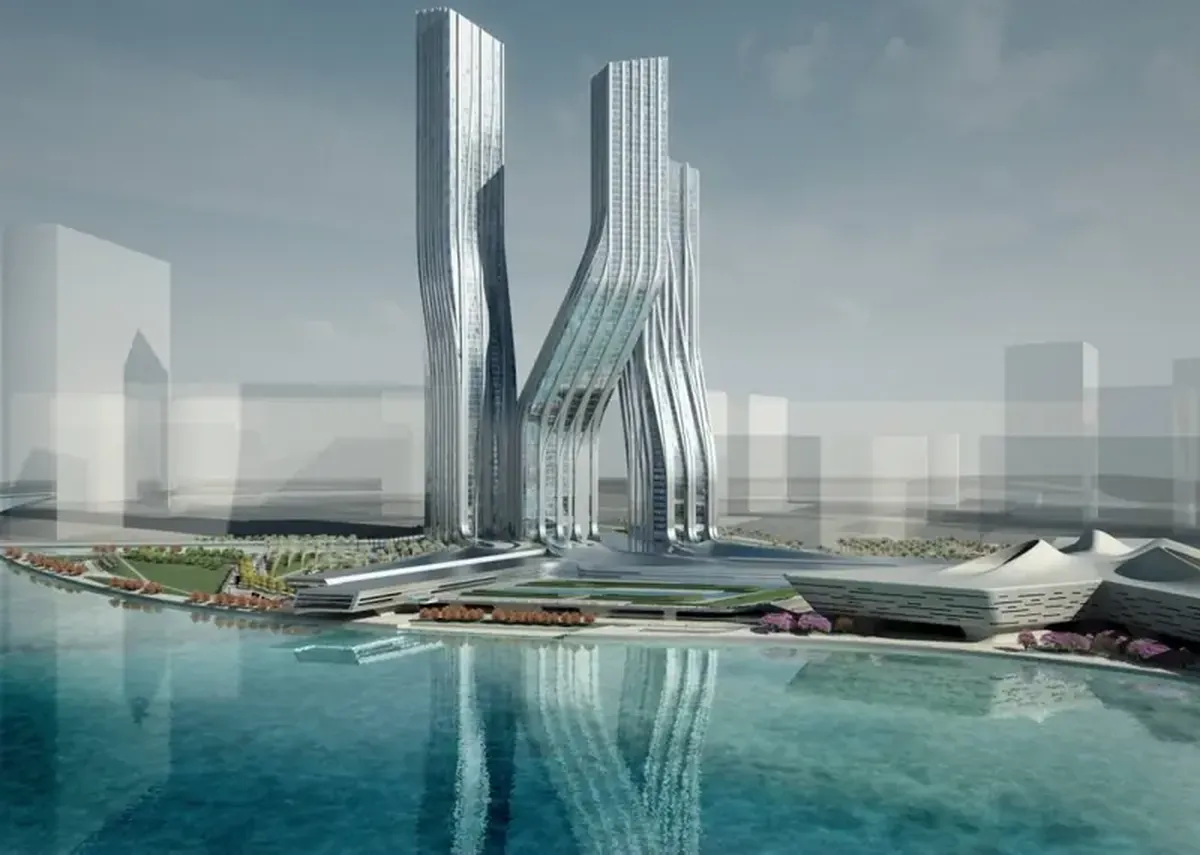
Signature Towers. Dubai, UAE
A British Farewell
Hadid’s final project—a 170-meter skyscraper on the banks of the Tigris—was planned as the tallest building in Baghdad. Construction of the CBI headquarters was to be completed without her supervision: like many of the “queen of curved lines'” ideas, the project was being realized by colleagues at her firm. About 40 large projects she did not finish remained in development. Zaha Hadid died on March 31, 2016, at 65, after suffering a heart attack in Miami while being treated for bronchitis; she had been named Designer of the Year in London in late 2005.

Her death shocked the design world and underscored the scale of the loss. Hadid’s work helped establish Deconstructivism as a cultural movement that touched architecture, philosophy, and fashion. Her projects provoked strong reactions—both admiration and criticism—but they also offered a glimpse of the future, realized through her keen creative intuition. Her bionic masterpieces refreshed cityscapes and made her signature instantly recognizable.
As a creator of original recreational spaces and stylish complexes, she left humanity examples of high architectural craftsmanship and aesthetic taste. One of her unique projects, featuring man-made valleys with hills and craters, was even included on a list of the “seven wonders of the world.” As her fame spread overseas, Hadid said, “I have finally overcome all barriers in my professional journey, but it was a long struggle that made me tougher—women in architecture need more confidence.” When people linked her name to the “liberation of Arab women” and feminism, she replied that gender wasn’t her main concern—”but if my example helps someone, I’d be willing to be that.”
