
 Gaby
Gaby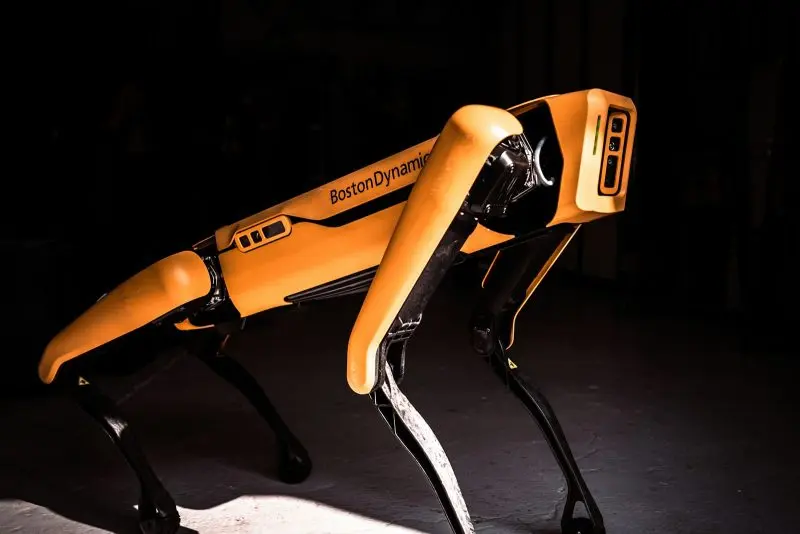
Four-legged robotic dogs have gained popularity among scientists and rapid response teams in recent years, primarily due to their unique ability to maneuver in dangerous or inaccessible areas for humans. Some of these robots, like Spot from Boston Dynamics, can use large claws and other devices that help them interact with the surrounding world. However, these additional limbs are not always ideal, as they add weight and take up extra space. Both of these factors can limit the effectiveness of the robotic dog in tight spaces.
Researchers from the Robotics Systems Laboratory at the Swiss Federal Institute of Technology Zurich attempted to solve this problem by training a dog-like robot to use one of its four limbs to open doors and manipulate objects. Meanwhile, the three other limbs were used for walking and maintaining balance.
In a paper on their findings, the engineers said their limb innovations for the ANYmal robot could be useful for space exploration.
How did the robot dog use its legs?
Researchers used a reinforcement learning model to train the ANYmal robot (created by the company ANYbotics) to perform a series of tasks involving interaction with various objects. With a neural-network controller, the robot learned to move its front-right limb to a desired location. After that, the robot used the remaining three legs for balancing and navigating challenging terrain.
As reported by the publication Popular Science, the team controlled the robot using a joystick on the remote control.
Photos and videos showed the robot lifting its front limb and placing it next to a door handle, then shifting its weight to open the door. These movements reminded researchers of a real dog lifting its leg next to a fire hydrant. The team also recorded the robotic dog looping a backpack strap around its limb and then transferring the pack into a plastic container. Engineers experimented with a small claw-like manipulator attached to the limb, which helped the ANYmal robot successfully grasp and lift stones from the floor.

Researchers also trained the robot dog to navigate complex surfaces. The team emphasized the importance of maintaining balance even in imperfect real-world scenarios. For instance, engineers placed the robot on a smooth, slippery board and had it balance; it slipped slightly but did not fall.
What could this robot dog be used for?
The researchers agreed from the start to avoid adding unnecessary mechanical complexity when training new skills. That approach could reduce the robot’s weight and energy consumption, which would be especially beneficial for space exploration or remote search-and-rescue missions.
Until recently, four-legged robotic dogs were limited to inspection and observation. But the Zurich team’s results point to a future in which these robots use artificial intelligence models to explore their surroundings, interact with objects, and perform complex tasks with their limbs.
