
 Gaby
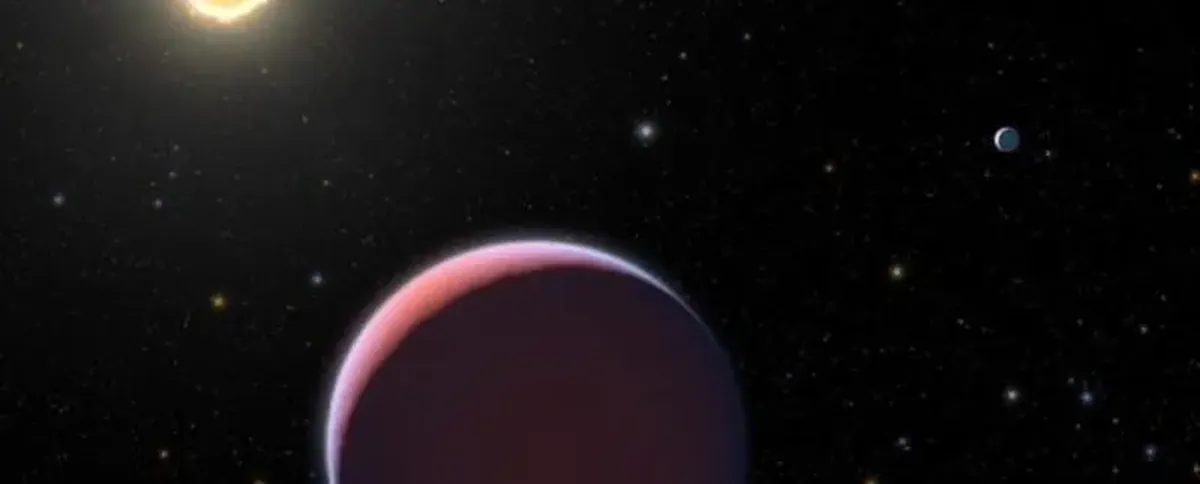
GabyThis enormous world sits 1,232 light-years from Earth. The exoplanet WASP-193b is nearly 50 percent larger than Jupiter. Despite that size, it’s so light and fluffy that its overall density can be compared to cotton candy. That’s just a little over one percent of Earth’s density.
Exoplanets, or extrasolar planets, are planets outside our Solar System.
Dandelion in the World of Planets
Astronomers say that if a dandelion could be a planet, it would look just like this.
An international team of researchers led by Khalid Barkawi from the University of Liège (Belgium) says exoplanets like WASP-193b are quite rare. They also help us better understand planetary evolution.
According to the authors, WASP-193b is “the second least dense planet discovered to date, after the much smaller Kepler-51d.”
“Its extraordinarily low density makes it a true anomaly among the more than five thousand discovered exoplanets. This extremely low density cannot be reproduced by standard models of irradiated gas giants, even under the unrealistic assumption of a coreless structure,” the scientists explained.
They add that these strange worlds help contextualize our Solar System and reveal how planetary systems form and evolve.
Gas giants located near their stars are a useful tool for this. Our understanding of planet formation suggests such planets may have formed farther out and migrated inward. Stellar radiation also affects these worlds and can change their structure, ScienceAlert reported.
What else is known about the fluffy exoplanet?
WASP-193b is an exoplanet that orbits the star WASP-193, which is similar to the Sun. This star is approximately 1.1 times more massive than the Sun and 1.2 times larger in radius. It is also very similar to the Sun in terms of temperature and age. However, the planet WASP-193b orbits much closer to its star than any planet in the Solar System. It completes one orbit every 6.25 days.
Astronomers have calculated the planet’s density as 0.059 grams per cubic centimeter. For comparison, Earth’s density is 5.51 g/cm³. Jupiter’s density is 1.33 g/cm³, which makes sense since it has a lot of gas and clouds. Cotton candy has a density of about 0.05 g/cm³—almost the same as that of WASP-193b.
“The planet is so light that it’s hard to imagine a similar solid material,” noted planetologist Julien de Wit from the Massachusetts Institute of Technology (USA).
“The reason it is similar to cotton candy is that both are largely made up of air. The planet is essentially very fluffy,” he added.
What is the composition of the planet’s atmosphere? How can WASP-193b exist so close to its star and expand so much? More broadly, how can such an old, strange, fluffy world exist in the universe? Barkawi says solving these puzzles will require additional observations and theoretical work.
The team plans to study WASP-193b with the James Webb Space Telescope (JWST).
The team’s study was published in the journal Nature Astronomy.
