
 Gaby
Gaby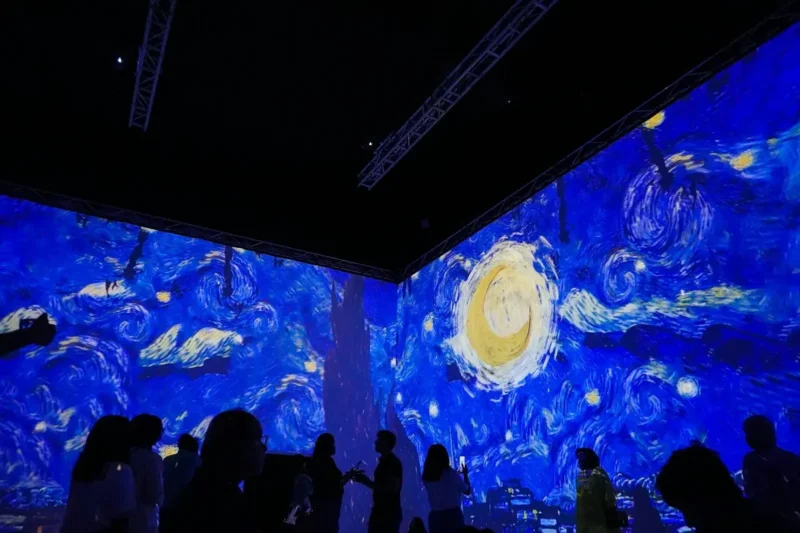
Chinese and French researchers say that in the painting “Starry Night,” Dutch artist Vincent van Gogh (1853–1890) demonstrated an excellent understanding of turbulence.
“Starry Night,” by Vincent van Gogh, is one of the most famous paintings in the world. It has repeatedly been called one of the greatest works of art. The legendary swirling sky, painted in 1889, has long been read as a reflection of the artist’s troubled state of mind. Despite its reputation today, Van Gogh himself called the painting a “failure” a few months after he finished it.
A new study shows that this post-Impressionist masterpiece, now in the Museum of Modern Art in New York, has scientific significance as well as artistic. The research team says it accurately reflects hidden turbulence — gusts of wind invisible to the naked eye that appear as complex vortices.
What did the scientists learn?
During their research, experts analyzed a high-resolution digital image of the painting. They found the same hidden turbulence in van Gogh’s depiction of the sky. The scientists specifically examined 14 main vortex forms in the painting and the spacing between brushstrokes that conveys the complex movement of air.
The lead author of the study, Yunsian Huang, a graduate student at the Hong Kong University of Science and Technology, said the artist demonstrated a “deep and intuitive understanding of natural phenomena.”
“The precise depiction of turbulence in Van Gogh’s work may have come from studying the movement of clouds and the atmosphere or from an innate sense of how to portray the dynamics of the sky,” Huang said.
The researchers say the painting visualizes cascade energy theory — the idea that energy transfers from larger circular flows to smaller ones. That suggests van Gogh had an “innate understanding of atmospheric dynamics,” the Daily Mail reported. Ultimately, the study authors concluded that the artist most likely observed turbulent winds closely.
The researchers say van Gogh reproduced not only the vortices’ size but also their intensity.
The results of the study were published in the journal Physics of Fluids.
***
The largest vortex in the center of the canvas was previously interpreted not as air turbulence but as another galaxy.
In 2015, American artist and photographer Michael Benson argued that “Starry Night” depicts the Whirlpool Galaxy (M51). That galaxy sits in the constellation Canes Venatici, about 37 million light-years from Earth. The galaxy’s diameter is roughly 100,000 light-years.
