
 Gaby
GabyAn international team of astronomers led by Dr. Maosheng Xiang from the Chinese Academy of Sciences says the population of stars older than 13 billion years is the primordial disk from which the Milky Way formed.
It was previously believed that the original structure of our galaxy emerged about 12.5 billion years ago. However, Dr. Xiang and his colleagues dispute this. By studying the motions of the discovered population, the authors reconstructed the Milky Way’s original shape. They say that shape is unusual for galaxies similar to ours.
The Milky Way is not a giant galaxy. However, it is significantly larger than the average galaxy in our part of the Universe, the publication reported. IFLScience said mapping with the Gaia space telescope has allowed astronomers to identify clusters of stars that were once part of galaxies the Milky Way consumed.
A decisive step in understanding the development of our galaxy was the discovery of the initial structure of the Milky Way disk. This was quite challenging, as the most massive—and therefore the brightest—stars from that time have long since burned out. Moreover, the smaller surviving stars were thoroughly mixed.
However, astronomers say they have successfully completed the task. The team tracked the oldest stars and found differences between stars more than 13 billion years old and relatively younger ones born after about 12.5 billion years ago. They named the 13-billion-year-old disk Pangu, after the Chinese mythological god who separated heaven from earth.
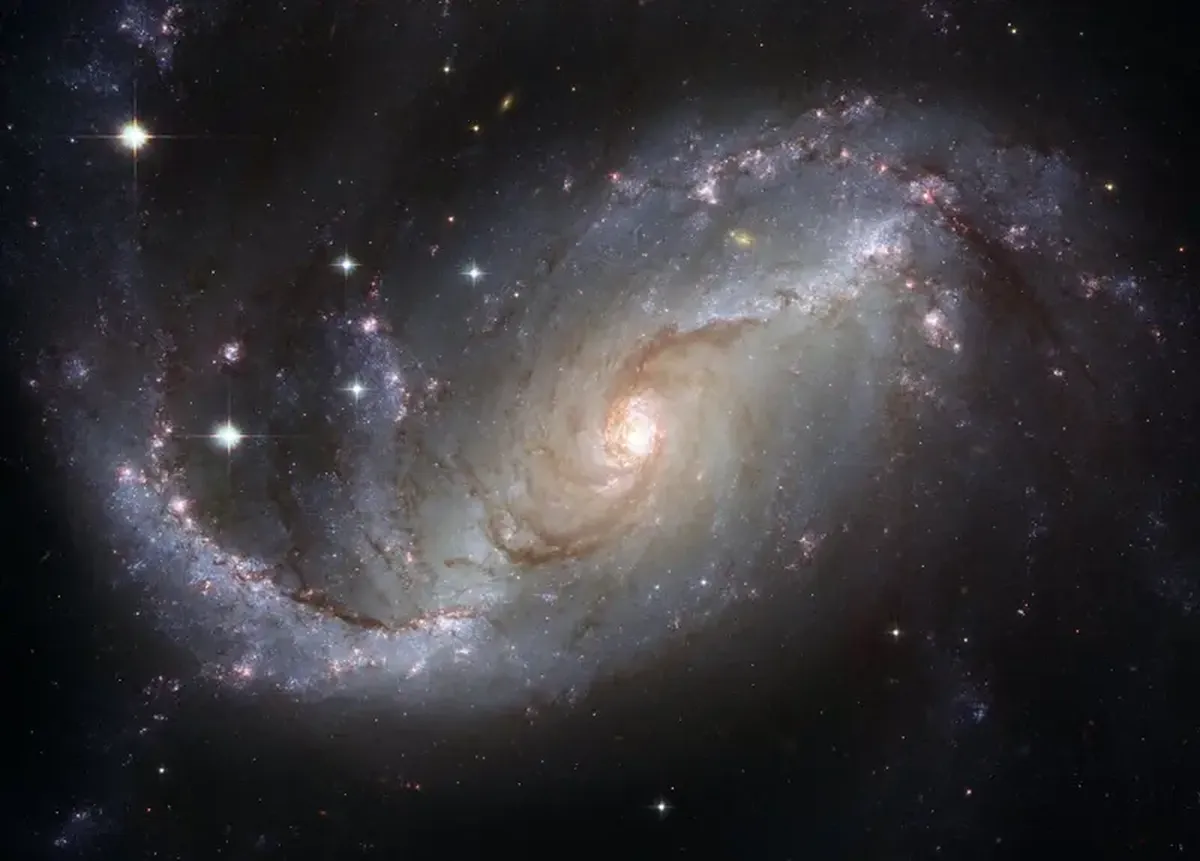
What else did the scientists talk about?
At different times, astronomers have tried to find out when the first stars were born. They likely formed about 400 million years after the Big Bang, around 13.4 billion years ago. However, these early stars did not necessarily belong to well-structured galaxies; they could have been isolated points of light amid amorphous gas.
Dr. Xiang’s team says that the Pangu stars, with a total mass of about 3.7 billion solar masses, formed at a relatively constant rate over several hundred million years. Today, those oldest stars make up only about 0.2 percent of the Milky Way’s current mass. The team also concluded that our galaxy reached its peak star formation about 11 billion years ago.
Researchers also found that the primordial disk had roughly the same height and width. Over time it flattened to about one-tenth of its original height.
Modeling has shown that early galaxy development occurred through powerful mergers that disrupted the formation of well-structured disks. However, that history does not seem to apply to the Milky Way.
The results of the study were published in the journal Nature Astronomy.
