
 Gaby
Gaby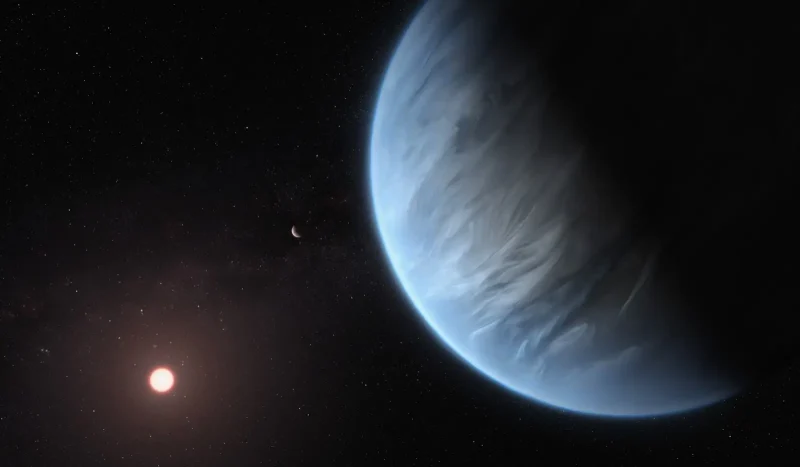
Not only did researchers at Cambridge and Manchester study this — artificial intelligence got involved too. The Daily Mail asked an AI to depict possible forms of life on the ocean-covered planet K2-18b, using the researchers’ data.
The exoplanet K2-18b is located about 124 light-years from Earth. It lies in the constellation Leo. K2-18b is 2.6 times larger and 8.6 times more massive than Earth.
What led scientists to suggest there might be signs of life on this distant world? Using the James Webb Space Telescope, researchers detected a number of chemical compounds in K2-18b’s atmosphere that on Earth are produced by living organisms. Those compounds include dimethyl sulfide (DMS) and dimethyl disulfide (DMDS).
Astronomers at Cambridge say the findings point to an “ocean teeming with life.”
Plankton
The most likely scenario is that the oceans of K2-18b are filled with something like phytoplankton — microscopic organisms that capture energy from the nearby star, the red dwarf K2-18. And where there is plankton, there is the potential for more complex life that feeds on that abundant food source.
Arik Kershenbaum, a researcher at the University of Cambridge, said that compounds like DMS break down very quickly. He added, “Even if there is an ocean on this planet, it would be more similar to Earth three to four billion years ago, when life was just beginning to emerge.” Kershenbaum also thinks life on K2-18b would be very different from life on present-day Earth.
Filters
Kershenbaum told the AI to consider this: “When organisms that capture light from a star (like plants do on our planet) die and sink into the water, other organisms that feed on the dead creatures may arise.”
He suggested that if more complex life evolved on an exoplanet, it might resemble some of Earth’s ancient filter feeders. The first organisms to feed on microorganisms on Earth were single-celled choanoflagellates — the most ancient ancestors of all animals on our planet. They looked like tiny badminton shuttlecocks and used microscopic hairs to draw in bacteria. Simple beings on K2-18b could plausibly be similar.
The first filtering animal on Earth was a large shrimp-like creature called Tamisiocaris borealis, which lived about 540 million years ago.
Although unlikely, if complex life exists on K2-18b it could have evolved along similar lines. Complex animals appeared on Earth relatively recently, but the fossil record offers clues about what extraterrestrial life might look like.
Even more complex organisms
The chance that highly complex life exists on K2-18b is small. Still, if such life does exist, scientists have a few ideas about how it might adapt.
Michael Garrett, a professor at the University of Manchester, said the complexity of life on a planet depends a lot on the environment in which it develops. Around a red dwarf star, organisms might evolve much larger, more light-sensitive eyes.
Garrett also suggested that a thin atmosphere could favor life forms with enormous wings.
Since K2-18b appears to be an ocean world, its seas could host strange flying fish and even seabird-like creatures.
