
 Gaby
Gaby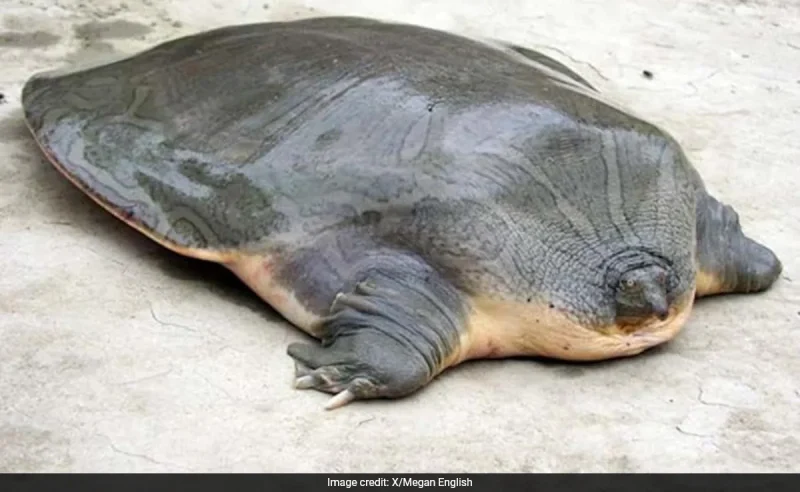
This animal is critically endangered. It lives in Southeast Asia, and people in Thailand, China, Bangladesh, Vietnam, Malaysia, Indonesia, India, the Philippines, and New Guinea consider encountering this remarkable turtle a stroke of luck. The rare species is named after Danish zoologist Theodore Edward Cantor. Cantor’s giant softshell turtle (Pelochelys cantorii) is an ambush predator, as paradoxical as that may sound. It spends about 95 percent of its life sprawled out in sand or river mud. When passive, the turtle looks like a massive, leathery pancake with round, sorrowful eyes and a comical, double-snouted nose. But once it spots prey, the animal swiftly extends its neck and springs into action. With long claws and powerful jaws that can crush bone, it’s a formidable hunter.
The Cantor’s giant softshell turtle has a broad diet. It eats fish, crustaceans, mollusks, frogs, insects, birds, and even small mammals, Live Science reports. Unlike hard-shelled turtles, Pelochelys cantorii has a flat, leathery shell that is green or brown. According to various sources, the giant Cantor’s turtle can reach one to two meters in length and weigh between 50 and 100 kilograms. Like other softshell turtles, it can extract oxygen from water through its skin, which lets it stay submerged for extended periods. That method supplies only a limited amount of oxygen, so the turtle must surface at least twice a day to breathe.
Cantor’s giant softshell turtle is extremely rare. For a time, it was even considered extinct. Between 1985 and 1995, only one specimen was recorded. In 2007, several individuals were spotted in the Mekong River in Cambodia. Recently, biologists discovered a nesting site for this reptile in the southwestern Indian state of Kerala.
