
 Gaby
Gaby
On August 12, 30 B.C., she took her own life at 39 to avoid capture by a conqueror. Two millennia later, we still remember this remarkable ruler. She captivated would-be conquerors, used charm to influence powerful men, and her death marked the downfall of a nation—the conquest that ended an ancient civilization.
You Can’t Paint Charisma
Thanks to the romantic trappings of her story, Cleopatra VII has been more myth than tragic historical figure in popular memory. One of antiquity’s most famous women continues to intrigue artists with dramatic tales of her affairs with Julius Caesar and Mark Antony.
Behind the glamour, however, was a ruler who dealt ruthlessly with anyone who threatened her power or tried to exploit their relationship with the crown. The 4th-century Roman historian Aurelius Victor wrote that Cleopatra removed any doubt about the nature of her ties to partners who might claim a special status. She also kept the public from learning about any intimate relationships with ordinary people.
Her name is linked to purges that removed lovers and family members who could challenge her rule; ancient sources claim that in 44 B.C. Cleopatra “sacrificed” her younger brother Ptolemy XIII and later her sister Arsinoe IV. During her 22-year reign, the last independent queen saw four of her children die: her son by Caesar and three children by Antony were killed.

Seeing Cleopatra through the Hollywood lens of Vivien Leigh or Elizabeth Taylor makes it hard to accept historians’ descriptions of her as plain-featured and not conventionally elegant. Reconstructions by researchers at the British Museum and Cambridge University show a dark-skinned face with a pronounced nose, thin lips, and a sharp chin. The ancient historian Plutarch described Cleopatra’s powers without praising her looks: “In appearance, she was not particularly beautiful, but in conversation, she became enchanting. Her soft voice and alluring manner of speaking combined with a strong character and high intellect formed the secret of her charisma.”

Reconstruction of Cleopatra’s appearance based on a bust from Shershel
A “Multifaceted Instrument”
The most famous queen of Egypt was not ethnically Egyptian: by the end of the Hellenistic era, the Nile was ruled by the Macedonian Ptolemaic dynasty, which had settled there during Alexander the Great’s time. In that family, most sons were named Ptolemy and most daughters Cleopatra. Though the seventh Cleopatra was born in Alexandria on January 13, 69 B.C., she might have remained a foreigner to the local population if she hadn’t worked to break the dynasty’s habit of distancing itself from the people.
Cleopatra was the illegitimate daughter of Ptolemy XII (her mother was likely a concubine, though sources vary). She was the first ruler in her dynasty in about 300 years to learn the Egyptian language; her predecessors had used only Greek.

“Cleopatra Tests Poison on Condemned Prisoners,” painting by Alexandre Cabanel
She abandoned the dynasty’s tendency to keep the ruling family separate from Egyptian religion and customs. An eager scholar, she mastered a dozen languages from a young age. In addition to Egyptian and Greek koiné, she knew Ethiopian, Aramaic, Persian, and spoke Latin and Hebrew. At a time when Greek women rarely received formal education, Cleopatra studied astronomy, mathematics, philosophy, and rhetoric.
As Plutarch wrote, “The rare persuasiveness of her speeches was achieved by her ability to adapt to any interlocutor. Her immense charm shone through in her gentle voice, the sounds of which tuned to any mood like a multifaceted instrument.”
“She Who Loves Her Father and Homeland”
Her name in the original title was Thea Philopator—”goddess who loves her father.” Her full official title included Thea Neotera Philopator Philopatris—”she who loves her homeland.”
Under the laws of the time, a female heir could not rule alone: male co-rulers—usually brothers—were required, and Cleopatra entered into formal marriages with her brothers in turn. Those siblings, however, were often rivals rather than allies.
She had to battle her younger brother and first legal husband, a conflict that forced her to flee to Syria. Her fortunes turned when Ptolemy XIII allied with Caesar and then made a fatal error Caesar could not forgive: the public execution of a Roman noble. Caesar shifted his support to Cleopatra, backed her in overthrowing Ptolemy, and restored her to the throne.
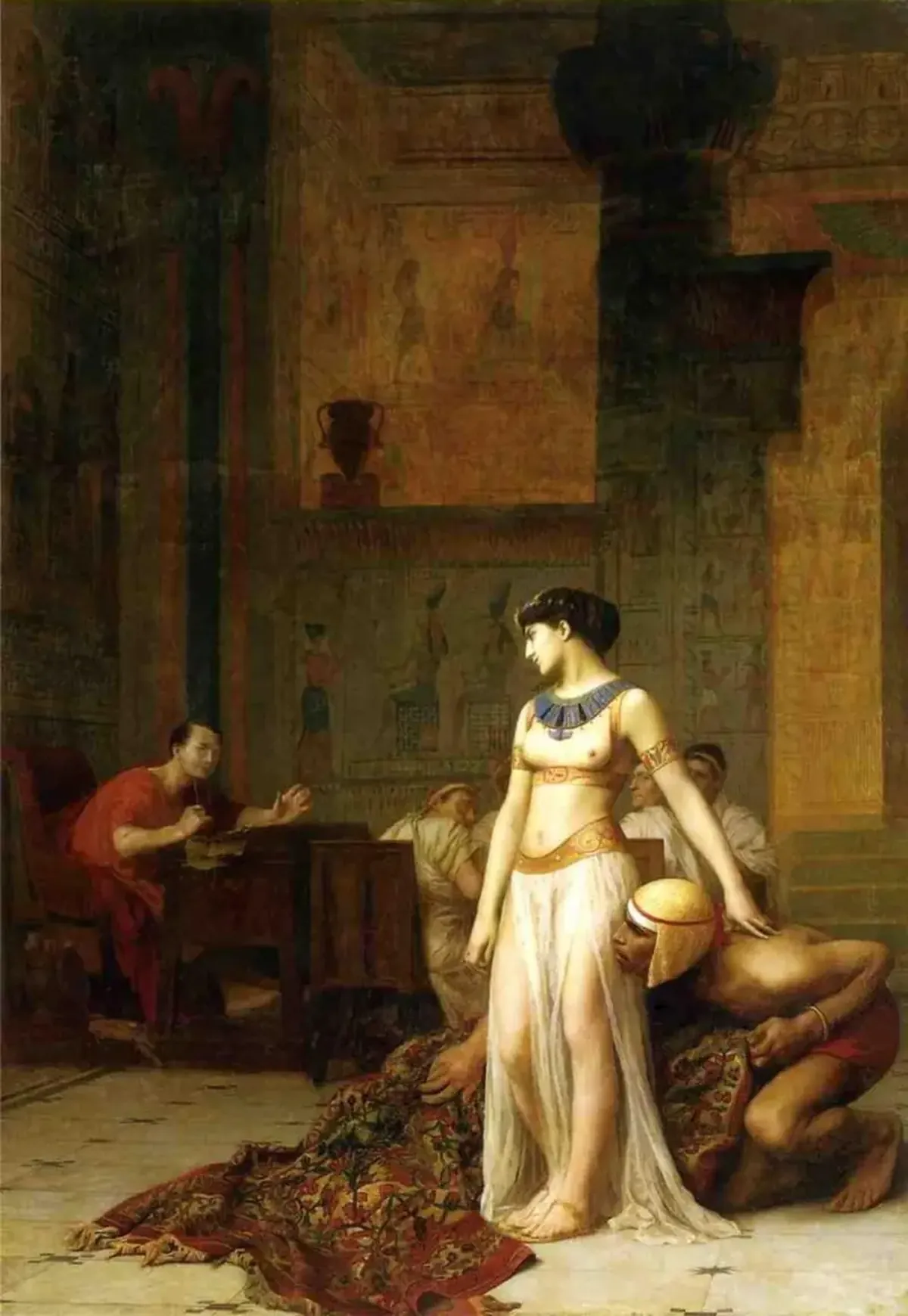
“Cleopatra and Caesar,” painting by Jean-Léon Gérôme (1866)
Legend says the 21-year-old Cleopatra smuggled herself into Caesar’s private chamber rolled up in a carpet (some accounts say servants carried her in a laundry bag). The meeting paid off: the affair solved many of her immediate problems.
Happiness Loves Silence
Ancient rumors tie Cleopatra to the deaths of both brothers and her sister. Accounts claim Arsinoe was executed on the steps of a Roman temple; Ptolemy XIII drowned while fleeing; and another brother was poisoned at about 14. After those deaths, Cleopatra installed her son as co-ruler, but her triumph alongside Caesar proved brief.
With Caesar’s backing, she governed Egypt under Roman protection, symbolized by three legions stationed in the country. She lived openly at Caesar’s villa in Rome, entertaining the local elite. Roman republicans bristled at the arrangement and at rumors that Caesar planned to marry Cleopatra and shift power to Alexandria. Yet when it came to succession, Caesar did not acknowledge Cleopatra’s son: he omitted the boy from his official will.
Caesar was assassinated on March 15, 44 B.C. After his death, Cleopatra fled back to Egypt.
Cleopatra’s beauty rituals and perfumes made her the most desired woman among the ruling elite. Men became enthralled, and Caesar’s successor Mark Antony was no exception. Both of her great romances were scandalous—both lovers had legal wives and heirs—but Cleopatra seemed unconcerned with reputation. She lived openly, as if she expected her happiness to be brief.

“The Meeting of Mark Antony and Cleopatra,” Lawrence Alma-Tadema (1885)
Head Over Heels
When Cleopatra met Mark Antony, she was 28 and he was about 40. Their first encounter reportedly amazed him: she dressed in a tunic evoking Aphrodite and sailed to Antony on a ship trimmed in gold and silver, staged as if for the gods. Antony soon cast aside his legal family when Cleopatra was present; he would reportedly send his wife and children away rather than be reminded of them.
Antony and Cleopatra were inseparable: they feasted, hunted, joked, and shared a private life. Their passion produced three children: twins Alexander Helios and Cleopatra Selene, and a younger son. None of Cleopatra’s children ultimately survived; notably, her son by Caesar, Caesarion, was later killed by Octavian.
The decade-long romance combined real passion with political calculation. The alliance helped Cleopatra pursue her plans while Antony used Egyptian resources to sustain his forces. But Antony’s attachment to her cost him dearly in Rome; his infatuation helped brand him a traitor in the eyes of many.

“Cleopatra and Octavian,” painting by Louis Gauffier (1787)
Look for the Woman!
Cleopatra’s presence in Antony’s camp and her reported intrigues—she allegedly saw enemies everywhere—undermined his position and prompted many supporters to defect.
From these defectors, Octavian learned the contents of Antony’s will, which damaged Antony’s reputation. The will reportedly recognized Cleopatra as his wife, named her children as heirs, and expressed Antony’s wish to be buried beside Cleopatra in Egypt rather than in Rome.
Octavian defeated Antony’s fleet and forced the couple to flee. After their loss, both took their own lives: Antony fell on his sword, and Cleopatra died from poison. One version claims a snakebite; another, more widely accepted, involves poison taken from a hidden compartment in a hairpin—two attendants reportedly died with her.

“The Death of Cleopatra,” Jean-Baptiste Regnault (1797)
After Cleopatra’s death, Egypt did not simply come under foreign control; it became a Roman province. The emotional drama ended in naval defeat and a national catastrophe—the fall of Egypt as an independent ancient civilization.
