
 Gaby
Gaby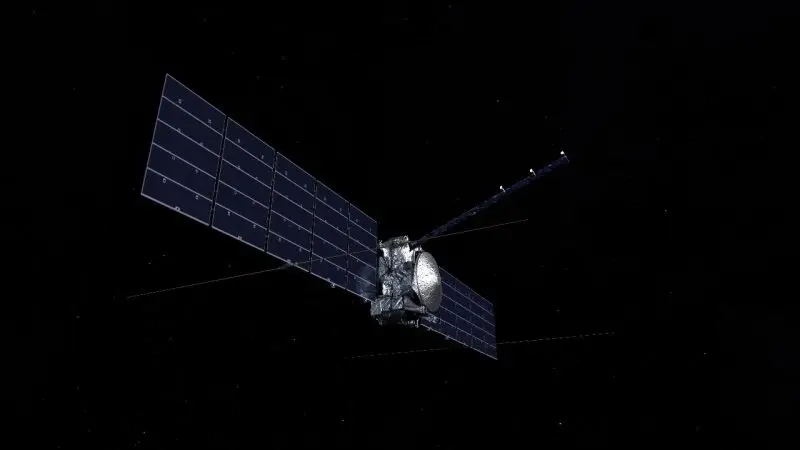
The message for extraterrestrial civilizations contains multi-level information, including 2.6 million names on a silicon microchip. Those names were submitted on NASA’s website by people who participated in the “Message in a Bottle” campaign.
NASA’s Jet Propulsion Laboratory reported that the Europa Clipper spacecraft will launch on October 10. After traveling 2.6 billion kilometers, it will reach Jupiter’s orbit in 2030 and conduct 49 close flybys of Europa.
And what’s on the record?
The metal plate, measuring 18 by 28 centimeters, is made of tantalum. Both sides of the plate are adorned with graphic elements.
In addition to the microchip with names, the artifact features an engraving with a handwritten inscription by the American poet Ada Limón: “Ode to Mystery: A Poem for Europe”.
On the outer panel of the plate, linguists recorded the word “water” in 103 Earth languages. The audio files were converted into signal forms (visual representations of sound waves) and engraved onto the plate. In this way, the project team emphasized one of its key goals: the search for the vast ocean that may be hidden beneath Europa’s icy surface.
In the spirit of the Voyager “Golden Record,” which carries sounds and images that convey the richness and diversity of life on Earth, the multilayered message on Europa Clipper offers a vivid introduction to our planet.

“The message about the connection through water, essential for all forms of life, beautifully illustrates the link between Earth and this mysterious oceanic world that we are about to explore,” said Lori Glaze, director of NASA’s Planetary Science Division in Washington.
Because the search for habitable conditions is central to the mission, the Drake equation is engraved on the inner side of the plate. The Drake equation is a mathematical formula developed by astronomer Frank Drake in 1961 to estimate the potential number of extraterrestrial civilizations, and it has guided research in astrobiology and related fields since then.
The inner side also includes references to radio frequencies considered suitable for interstellar communication. These frequencies correspond to radio waves emitted by water-related components in space, known to astronomers as “water holes.” They are depicted on the plate as lines of radio emission.
The message also includes a portrait of one of the founders of planetary science, Ronald Greeley. His work on Europa missions two decades ago helped lay the groundwork for this year’s Europa Clipper flight.
“We put a lot of thought and inspiration into this plate design, as well as into the mission itself,” said project researcher Robert Pappalardo of NASA’s Jet Propulsion Laboratory in Southern California.
A little about the mission
The main scientific goal of the Europa Clipper is to determine whether there are places beneath Jupiter’s icy moon Europa where life could be supported. The mission’s key objectives are measuring the thickness of Europa’s ice shell and investigating how that shell interacts with the subsurface ocean, as well as studying the moon’s geology and its potential to support life. A detailed exploration of Europa during the mission will help scientists better understand the potential habitability of worlds beyond Earth.
To view the message and listen to the audio recordings, follow the link: go.nasa.gov/MakeWaves.
