
 Gaby
Gaby
September 10 marks International Makeup Day. It was started in 2016 by American makeup artist and beauty blogger James Charles, who argued that outer beauty can support inner harmony. As the Roman poet Ovid wrote long ago, “perfect faces are a rarity,” advising people not to show bodily or facial flaws that can be hidden. For centuries, pencils, brushes, and paints have done more than help artists — cosmetics have helped many women feel more successful and happier.

Your Own Makeup Artist
Makeup is the art of decorating the face with cosmetics. The French word maquillage translates to “makeup” or “cosmetics.” The English word makeup comes from the phrase “to make up,” meaning “to assemble” or “to put together,” originally used in theater to describe creating a character. The purpose of makeup includes self-expression, beautification, and camouflage (from the French camouflage, meaning “to hide” or “to mask”). Makeup is not just about adding color; it also involves shaping features, creating visual effects, and correcting tones and contours.
Cosmetics can highlight attractive features and conceal disproportions or flaws. With makeup, a person can change their appearance, create a unique persona, enhance aesthetics, or achieve a more youthful look. As a developed and profitable industry, the decoration of skin, eyes, brows, and lips follows principles that date back to the dawn of civilization. The use of cosmetics has a millennia-old history: human ideas about beauty have evolved, yet the basic materials for creating it have remained similar. They compensate for color variations in hair and skin that arise from the combination of three natural pigments: melanin, carotene, and hemoglobin.

The History of Makeup
The lineage of cosmetics traces back to early human development, when ritual face and body painting was intended to influence the world around them. Indigenous peoples of Papua New Guinea, and the early civilizations of Mesopotamia and Egypt, used natural pigments. Excavations of caves in North America have revealed colored pigments estimated to be 100,000 to 150,000 years old, which scientists have called “prehistoric cosmetics.” Ancient people around the globe used similar dyes for their faces, including charcoal, chalk, copper ore, yellow ochre, lapis lazuli, and manganese dioxide.
Makeup played a significant role in ancient Egyptian culture, where both men and women used cosmetics. Roman patricians were also known to use beauty products, even coloring their bald heads. As far back as 10,000 B.C., ancient Egyptians knew ingredients for moisturizing creams and made paints for long-lasting makeup that adhered well to the skin. In tombs from that era, archaeologists found applicators, grinders, and mixing palettes; ancient Egyptians couldn’t imagine life — nor the afterlife — without cosmetics and the tools to apply them. Their most famous contribution to the art of makeup was the invention of black eyeliner made from kohl.

Vivid Associations
In 4000 B.C., people in Egypt painted elaborate “cat eyes” with black pigment to signal high status and wealth. Greek women darkened brows and lashes with soot and added rosy cheeks with red ochre or local lichen dyes. In Egypt, people used malachite eyeshadow and other pigments to honor gods such as Horus and Ra, who were believed to protect them from illness. Across cultures, ancient decorative cosmetics — pencils, blush, eyeshadows, powders, mascara, foundation, and nail polish — tended to be vivid because they relied on natural pigments. Makeup even appears in the Old Testament: it recounts how Jezebel painted her eyelids around 840 B.C., and the Book of Esther also describes cosmetic procedures.
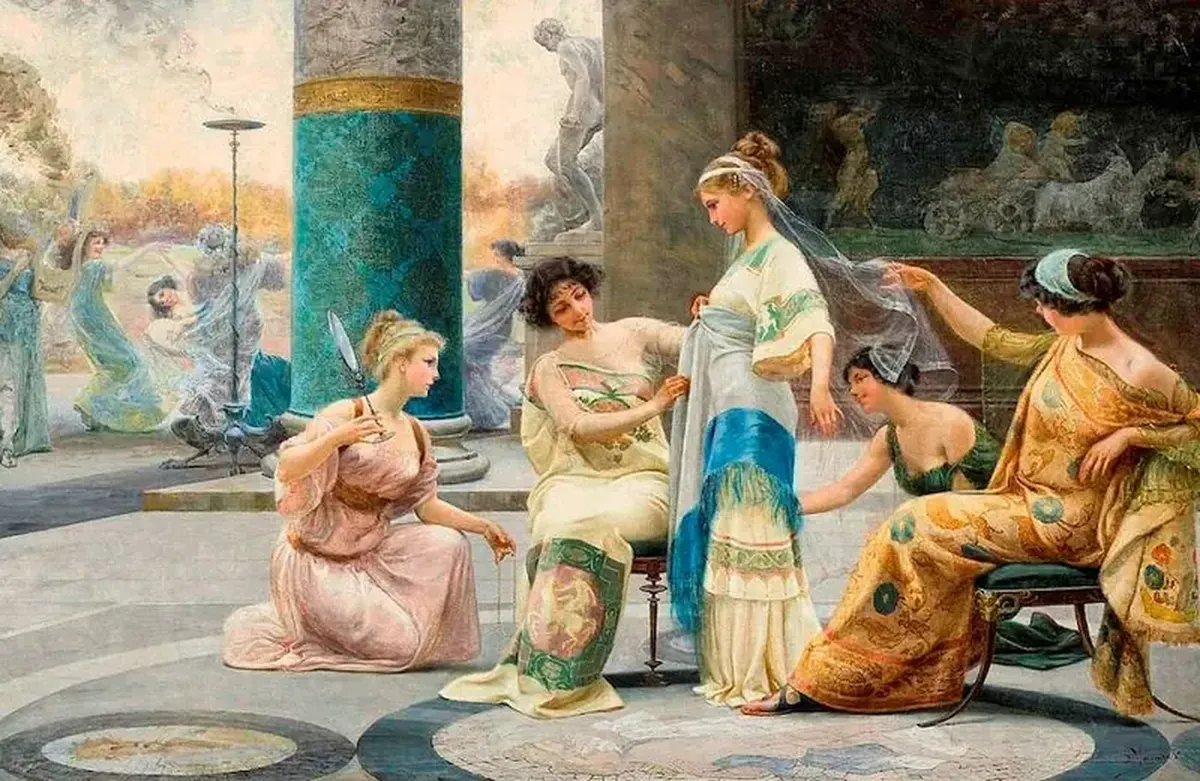
In the 1st century A.D., women in ancient Rome used red pigment from crocus flower stamens (saffron, later a traditional blush ingredient) on their cheeks and brightened other areas of the face with white powder. Roman women also painted their nails red using a concoction from animal products. The earliest blushes were ochre sticks, similar to today’s stick blushes, made by mixing iron oxide with fat. Some red pigments came from the cochineal insect; others were extracted from plants or produced from toxic minerals like mercury sulfide and lead oxide. Safer red hues were made from plant parts and fruits such as red amaranth, beets, safflower, mulberries, or strawberries.
Protection and Well-Being
While women of the Han dynasty in China whitened their faces with powders from mandarin peel, peach petals, and melon seeds, Roman women in the 2nd century A.D. used wild melon roots to whiten their skin and reduce freckles. That was an improvement over earlier practices: Greek women in the 200s B.C. sought a noble paleness by rubbing lead pigment on the skin (toxic lead-based cosmetics remained common until the 1800s). Archaeological finds of white powder in burials from the 4th to 5th centuries in modern-day Iran show that both women and men used foundation. Traces of red pigment were found on metal bowls that held paints for cheeks and lips, and ancient Iranians applied them using cotton pads.

In the 8th century A.D., the art of body painting with henna spread from Africa and the Middle East to India. Henna patterns on the palms, feet, and neck have long been thought to protect Indian women from the evil eye and to bring happiness in marriage. In Hindu tradition, married women often draw a sacred mark in the center of the forehead — the “bindi” — using sandalwood paste, clay, ash, or other substances. For young brides, the bindi is usually red. Red shades remain the most common color in makeup across cultures, symbolizing health, happiness, love, and passion. That popularity has a biological basis: red mimics the rush of blood. Bright red lips and rosy cheeks signal youth and vitality. Red is also a staple of theatrical makeup in Chinese opera and Japanese Kabuki theater.
From “Vamp” to “Cinderella”
Over 5,000 years, facial decoration traditions have changed little. Today, the classic staples of our cosmetic arsenal remain traditional products: black eyeliner, black mascara, eyeshadow, powder, and color accents on cheeks and lips. Makeup types vary by time, place, and occasion: natural (the art of making it look invisible), daytime, evening, cocktail, festive, bridal, halal (used by some Muslim women following religious guidelines), and special-purpose makeup such as military camouflage for soldiers, hunters, and outdoor enthusiasts. Fashion trends in makeup evolve each decade, a process accelerated by factory-produced cosmetics in the 20th century.

During World War I, women used makeup sparingly while men were at the front, but in the 1920s, amid new social freedoms for women, the “vamp” look emerged — bold eye makeup, dark eyelids, and burgundy lipstick. In the 1930s, cosmetic fashion swung toward aristocratic restraint: dramatic eyes remained, but lip color softened. From then on, trends were driven by runways, glossy magazines, and Hollywood. From the 1960s onward, a rule of “good taste” often meant emphasizing either the lips or the eyes. To convey innocence, many women highlighted their eyes to make faces look younger. That preference resurfaces periodically; the dominant direction lately favors natural beauty and “invisible” makeup.

Enforced Femininity?
As cosmetics became more accessible and popular, waves of resistance arose against what some saw as “institutionalized deception.” In the 1920s, some feminists viewed makeup as a tool of oppression that forced women into arbitrary social standards. Later criticism came from many sides: women’s rights advocates who condemned enforced femininity, animal rights activists who opposed animal testing, doctors who examined supposed links between makeup use and mental health, religious groups, and even men who felt deceived.
In 1968, during the Miss America pageant, feminists protested cosmetics as “instruments of female torture.” By the 1990s, proponents of “lipstick feminism” rejected restrictions on makeup use. Despite the long history of cosmetics, public attitudes remain mixed. A generation ago, makeup was often banned in schools; high school girls could only imagine the freedoms their daughters and granddaughters would one day enjoy. Today, stores carry dedicated sections for teen and children’s cosmetics, which are generally milder than adult formulas.

Personal Choice
Scientific studies show that appropriate makeup can enhance perceived attractiveness and increase how competent and reliable a woman appears to others. Researchers at Harvard University have argued that cultural shifts changed the purpose of cosmetics: where once beautification was seen primarily as a way to “please men,” it is now largely framed as personal choice. Today, cosmetics can function as a career tool and an essential accessory. In some workplaces, appearance rules are part of job expectations: for example, pharmacists in drug manufacturing may be prohibited from wearing mascara or lipstick, while retail staff, flight attendants, interpreters in diplomatic settings, and office managers may be expected to wear makeup under company protocols.

Studies find that women who wear appropriate makeup are often judged as more intelligent and responsible, since maintaining a polished appearance can signal self-discipline. At the same time, some professionals criticize this “beauty bias,” arguing that a person’s professional value should be judged by knowledge rather than lipstick color. Many women find that makeup helps them appear more approachable in first impressions and lets them create the image they want to project. That kind of “manipulation” is intentional and under the wearer’s control. If beauty really can change the world, then the makeup artist may be the one preserving it.
