
 Carlos Solis
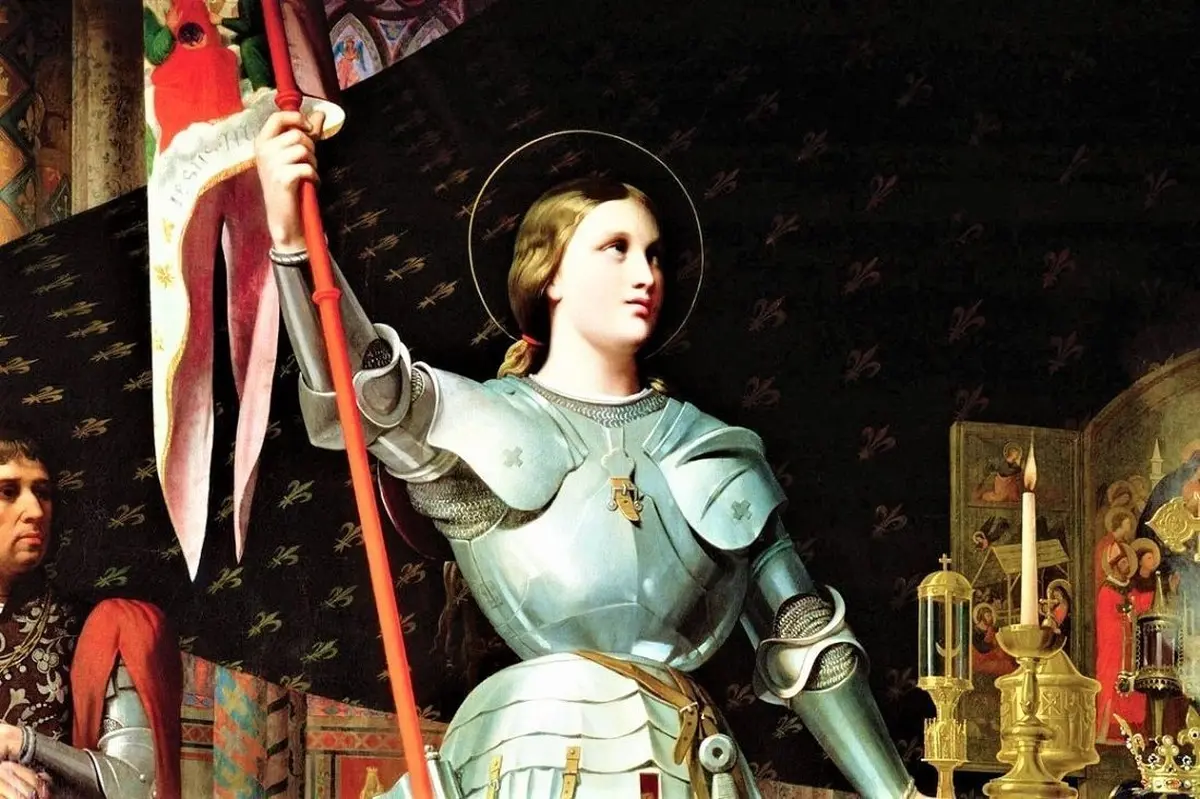 Joan of Arc is the archetypal national heroine: a patriot whose faith, charisma, and military effectiveness came together at a pivotal moment in her country’s history. She combined virtue, force of personality, and an unwavering belief in a divine calling with practical impact on the battlefield. The fate of this illiterate peasant girl—who changed the course of the Hundred Years’ War in just two years—was extraordinary even by medieval standards. At 17, dressed in men’s clothes, she led an army to liberate parts of France from English rule; by 19, she was executed on trumped-up charges of heresy, only to be rehabilitated later and eventually canonized. Her burning in 1431 made her a potent symbol at the crossroads of religion, politics, and mysticism.

Symbol of France
First and foremost, Joan of Arc became a durable national brand shaped by popular devotion, religious mysticism, and political promotion. For centuries her image was carefully constructed: as both a historical person and an artistic figure, she served as a powerful propaganda tool to unite France during the crisis of the Hundred Years’ War. Her arrival in 1429 came against a backdrop of despair and division.
At that time, a third of French territory was under English control. Burgundy sided with the English, and the French army seemed spent. The heir to the throne had been stripped of his rights by treaty and was sheltering in Chinon in southern France. The English king’s claim threatened the independence of France. To complete their domination, the English needed to take Orléans.
The city that would forever be linked with Joan was barely holding on when she appeared, promising victory and quickly becoming the most famous French military leader of the moment. She did not write elaborate battle plans, but she became the driving force that pushed the army forward. Both England and traitorous French factions came to see her as a threat. Her death was in part the result of King Charles VII’s inaction—he did little to save her.
Her sacrifice and heroic resistance turned her into a moral exemplar. The title “Maid of Orléans” tied her to the city she helped save and to an image of biblical purity. Central to the mystical image of Joan were the “voices”: she claimed guidance from Archangel Michael and Saints Catherine and Margaret, which she presented as divine justification for her actions.
The nature of those “voices” is still debated—were they psychological episodes, genuine visions, or political theatre? Questions also remain about the details of her biography. Early promoters cast her as everything from a beggar to an illegitimate princess, neither of which is accurate. Her sudden appearance suited the needs of Charles’ coronation and served France’s political interest in national consolidation.
With Joan’s help, Charles VII and his supporters boosted French morale and strengthened his claim to the throne. Turning the popular heroine into a martyr after her execution fortified the national idea. Once proclaimed patron saint of France, Joan became an icon of unity and patriotism, and her story—of a strong woman who defied norms, rallied people, and inspired belief in miracles—has fueled centuries of literature, music, film, and popular culture.
A Foretold Mission
Joan of Arc was born in Domrémy on January 6, 1412, into a relatively well-off peasant family. She was the daughter of Jacques d’Arc and Isabelle Romée; her parents owned about 50 acres of land (roughly 20 hectares). Jacques not only ran the farm but also served as head of the village watch and collected local taxes. The family lived in territory loyal to the French crown but surrounded by Burgundian lands and periodic attacks. As a child, Joan witnessed her village being burned.
That trauma may have prompted her first vision at age 12. In 1424 she said she saw Archangel Michael and Saints Catherine and Margaret in a field, and they told her to drive the English from French soil and to lead the Dauphin Charles to Reims for his coronation. Joan later said she cried when the figures vanished; their appearance left a lasting impression. Four years later, at 16, she persuaded a relative to take her to a nearby castle, where she made an extraordinary request of the garrison commander.
Joan approached Count Robert de Baudricourt and asked for permission to visit the royal court. He initially mocked and refused her, but she persisted. When she returned to Baudricourt in early 1429, accompanied by a small group, she predicted a change around Orléans. Her warnings gained credibility when frontline reports confirmed facts she could not have known. She was given an escort to the court of Dauphin Charles VII.
To cross Burgundian-held territory safely, Joan wore men’s clothing supplied by her uncle. Before a private audience with the future king, two weeks of inquiries established her identity—starting with two midwives who confirmed she was a virgin. She impressed the royal household and asked Charles’s mother-in-law, Yolande of Aragon—who was financing aid for Orléans—for permission to join a relief force.
The determined girl received a horse, a sword, and permission to wear armor. Joan rode ahead of the army carrying a banner. No contemporary portrait survives, but court witnesses described her appearance: Philip of Burgundy said she was dark-haired with a bob cut and a large birthmark behind her right ear; her squire Jean d’Olon described her as robust.
Though short (about 5’2″ to 5’3″), with a slender waist and a soft voice, Joan was no weakling. Dressed in armor, she endured the hardships of military life alongside men and won their respect through modesty and moral seriousness. Gilles de Rais, one of her comrades, wrote that no one had ever seen her kill an enemy with a sword. She took communion before battle and prayed for the fallen afterward, urging other soldiers to do likewise.

Father Jean Pasquerel recorded that Joan fasted weekly—on Fridays she mostly abstained from food and drink. There was no swearing or fighting around her. Many who believed the old prophecy thought a maiden would save France from ruin, contrasting Joan with Queen Isabella of Bavaria, the wife and regent of the mad King Charles VI, who had signed the Treaty of Troyes in 1420 ceding the crown to the English.
“Ladies” and “Gentlemen”
For believers in her mission, Orléans would prove whether Joan’s claims were true. When she arrived at Orléans on April 29, 1429, the 17-year-old met resistance from the royal command. Jean de Dunois, the Orléans commander, initially barred her from military councils and kept her out of attack plans. Joan joined skirmishes despite official prohibitions, leaving the exact scope of her military authority open to debate.
During her trial she said she “preferred the banner to the sword,” which led some historians to argue she was mainly a standard-bearer meant to lift morale. Yet, under her leadership—Joan could not read and had not studied military strategy—the French won a string of victories that shifted the war’s momentum. When English positions were abandoned without a fight, contemporary observers quipped that “English gentlemen do not fight with ladies.”
At Orléans, Joan rejected the cautious tactics used in earlier campaigns and pushed for a rapid assault. Under her leadership, the city was freed from siege within a week. To rally exhausted soldiers, she set a ladder against the fortifications and cried, “Who loves me—follow me!” She stayed in the fight even after an arrow struck her collarbone. The fortress of Le Turel fell to the French in a day.
The next planned assault did not take place—Joan preferred not to fight on Sundays, and the English withdrew on their own. After the siege, Joan was expected to march on Paris or push into Normandy. Several towns along the army’s route switched sides without fighting. Thanks in part to her victories, the French king was crowned that summer in Reims. An assault on Paris was postponed because the court opened peace talks with the Burgundians.
Political errors after the coronation weakened Paris’s defense. The delay let the enemy regroup. Joan was wounded in the leg by a crossbow bolt on September 8 but continued to command the fight for Paris through the day; by morning the king had ordered a retreat. Still, within a year of campaigning, Joan’s successes had elevated her from peasant girl to noblewoman after another victory in October 1429.

She had little time to enjoy that status. On May 23, 1430, during an attack on an enemy camp, Joan was unhorsed and captured by Burgundian forces, who sold her to the English for 10,000 crowns. Charles VII, who owed his crown in part to Joan’s victories, chose not to ransom her. Joan made several escape attempts, even leaping from a 21-meter tower, but failed. The English then put her fate in the hands of the Church.
The pro-English Bishop Pierre Cauchon presided over an inquisitorial trial in Rouen, despite lacking proper ecclesiastical jurisdiction. The proceedings were rife with procedural violations. Joan often navigated the theological traps placed before her, but court records were altered to make her look worse. The aim of the trial was political: to undermine the legitimacy of Charles VII.
The Death of Joan of Arc
The political trial that ended in her execution by burning in 1431 relied on coerced confessions and the court’s assumption that her “voices” were diabolical. Judges used intimidation and deceit: shown a pyre prepared for her burning, Joan was pressured into signing a statement of submission to the Church and a renunciation of heresy—and the text she agreed to was later replaced with a harsher version.

She signed a formal renunciation of the twelve accusations by marking a cross, even though in other documents she had signed her name as “Johanne.” Having agreed to wear women’s clothes as part of that settlement, she later put on men’s clothing again—a move the court treated as a repeat offense of heresy and punishable by death. Joan explained she dressed as a man to protect herself from rape; she did not feel safe in prison or on campaign.
Historians cannot say for sure from the trial records why she returned to men’s clothes: perhaps her dress was taken from her, leaving her no choice, or perhaps an unwelcome English lord made advances while she was imprisoned—a claim she reportedly raised during the trial. Whatever the cause, Joan’s faith and sense of innocence stayed with her until the end. On May 30, 1431, as flames consumed her at the Old Market Square in Rouen, she cried out, “Jesus!”
Burned as a “heretic, apostate, idolater”—the words written on the paper mitre she wore—she asked for a cross before the flames took her. Her death did not restore English fortunes. Four years later France and Burgundy reconciled and turned decisively against England; the conflict that became the Hundred Years’ War eventually came to an end.
After the war, at Charles VII’s request, a retrial cleared Joan of the charges. Her conviction was annulled, the accusations dismissed, and she was recognized as a martyr. After her canonization, images of the Maid of Orléans—typically pictured in men’s clothing with a sword—appeared in churches across France.
Joan of Arc: Interesting Facts
- The name “Joan of Arc” is a later convention; she did not use that form in her lifetime. The apostrophe and the “d’Arc” appeared later because of confusion over her father’s origins and inconsistent spelling in the 15th century.
- Modern neurologists have suggested Joan’s “voices” might have been auditory hallucinations linked to idiopathic partial epilepsy, sometimes triggered or amplified by loud sounds such as bells. Some historians have also proposed schizophrenia as a possibility.
- Contemporaries described Joan as fiery and demanding: she scolded knights for swearing, gambling, and missing Mass. She punished soldiers for looting and sharply reproached commanders for indecisiveness.
- At the start of the investigation, the list of charges against Joan numbered about 70, including witchcraft accusations. Most were later judged unfounded, and only twelve counts remained in the final indictment.
- After her execution, several women claimed to be Joan, and even some of her brothers supported an impostor for profit.
- One of Joan’s companions was Marshal Gilles de Montmorency-Laval, Baron de Rais—her protector and a military commander, an educated aristocrat, alchemist, and owner of a large library. Legends claim that in his castle he sacrificed many children to Satan and murdered wives who opposed him; he was eventually arrested, tried for witchcraft, murder, and heresy, and burned at the stake. His gruesome story helped inspire Charles Perrault’s tale “Bluebeard.”
