
 Gaby
Gaby
Archaeologists uncovered stone tools used by prehistoric Homo erectus at the Korolevo site back in the 1980s. But at the time, researchers couldn’t accurately determine the age of those finds. Recently, a team led by Roman Garba of the Czech Academy of Sciences dated the artifacts using advanced techniques. They turned out to be about 1.4 million years old.
This discovery is the earliest evidence of human presence in Europe and rewrites the story of ancient migrations across the continent. Homo erectus populations spread into Europe from the Caucasus, traveling westward through the Carpathians.
The archaeological site at Korolevo, located in the Berehove district of Transcarpathia, reaches down 14 meters. Within layers that accumulated over roughly one and a half million years, researchers have unearthed thousands of artifacts. At least seven separate periods of hominid occupation have been identified at the site, Science Alert reported.
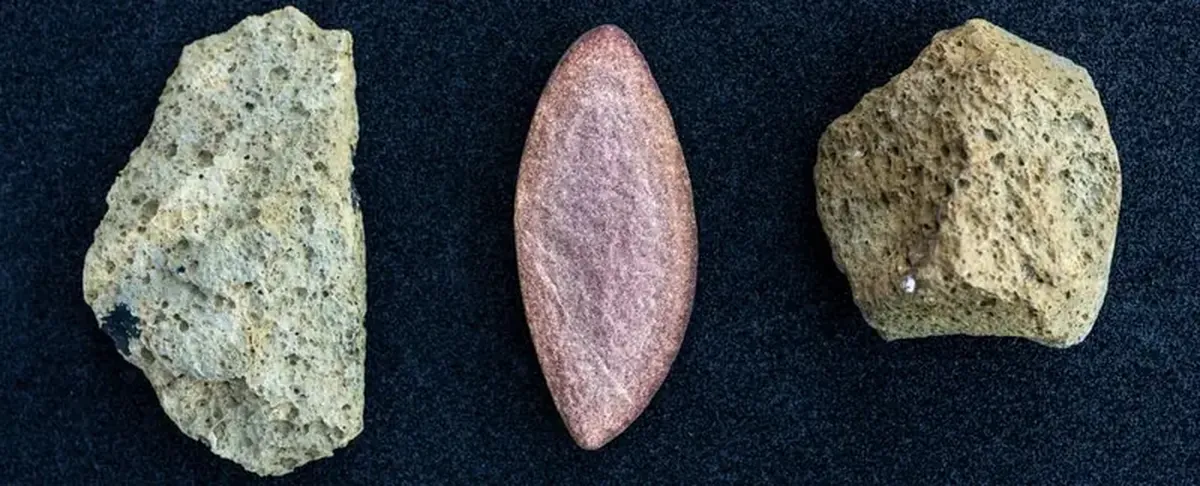
Two stone tools and a quartzite fragment from the oldest layer at Korolevo. (Czech Academy of Sciences)
What the researchers discovered
“It was previously thought that the earliest humans could not survive in colder latitudes without the use of fire or complex stone tools. However, we have evidence that Homo erectus lived further north than previous studies suggested,” said archaeologist Andy Harris of La Trobe University in Australia.
At the site in Transcarpathia, scientists found no biological remains—only stone artifacts, Mads Knudsen, the lead author of the study from Aarhus University in Denmark, said. That ruled out radiocarbon dating, which is used to date organic materials. For decades after the artifacts’ discovery, researchers could only speculate about their age.
Unassuming fragments of stone turned out to be tools once used by our direct ancestors—Homo erectus. These tools are now the earliest evidence of hominid occupation on the European continent.
To reach this conclusion, the team used more modern dating methods. “To answer the questions posed by archaeology and anthropology, we need to employ methods from both nuclear physics and geophysics,” Garba explained.
The team applied cosmogenic nuclide dating. These rare isotopes form when high-energy cosmic rays strike minerals at the Earth’s surface. Changes in the concentrations of the cosmogenic nuclides beryllium-10 and aluminum-26 helped determine the age of those minerals, Garba said.
The researchers also developed their own mathematical model to estimate the age of the sediment layers—the first time this model has been applied to archaeological dating. Ultimately, the oldest tools were dated to about 1.42 million years ago.
That timing means Homo erectus was present in Europe more than 1.4 million years ago. The species had already been moving through Asia about 1.8 million years ago.
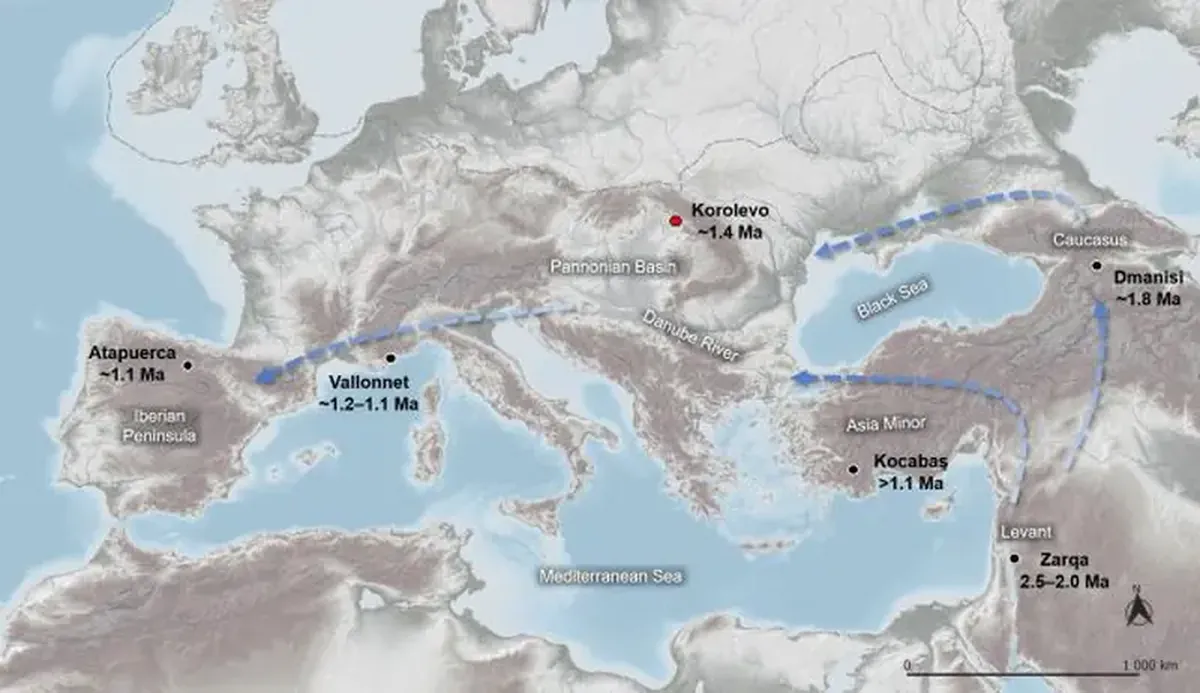
A new map of Homo erectus migration history developed by Garba’s team
Geochronologist Véronique Michel of the University of Nice (France) said artifacts proving the presence of the first humans in Europe beyond 800,000 years are extremely rare.
Researchers wrote that the earliest accurately dated evidence of hominins in Europe was previously thought to be about 1.1 to 1.2 million years old. Fossils and tools supporting that view were once found in Spain and France.
The oldest Homo erectus fossils in the world are about two million years old; they were excavated from a cave in South Africa.
The results of the study were published in the journal Nature.
