
 Carlos Solis
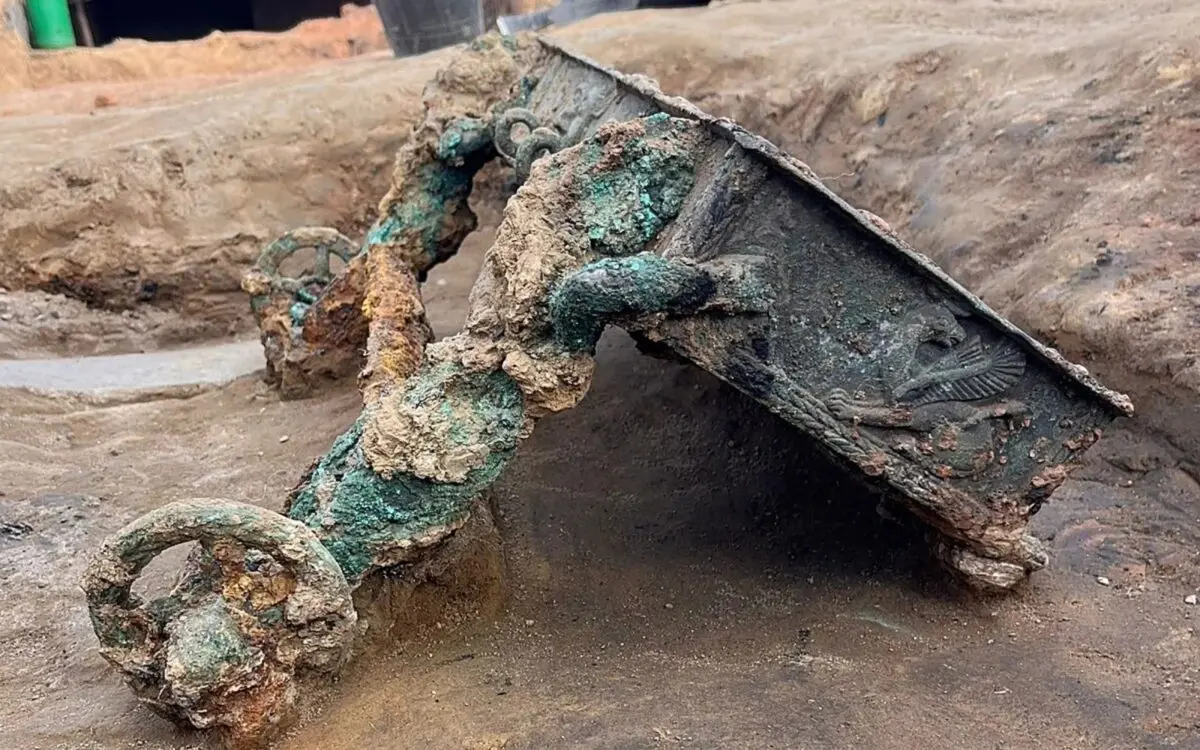 Archaeologists at one of Spain’s most mysterious sites uncovered a small bronze cart — split in half but tightly packed with mythological figures.
The team found it during excavations of a monumental building dating to the end of the first millennium BCE. After the structure was destroyed, it was carefully covered, leaving its contents exceptionally well preserved.
What the object is and how it was used
The cart wasn’t a transport vehicle in the usual sense. It served as a small ceremonial wheeled platform, probably used in religious rites. Archaeologists think people placed embers or aromatic resins on it, turning the cart into a portable censer during festivals.
Excavators have recovered only half of the cart so far, but that is enough to show its unusual design. Two wheels and part of the main chest survive. The side panels show griffins — creatures with a lion’s body and an eagle’s head and wings — a motif that has deep roots in Egyptian and Mesopotamian art and later spread through Greek and Etruscan traditions.
On the front, the team found a horned mask identified as Achelous, the river god in Greek mythology who also appears in Etruscan art. Two bearded male figures wearing short kilts, posed like atlantes, also draw attention.

A settlement buried under a layer of clay
Casas del Toruñuelo has become important because of how well the site survived. The architecture includes monumental staircases, engineered hydraulic features, lime-and-clay mortars, and rooms that point to administrative, residential, and ritual functions.
The lower courtyard has already produced one of the site’s most dramatic discoveries: remains of a large animal sacrifice, mainly horses, along with cattle, pigs, and dogs.
The reason the settlement declined remains unknown. At the end of the 5th century BCE, several Tartessian complexes in the middle Guadiana valley were destroyed, burned, buried, and abandoned. Scholars debate whether this reflects social crisis, religious disruption, political collapse, or some combination of factors.
About half of the structure remains unexcavated, so archaeologists hope the missing half of the bronze cart still lies in those layers.
Small in size but rich in meaning, the cart — decorated with griffins, a horned river deity, figures resembling atlantes, and movable wheels — preserves a fragment of Mediterranean culture where myth, trade, and ritual intersected.
Based on reporting from Arkeonews

