
 Gaby
Gaby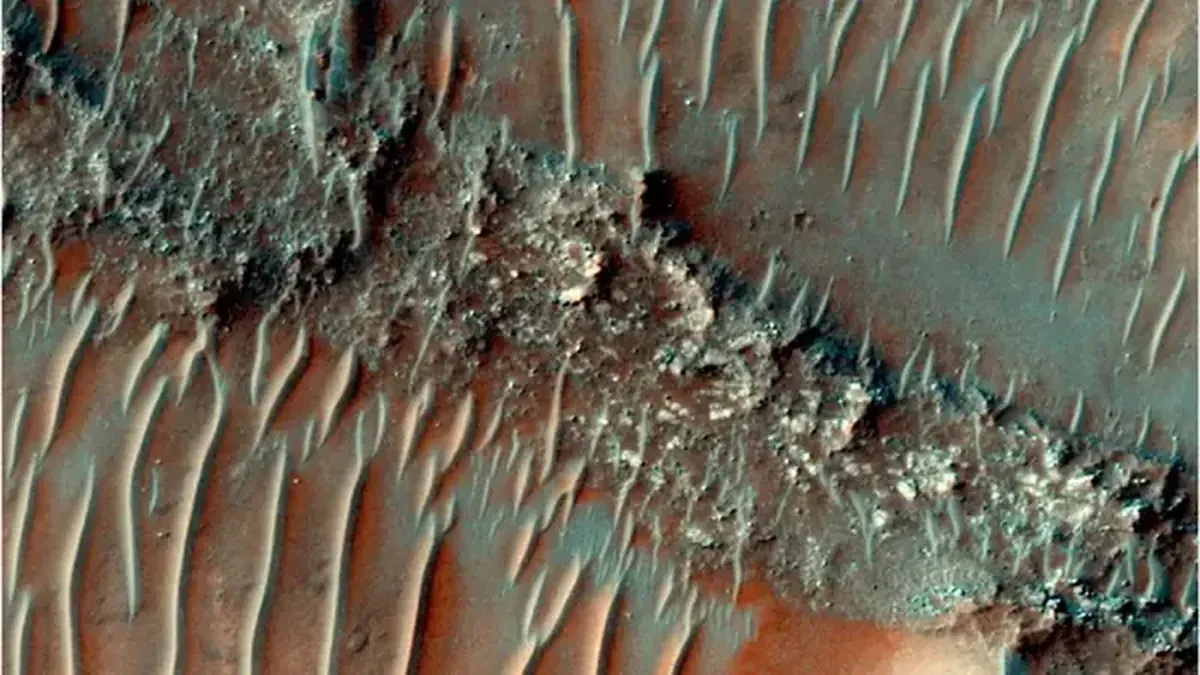
New research from planetary scientists at the Open University in the U.K., led by Adam Loskutov, shows Mars was much wetter and rainier than previously thought. His team studied ancient inverted riverbeds stretching more than 15,000 kilometers across the southern region of Noachis Terra (“Noah’s Land”). “Our work provides new evidence that Mars was once a far more complex and active planet than it is today,” Loskutov said.
What Did the Scientists Discover?
When Mariner 9 photographed the surface of the Red Planet in the 1970s, revealing networks of dried-up river channels, scientists concluded Mars was wet more than 3.5 billion years ago. But those channels weren’t the only signs of ancient water.
When that water drained away or evaporated, it left behind sediment deposits. You can sometimes see those deposits in craters that once held water. NASA’s Curiosity rover is exploring Gale Crater, where such sedimentary rocks have been observed, according to Live Science.
In other cases, sediments accumulated along river channels. Over time they hardened into rock while the surrounding terrain eroded away, leaving the tougher material standing as ridges. Geologists call these meandering ridges or, more simply, inverted riverbeds.
To uncover the many channels in Noachis Terra, Loskutov and his colleagues used images and data from NASA’s Mars Reconnaissance Orbiter — the HiRISE and Context Camera instruments — and laser altimeter data from the Mars Global Surveyor mission.
For a long time, scientists overlooked Noachis Terra because it lacks the classic river valleys that clearly signal past water. While mapping inverted riverbeds there, Loskutov’s team found many signs the area once held substantial water.

A riverbed left by a dried-up river on Mars billions of years ago
A Time Capsule
“Studying Mars, especially a little-explored region like Noachis Terra, is truly fascinating because this environment has remained virtually unchanged for billions of years. It is a time capsule that preserves fundamental geological processes in a way that is simply impossible on Earth,” Loskutov said.
Some of the inverted channels are isolated segments that have been exposed to the elements for billions of years, while others remain intact, forming towering, elongated systems.
Loskutov says the extensive network doesn’t point to sudden floods. More likely, the channels formed under relatively stable climatic conditions over a long geological period — around 3.7 billion years ago, during a transition between eras.
The most likely source of the water that carved these channels was precipitation: rain, hail, or snow. Given the size of the inverted-channel network in Noachis Terra, this suggests the region experienced many rainy days in a warm, humid climate.
This further supports the idea that Mars was once more Earth-like than the cold, barren desert it is today.
Loskutov’s team presented the findings at the Royal Astronomical Society’s National Astronomy Meeting at Durham University in the U.K.
