
 Carlos Solis
The brilliant feathers of a peacock contain nanostructures that scatter light in such a way that the plumage shimmers with shades of blue and green.
Researchers from Florida Polytechnic University and Youngstown State University (USA) applied a special imaging technique to several areas of a peacock’s tail and set out to discover structures that could emit a completely different kind of glow.
Ultimately, the team made a stunning discovery: they found that the wavy spots on the peacock’s magnificent feathers possess unique properties. They align light waves, reflecting them back and forth, effectively turning them into yellow-green lasers.
What Did the Scientists Learn?
The term “laser” is an acronym for Light Amplification by Stimulated Emission of Radiation. When light is directed at the atoms of certain materials, such as dyes or crystals, those atoms excite and emit a stream of photons.
The team says this type of light amplification isn’t uncommon in nature. This phenomenon often interests researchers working on biological lasers, ScienceAlert reported.
However, to create a laser beam, the buildup of stimulated waves must be aligned and their phases must be synchronized. One way to achieve this is by reflecting waves back and forth in a confined space known as an optical resonator.
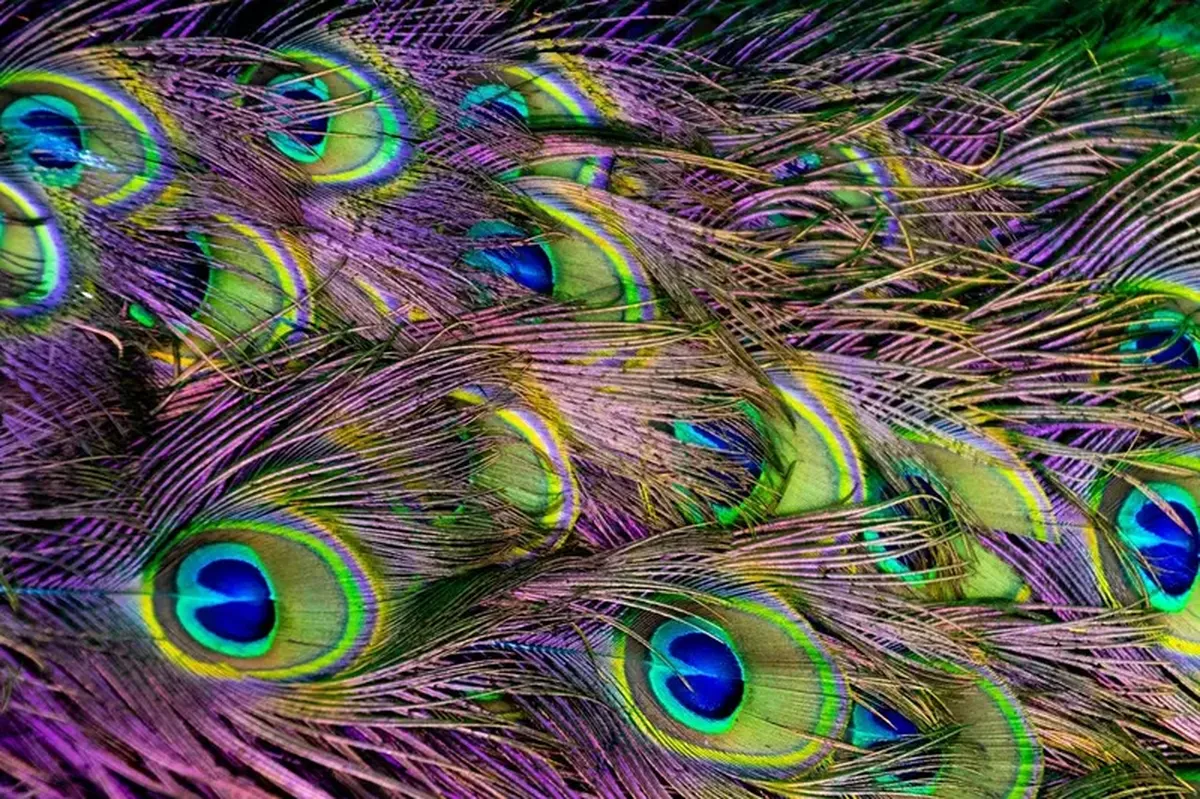
The researchers found evidence of optical cavities in the form of resonating nanostructures in various segments of the wavy spots. Each of these structures emits two distinct wavelengths: green and yellow-orange.
It remains unclear which specific structure is responsible for aligning the amplified light into those colors. However, the fact that these structures are scattered throughout the feather and emit the same precise wavelengths suggests something extraordinary is happening.
The team hypothesized that understanding the physical properties of these resonators could lead to advancements in laser technology or give biologists a new tool for studying living organisms.
As for peacocks, one can only speculate why evolution embedded laser-like resonators in their plumage, which shimmers so remarkably.
Their findings were published in the journal Scientific Reports.
Photo: pexels.com
