
 Gaby
Gaby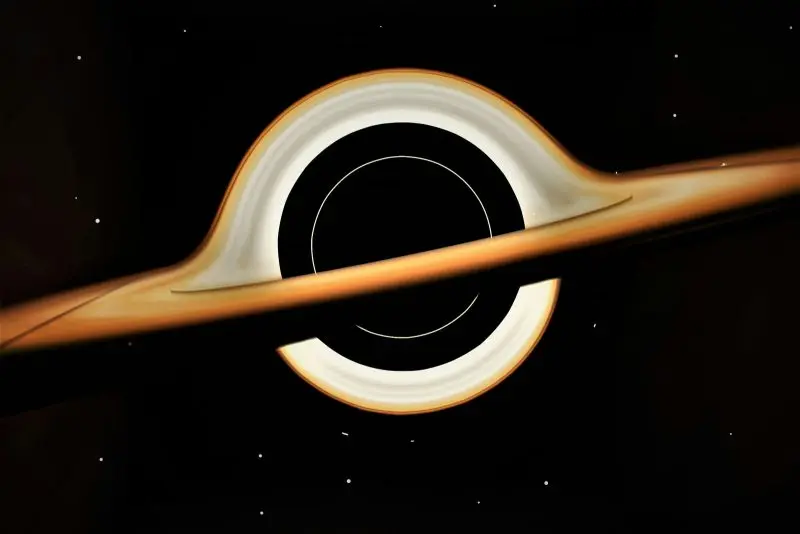
If you’ve ever dreamed of diving headfirst into a black hole, but the idea of turning your body into plasma doesn’t appeal to you, NASA has a solution.
At the National Aeronautics and Space Administration (NASA), researchers used a supercomputer to create an incredible 360-degree visualization of diving into a black hole.
A black hole is a cosmic object that creates such a strong gravitational force that nothing, not even light, can escape from it.
The event horizon of a black hole is the point of no return: the boundary that separates this cosmic object from the rest of the Universe. Once something crosses this threshold, it cannot escape. Thanks to astrophysicists at NASA, we can now imagine what it’s like to fly around a black hole or even dive into one. Those two scenarios were brought to life in visualizations by astrophysicist Jeremy Schnittman at NASA’s Goddard Space Flight Center.
Presenting the project, he noted that “modeling these hard-to-imagine processes helps connect the theory of relativity with real events in the real Universe.”
“I modeled two different scenarios: one where the camera does not go beyond the event horizon and returns, and the other where it crosses the horizon,” the researcher explained.

This modeled black hole is similar to Sagittarius A* – the supermassive black hole at the center of the Milky Way. It is 4.3 million times more massive than our Sun. Sagittarius A* has an event horizon measuring about 25 million kilometers across, writes IFLScience.
“Stellar-mass black holes, containing up to 30 solar masses, have significantly smaller event horizons and stronger tidal forces that can tear objects apart even before they reach the horizon,” said Jeremy Schnittman.

According to the astrophysicist, if a hypothetical astronaut were to orbit such a black hole at a colossal speed, they would return 36 minutes younger than someone who stayed at the starting position. Because gravity there slows time, being close to the black hole would make them younger relative to someone who stayed farther away.
The situation could be even more extreme, noted Schnittman. “If a black hole were to spin rapidly, like in the 2014 film ‘Interstellar,’ the hero could return many years younger than his shipmates,” said the astrophysicist.
Black holes are fascinating and very complex cosmic objects. Such visualizations help us to understand a little of what they are.
