
 Gaby
GabyIf a young caricaturist who despised landscape painters had been told he’d spend a third of his life painting water lilies in a backyard pond, he would have laughed. But on Monet’s creative journey, the leap from disdain to devotion was surprisingly short.
A Profitable Hobby
One of Impressionism’s founders was born a true Parisian. Oscar-Claude Monet was born into a family of grocers on November 14, 1840. When Monet was five, his family moved to Le Havre in Normandy. His father hoped he would join the family business, but fate had other plans. As a boy Monet wandered the coast instead of studying, skipping dull lessons to roam the river and cliffs. Those solitary walks sharpened his eye for beauty, and at school he amused himself by doodling in his notebooks. He filled the colorful covers with “disrespectful” caricatures of his teachers, and caricature became an art form for him. By 15 he was taking commissions—20 francs a portrait—and soon the whole school and town knew his work. The young student saved about 2,000 francs from those earnings.

Claude Monet with his family, 1880.
A Fateful Encounter
While selling his caricatures in a local shop window, Monet looked down on the “banal” landscapes displayed beside his work and refused to meet the artist who painted them. One day that painter walked into the shop anyway, and the owner introduced them. The newcomer was Eugène Boudin. Boudin praised Monet’s caricatures and urged him to learn to see nature’s beauty and paint landscapes. After some resistance, Monet agreed to join Boudin on sketching outings. As Monet later recalled, those trips opened his eyes and set him on his true path.
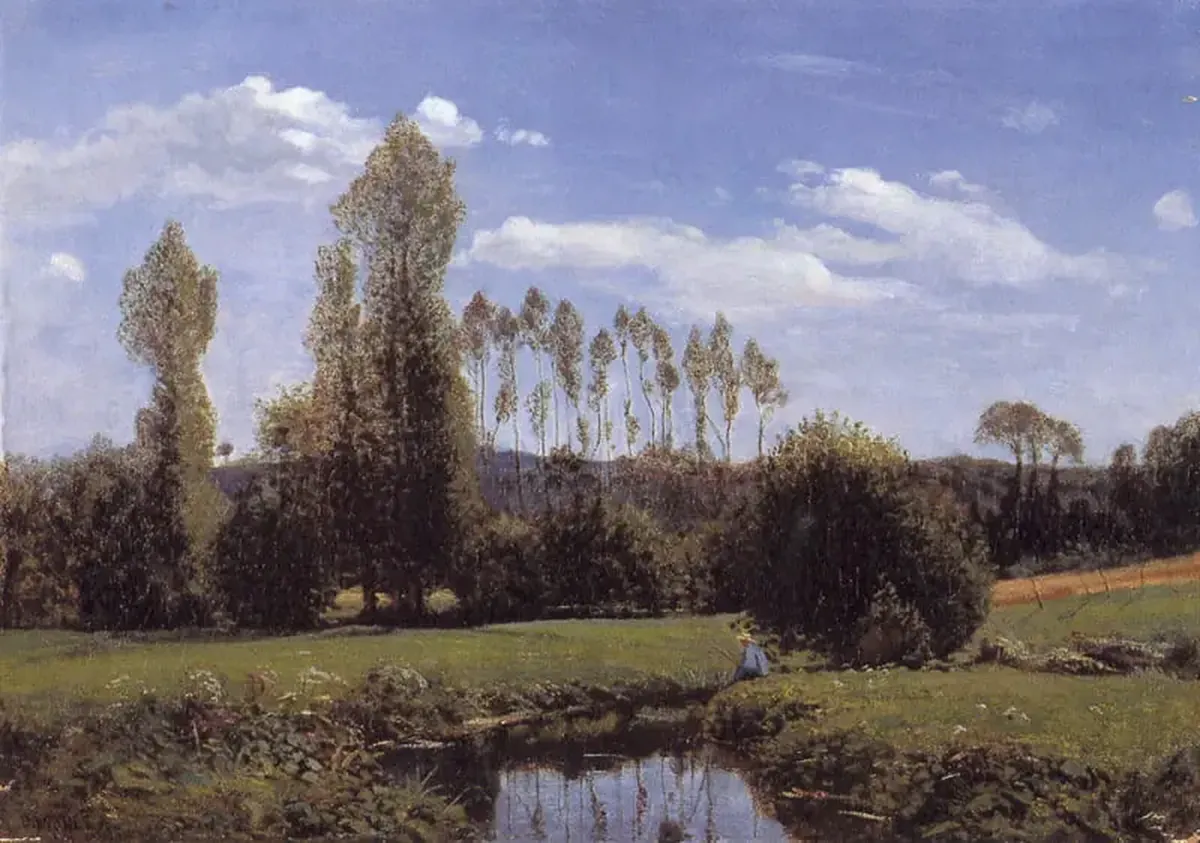
“View of Rouelles,” Le Havre 1858, one of Monet’s early landscapes.
Thanks to His Aunt
Encouraged by Boudin and other artist friends, Monet headed to Paris to study. He wasn’t eager to enroll at the École des Beaux-Arts, and his father refused to support him financially. His aunt, an amateur painter, came to the rescue: she shared her Le Havre studio, sent him money for life in Paris, and helped secure his exemption from military service after he contracted typhoid while serving in Algeria. In 1861 Monet enrolled at the Faculty of Arts at the University of Le Havre, but he didn’t stay long. After clashing with professors he joined Charles Gleyre’s studio, where he met like-minded peers—Auguste Renoir, Frédéric Bazille, and Alfred Sisley. Those young artists would later help found Impressionism.
Impression or Impact
The Franco-Prussian War forced him to move around Europe. In London his works were rejected by the Royal Academy, and in the Netherlands—where he planned to settle and painted 25 canvases—the police even accused him of revolutionary activity. After returning to France in 1872, he painted the work that lent the movement its name: Impression, soleil levant (“Impression, Sunrise”).

“Impression, Sunrise” (Impression, soleil levant), 1872. Musée Marmottan Monet, Paris.
The painting debuted at the first Impressionist exhibition in 1874. Critics mocked it as merely “an impression.” It took years for gallery owners to take notice. In 1880 Paul Durand-Ruel offered to represent Monet permanently, and his finances improved quickly.
The Main Theme
In 1883 Monet bought a house in Giverny, in northern Normandy about 80 km from Paris, where he would live for a quarter century. On the property he created a Japanese-style pond, a feature later reproduced in Japan for tourists.
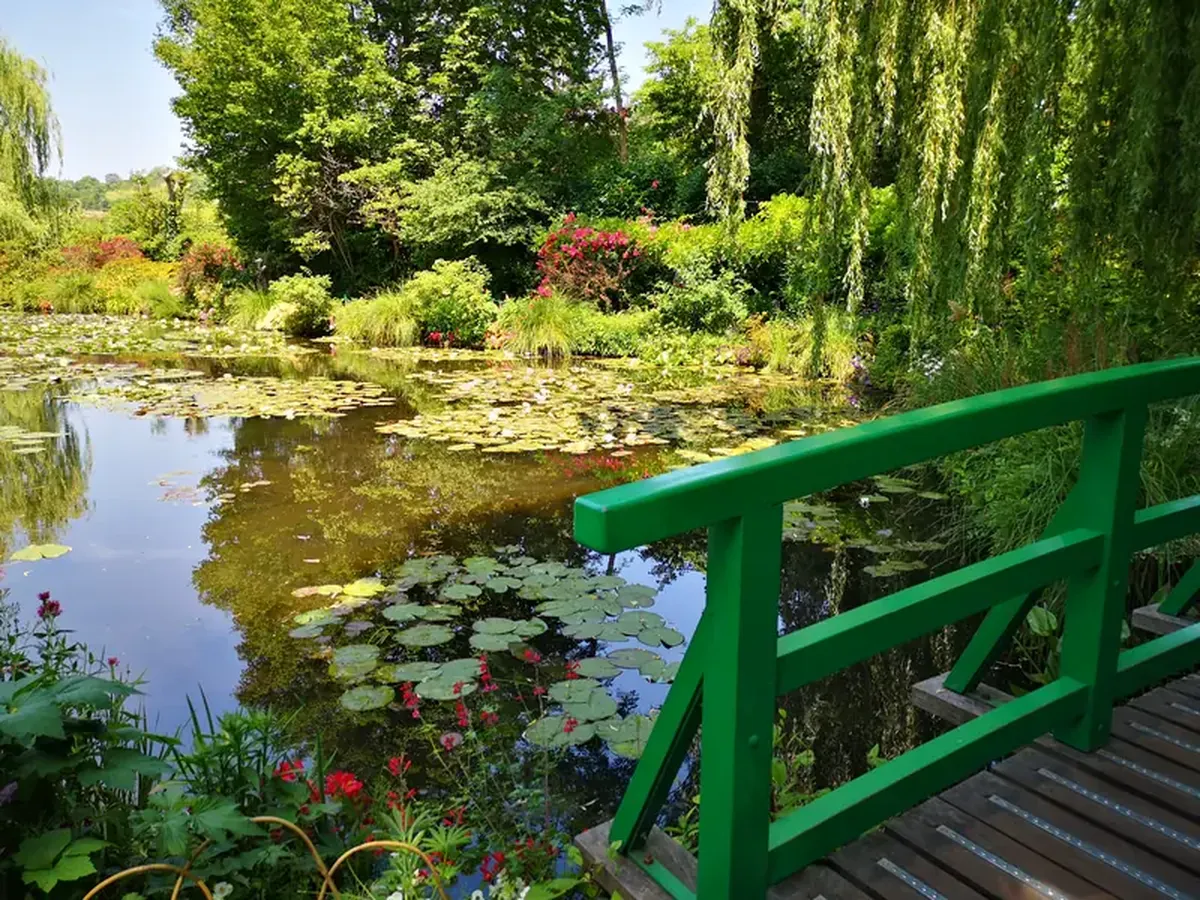
This is how the garden created by Claude Monet looks today.
Monet designed and planted the garden himself. He added a decorative bridge and filled the pond with water lilies and lotuses he selected—flowers he painted for the last 26–30 years of his life.

Water lilies in the artist’s paintings from various years.
The flowers on the water’s surface became the central subject of his late work. He painted the same scene in variations about 250 times. The first series of pond and water-lily paintings was created between 1898 and 1908. Another series of about 25 paintings was completed around 1900, and a third ran from 1903 to 1908.

The room with water lilies at the Musée de l’Orangerie.
In the 1920s the Musée de l’Orangerie gained two oval rooms—shaped like ponds—built with state funds to display eight large Monet canvases of water lilies. Monet painted those vast canvases specifically for those rooms late in his life.
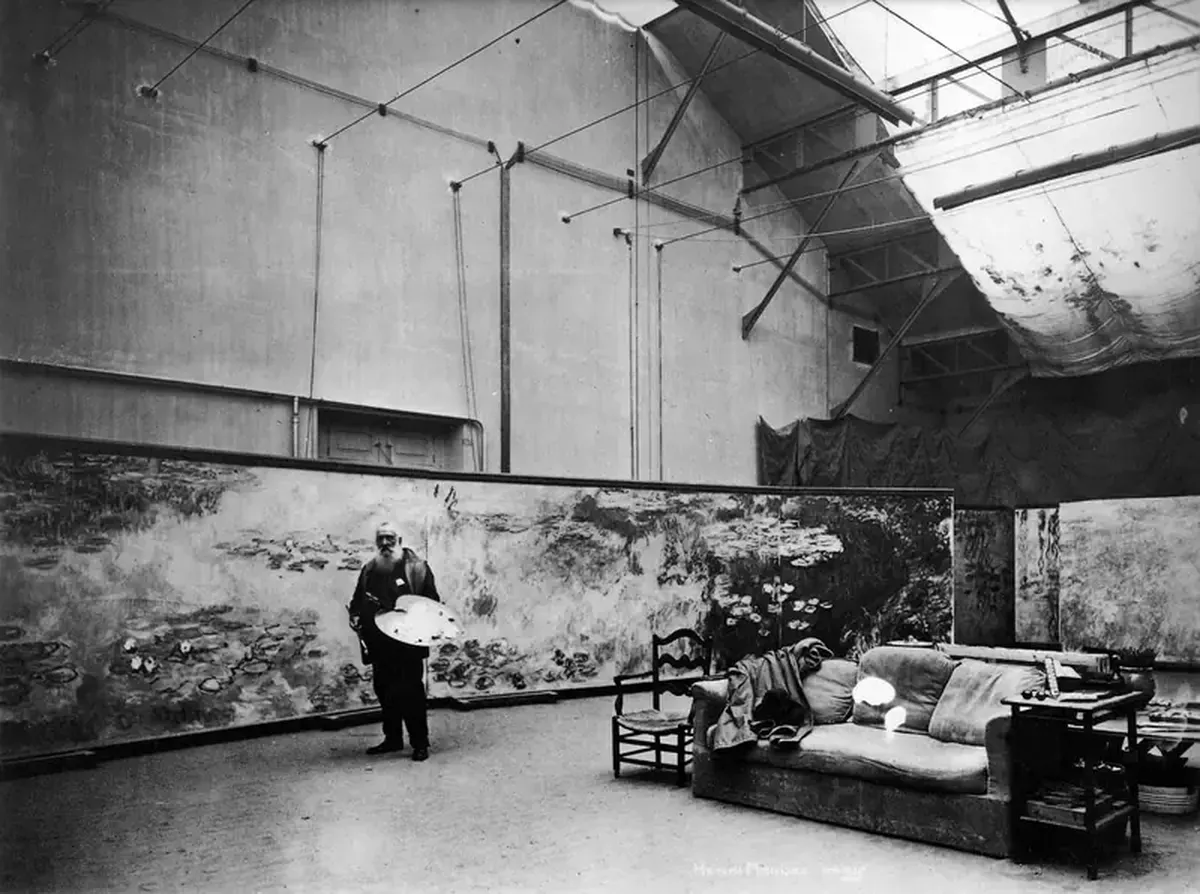
Monet in his studio, 1920.
A Unique Perspective
Few people know about quirks in Monet’s color perception. After suffering from cataracts he underwent eye surgery—two operations around 1912—which changed his vision and affected the colors in some of his late works. He also returned repeatedly to the same subjects, painting series that explored light and atmosphere through tiny variations. That habit began in 1877 with a series of 12 works of the Gare Saint-Lazare. Other series include The Haystacks (about 10 paintings), The Poplars (11 paintings), Rouen Cathedral (35 works), London (roughly 98 cityscapes in oil and 26 pastels), and Venice (28 paintings).

The artist in his garden.
No More Followers
Monet painted his last work at 84, two years before his death. He died of lung cancer on December 5, 1926, and was buried in the church cemetery in Giverny. His second wife, Alice Hoschedé—who had lived with him for 18 years and married him at 48 after helping care for his household and children—lies beside him, along with their sons and daughters-in-law. The collection of paintings inherited by his son Michel (from Monet’s first marriage to Camille Doncieux) was donated to the Musée Marmottan Monet shortly before Michel’s tragic death in a car accident in 1966, a few weeks before his 88th birthday. That gift became the largest collection of Monet’s works in the world. One of the paintings, “Water Lilies,” sold at Sotheby’s in 2015 for $54 million.
