
 Carlos Solis
An epitaph on the tombstone of the former slave Ankarenus Notus reads like a modern renter’s complaint. Scholars have nicknamed the inscription the “Tenant’s Lament.” It says: “My body knows no hunger… now it pays no rent or deposit and enjoys an eternal home for free.” For people who live in today’s megacities, those lines sound familiar.
Insula—An Island in the City
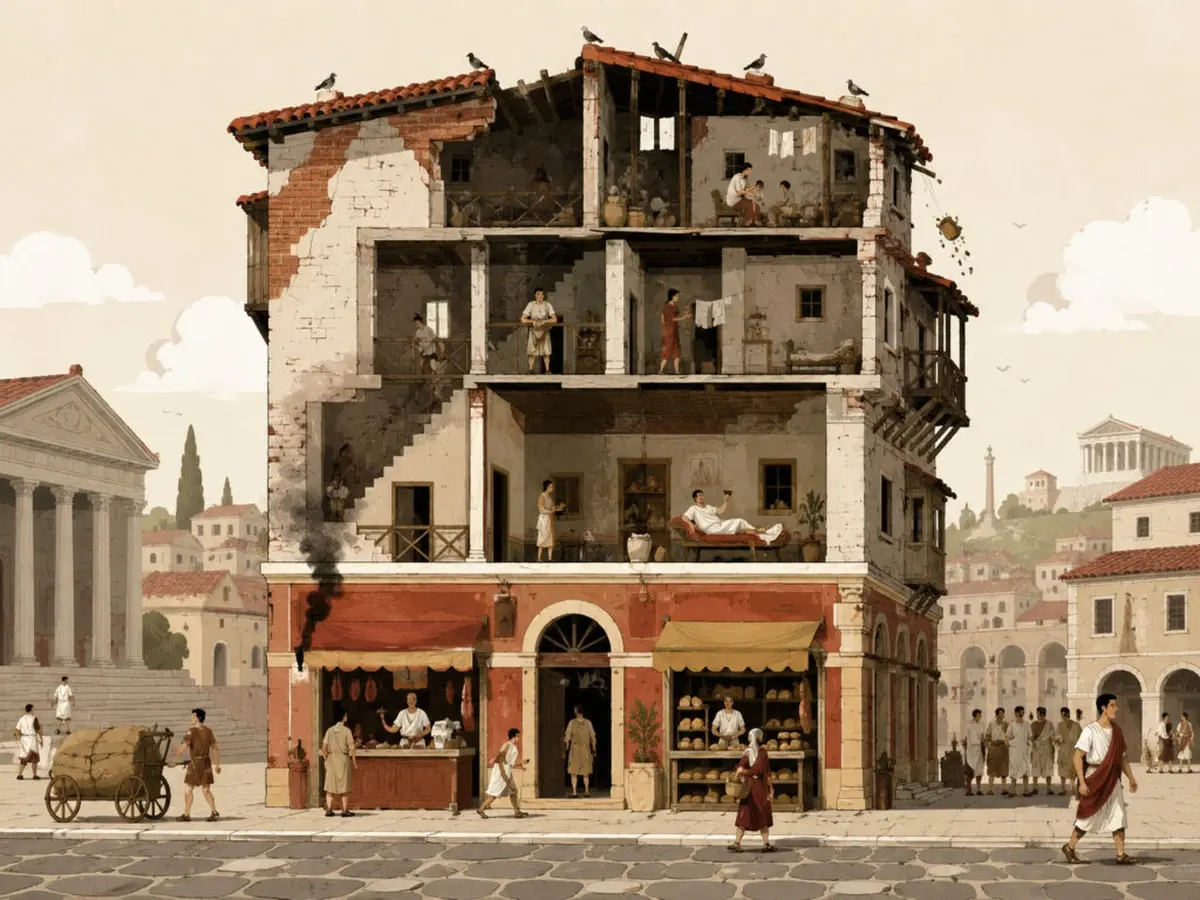
Insulae came in different shapes, but their basic layout looks familiar even now. Shops occupied the ground floors of insulae. Rented apartments sat above them. The higher you lived, the cheaper and usually the worse the space.
Most tenants lived in tiny single rooms called cellae, literally “small rooms” or “cells.” Families often shared those cramped spaces. Yet some insulae contained surprisingly roomy apartments with multiple rooms, internal courtyards, reception areas, and mosaics.
Rome had slums and luxury housing. The scale startled observers: in late antiquity, lists counted more than 44,000 insulae in Rome, while private houses numbered fewer than 2,000.
Villas dominate our image of Roman life, but multi-story mass housing housed ordinary Romans — a population that may have reached one million in the second century A.D.
Building Up Without Modern Technology
Rome faced a problem familiar to modern cities: more and more people kept arriving.
Migrants came for work, food, trade, and proximity to power. A stable monthly grain dole under Augustus made the city even more attractive. No European city matched Rome’s size until 19th-century London.
Faced with a flood of newcomers from across the empire, Romans logically began to build upward. Architect and urban planner Sten Al, in his book “Life on Earth: The Past and Future of the Places We Call Home,” cites Vitruvius: “Given the city’s present importance and its boundless population, it is necessary to endlessly increase the number of housing spaces.” That necessity pushed builders to raise structures skyward.
Cracked Walls, Smoke, and Stairs
Roman writers did not romanticize life in the insulae. Juvenal, the satirical poet who painted the city’s squalor, pictured Rome as nearly falling apart: “We live in a city propped up by temporary sheets and props, and so our landlords stop their buildings collapsing by patching large cracks in the gloomy fabric, reassuring residents that they can sleep peacefully while the structure really resembles a house of cards.”
Collapse risk was not the only danger. Fires plagued the city from its foundation in the 8th century B.C. onward. Stoves, oil lamps, wooden beams, crowding, and narrow streets made whole neighborhoods vulnerable. Vitruvius rejected wattle-and-daub walls because they caught fire easily.
Augustus created a Roman fire brigade partly because insula fires became a public problem. After the Great Fire of A.D. 64, authorities introduced reforms: wider streets, fire-resistant materials, gallery-like porches from which to fight blazes, and limits on building height. Later emperors tightened the rules further.
Archaeology tends to preserve sturdier constructions while the most fragile buildings disappear first, so Ostia sometimes paints a slightly rosier picture than city-center Rome.
Crowding and Filth—Life in an Insula
Life in an insula rarely meant privacy. Windows existed, but not like ours. Glass was expensive, so most openings had curtains or wooden shutters. Upper-floor apartments lacked running water. Without mechanical pumps to lift water, supply stayed at street level. Residents fetched water from public fountains or paid water carriers if they could.
Cooking at home was difficult and sometimes dangerous, so many Romans bought ready meals at thermopolia, the city’s hot-food stalls. People did their washing and bathing outside the home. Shops, taverns, shrines, baths, and apartments formed a single urban ecosystem.
Density made streets lively and filthy. Tenants used chamber pots. Some carried their waste downstairs; others dumped it out the window. Roman law recognized the danger and allowed victims to seek compensation when falling refuse caused harm. The legal action known as actio de deiectis vel effusis — a suit for things thrown or poured — aimed to protect passersby.
Plaintiffs did not have to prove who threw the waste. Since it was hard to tell from the street which window the liquid had come from, the law automatically held the property owner responsible, even if a guest or a slave had done the throwing.
Public latrines offered a communal alternative but not privacy. People sat side by side without partitions while water flushed waste away. They cleaned themselves with a shared sponge on a stick. Despite impressive aqueducts and sewers, Roman sanitation could still be unpleasant.
Noise added another layer: blacksmiths hammered metal, bakers shouted, wagons rumbled at night because daytime traffic faced restrictions, and children played in the streets.
A Problem Still Familiar
Romans invented mass housing because they had no alternative. Workers needed to live close to jobs, shops needed customers, and the state had to feed and control a large urban population.
The vertical fix proved economical, risky, and perhaps ahead of its time. Romans never fully solved the urban housing problem. No one has. They realized far earlier than most societies that a big city cannot survive on standalone houses alone.
Based on reporting from ZME Science

