
 Carlos Solis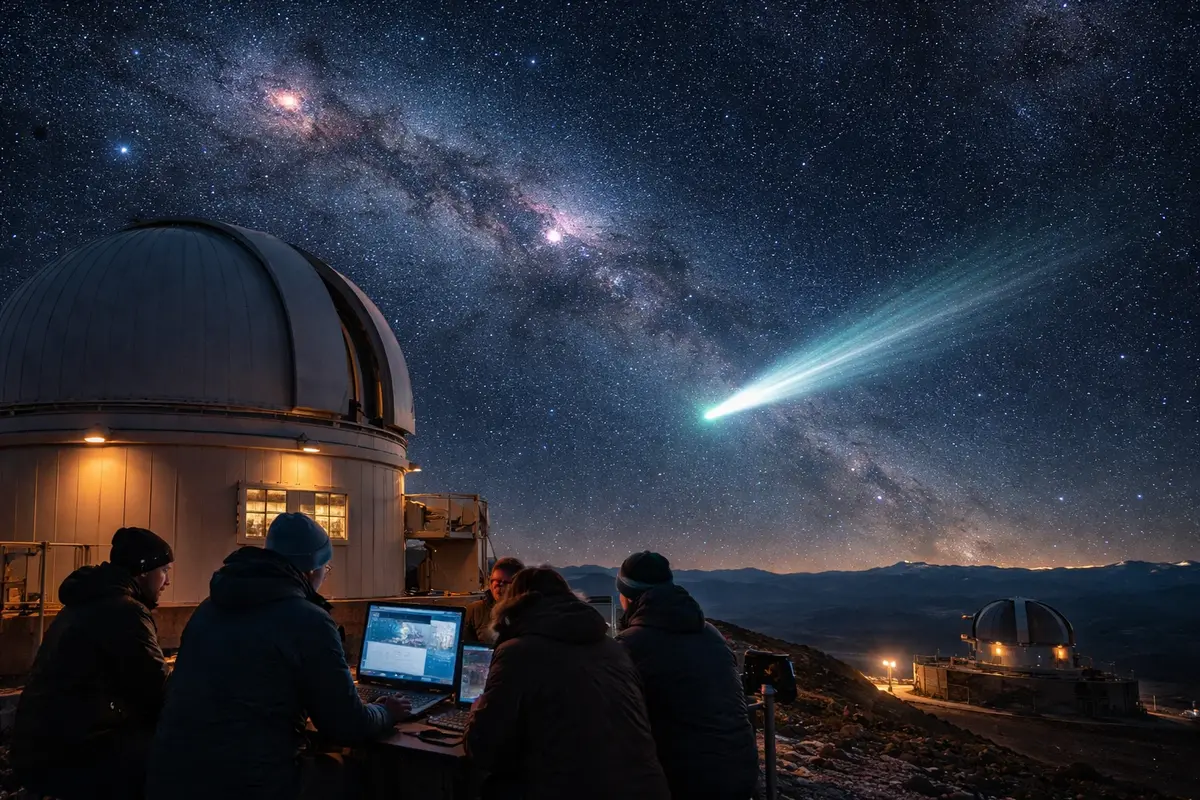
3I/Atlas, the interstellar comet that swept past last year, could be surprisingly ancient — possibly as old as 12 billion years. A new study published in Nature estimates the comet’s age at up to 12 billion years, compared with the Solar System’s roughly 4.5 billion-year age.
How researchers studied it — and what they found
Scientists used data from ALMA, the radio telescope in Chile, to analyze the comet. Their isotope measurements show that the comet’s chemistry differs from known bodies in the Solar System.
The most striking finding was a much higher abundance of deuterium, the heavy form of hydrogen. The researchers measured a roughly tenfold higher deuterium level in 3I/Atlas than in Solar System comets. In astrochemistry, such a high deuterium-to-hydrogen ratio forms only in extremely cold environments.
The isotope ratios point to a formation environment near −243°C, so the comet is likely one of the coldest objects ever observed in our Solar System.

NASA photograph of the interstellar comet 3I/Atlas
Where it came from — and how old it might be
Scientists do not yet know exactly where in the Galaxy 3I/Atlas formed. Researchers think interstellar objects form the same way comets do in our Solar System: material gets ejected during the violent process of planet formation. Unbound to any star, the comet likely traveled for billions of years on vast trajectories across the Milky Way.
The team also spotted a lack of the usual heavy-element enrichment, which suggests the comet formed relatively close to regions of active star formation. Martin Cordiner of NASA’s Goddard Space Flight Center, the study’s lead author, proposed that the comet could be a relic of an era astronomers call the “cosmic golden age,” when many stars formed roughly 10 billion years ago.
Cordiner said, “This may be the oldest object ever observed in our Solar System,” but he added that other, less likely scenarios could also explain the comet’s unusual chemistry.
Peter Veres, who helped discover the object at the Minor Planet Center of the International Astronomical Union, noted, “The comet is now leaving the Solar System and will never return, so further observations will become increasingly difficult.”
Despite periodic public speculation about alien technology — including from a few scientists — NASA did not endorse those ideas, and the Search for Extraterrestrial Intelligence (SETI) reported no evidence of alien hardware on the comet.
Astronomers expect to see more interstellar objects in the coming years, especially thanks to the new Vera C. Rubin Observatory in Chile. Cordiner said we’re only beginning to explore this field, and future discoveries should reveal much more about what these cosmic guests can tell us about the history of the Milky Way.
Based on material from The Guardian
