
 Carlos Solis
The incident happened on April 25, but NASA only shared the story now — Curiosity’s surprise unfolded over several days.
Curiosity encountered that surprise during routine work at the Atacama drill site.
Curiosity — the car-sized robotic rover — pushed its rotary-percussive drill into a rock to grind material into powder for detailed study. When the rover tried to pull the drill free, a 13-kilogram chunk of rock lifted up with it.

NASA said that in all of Curiosity’s time on Mars, nothing like this had ever happened before. (Reminder: the rover arrived at Gale Crater on Mars on August 5, 2012.)
“In the past, drilling caused cracking or splitting of the upper layers of rock, but no rock ever remained attached to the drill sleeve,” NASA said.
No matter how thoroughly engineers test on Earth, they can never predict every problem the rover will face on another planet hundreds of millions of miles away.
Even small differences in rock structure — tiny cracks, variations in hardness, or the way layers are bonded — can change how the rock behaves under stress.
On Earth, engineers can study those properties directly. On Mars, those properties often only reveal themselves the moment a drill first contacts the surface.
How Curiosity Was Freed
Fortunately, the chunk did not remain stuck to Curiosity’s manipulator permanently.
At first, the rover team tried using the drill’s vibration to shake the rock off, but that didn’t work.
On April 29, the team tried again, but the chunk wouldn’t budge.
Finally, on May 1 the Curiosity team tilted the drill more — rotating and vibrating it and also turning the bit, NASA said.
They were prepared to repeat the maneuver several times, but the rock fell to the ground and broke apart almost immediately.
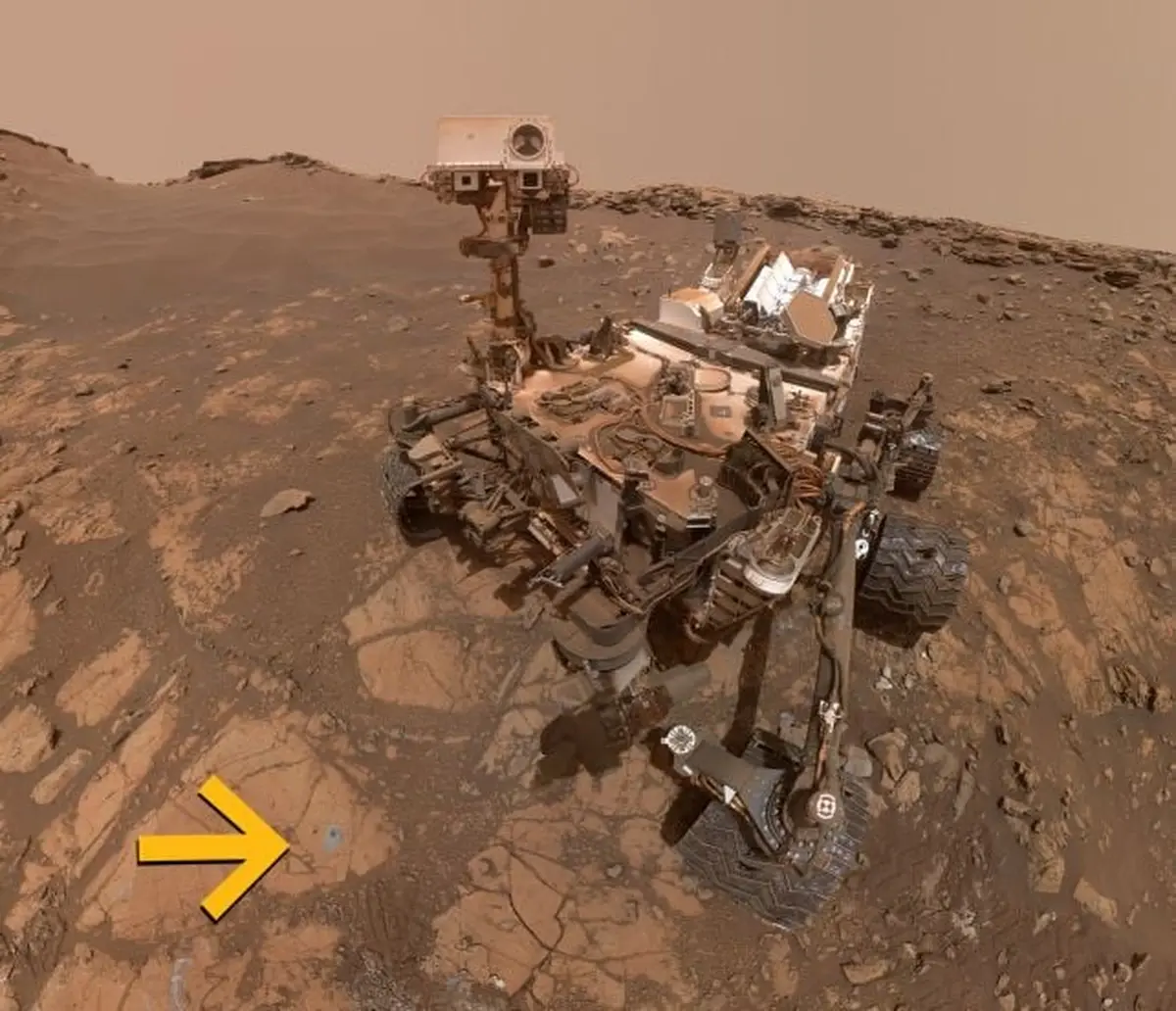
Selfie taken by Curiosity next to the hole it drilled in February 2020.
The Red Planet’s Tricky Surface
Since it arrived on the Red Planet, Curiosity has faced a rough relationship with Martian terrain. The rover has encountered a string of problems, including issues during drilling operations.
Trouble started back in 2015, when the percussion mechanism experienced short circuits. Later that year a foreign object interfered with the brakes’ operation.
Then, in November 2016, the feed of drilling fluid stopped because of the same brake problem. After the condition worsened through mid-2017, the team halted drilling indefinitely.
After extensive testing, NASA engineers developed a workaround, and drilling resumed in 2018.
Those drilling efforts eventually led to several notable discoveries. Among them was the detection of long-chain alkanes in Martian argillite, which NASA says are difficult to explain by known nonbiological processes.

42 holes that Curiosity had drilled by August 2024
How Curiosity Changed Our View of Mars
Curiosity’s mission was originally planned for just two years, but the rover’s productivity convinced the team on Earth to keep it operating.
Curiosity’s discoveries revolutionized our picture of the Red Planet — from the history of its watery environments and its geology to possible signs of ancient microbial life.
During its time on Mars, the Curiosity rover, among other achievements:
- It climbed Mount Sharp.
- It analyzed ancient lakebed deposits at the bottom of Gale Crater.
- It found preserved organic molecules in Martian rocks.
Although the rover is gradually wearing down, it still operates reliably and effectively. That continues largely because engineers on Earth skillfully solve the puzzles Mars throws at them.
Based on reporting by ScienceAlert and NASA
Photo: NASA

