
 Gaby
Gaby
Plautilla Nelli (1524–1588) has re-emerged in conversations about reviving the legacies of women artists who were unjustly forgotten—often sidelined in a male-dominated art world. Some critics argue the recent spotlight has gone too far, but that criticism doesn’t fit Nelli: she is widely regarded as an extraordinary Florentine phenomenon.
Her name resurfaced after the PBS documentary “Invisible Women: Forgotten Artists of Florence.” But was Mother Plautilla really invisible? She was abbess of one of Florence’s most influential convents, a popular religious painter mentioned in Giorgio Vasari’s Lives of the Most Excellent Painters, Sculptors, and Architects, and the first known female artist of the Renaissance in Florence.
She Was the First
We know little about her life. The basic facts: Pulisenna Margarita Nelli was born in the San Felice district of Florence to a wealthy family; her father, Piero de Luca, was a successful fabric merchant. The Nelli family belonged to Florence’s upper patrician class. A street called Via del Canto de’ Nelli still runs through the San Lorenzo area where their homes once stood. The family also funded the renovation of the sacristy of the Church of San Lorenzo.
Around 14 or 15—the typical age for brides in medieval Europe—she took monastic vows at the convent of St. Catherine of Siena in Piazza San Marco and took the name Sister Plautilla. She later became the abbess of that convent and died in 1588.
And that’s about it. We can only speculate why she entered the convent: she wasn’t a poor girl without a dowry, nor a noblewoman abandoned by relatives. A beautiful girl from a wealthy patrician family was usually seen as an investment, useful for forging business ties or political alliances in turbulent Florence.

Piazza San Marco in Florence
So it’s likely she went voluntarily. But why? Grief over a lost fiancé? A vow made during a serious illness? A youthful spiritual impulse? Or a refusal to be treated as the family’s asset?
How did her respectable family react? Did they forbid her or try to dissuade her? Or did they decide it would be useful to have someone in the convent praying for the family?
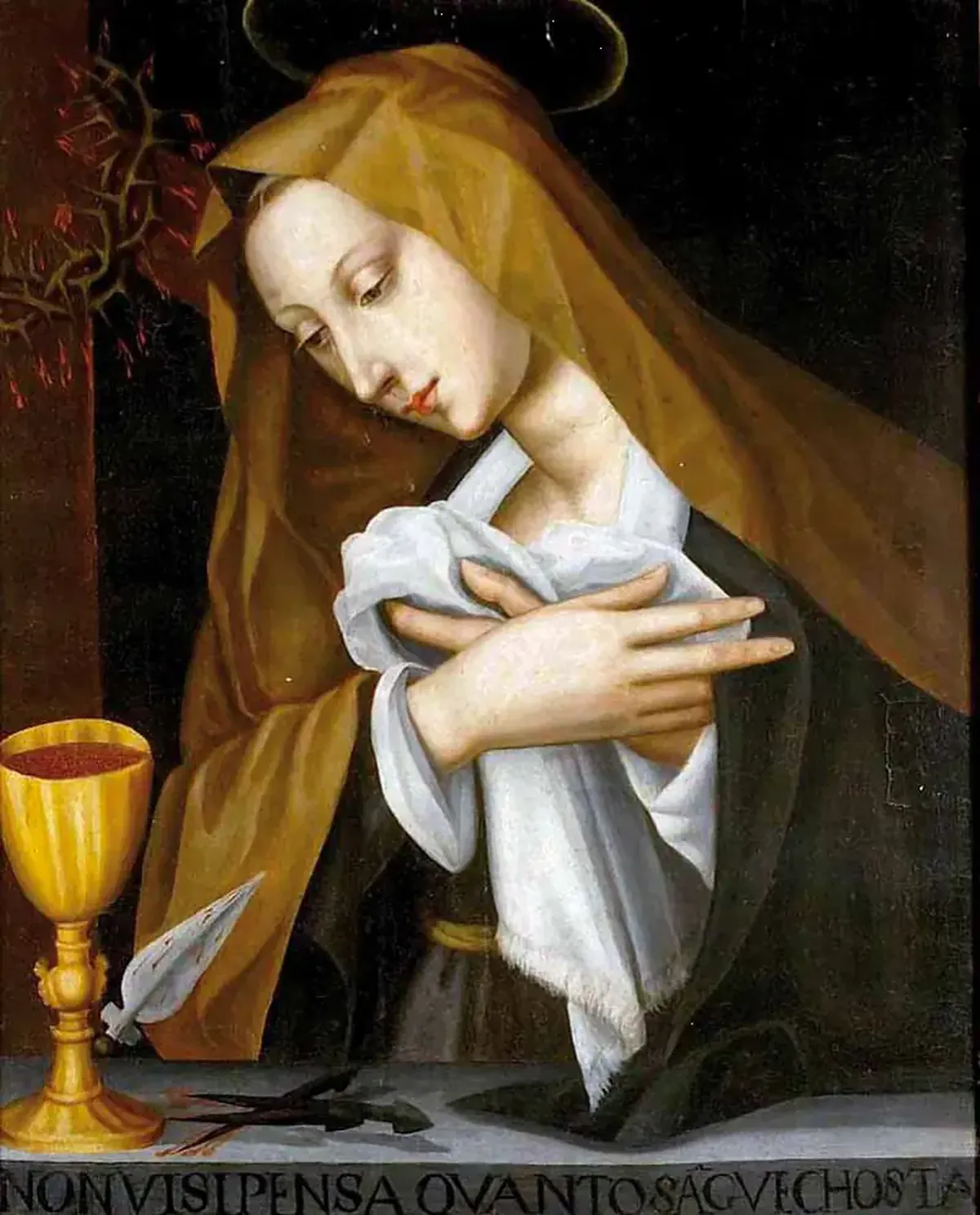
“The Suffering Madonna” by Plautilla Nelli
She must have been an extraordinary personality to pick up the brush. She painted large religious compositions at a time when nuns were generally allowed only to paint book miniatures. She must have been strong-willed and a capable manager to lead the convent. Perhaps she was devout and preferred the cloister to the secular life of Florence, where pagan imagery and worldly fashions circulated freely. Gossip even claimed that a Venus painting had been based on the duke’s latest mistress, and that the bishop looked the other way because the ruler was generous to the church.
The Brothers and Sisters of Savonarola
To understand religious life then, you have to know what the San Marco complex—the Church of St. Mark and the Convent of St. Catherine—meant for Florence.
Girolamo Savonarola (1452–1498) once headed the San Marco convent and was the de facto ruler of Florence from 1494 to 1498. Condemned by Rome as a heretic, he combined harsh political rule with intense religious zeal: a strict moralist, a powerful preacher, and a fanatical theologian. He fiercely criticized Rome while claiming absolute devotion to Catholicism, organized “bonfires of the vanities” to burn artworks, and promoted spiritual art. He enacted laws against blasphemers and “sodomites,” yet in his sermons he defended the rights of women and children, arguing that women who chose religious devotion had spiritual courage equal to men’s at a time when theologians debated whether women had souls.
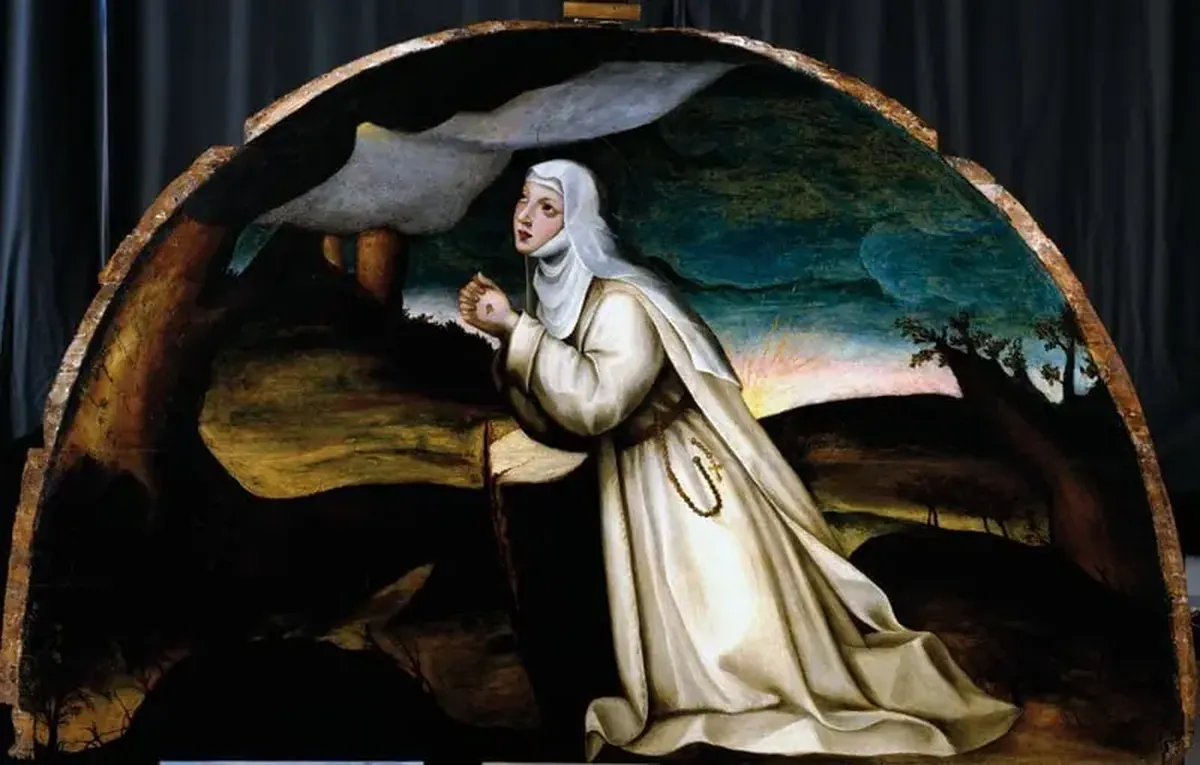
“St. Catherine Receives the Stigmata” by Plautilla Nelli
During Savonarola’s influence, Florence changed drastically: ladies stopped wearing jewelry, psalms replaced songs in the streets, and the wealthy donated large sums to the poor. At the same time, denunciations and brutal executions became more common. Like any utopia, Savonarola’s spiritual republic could not last: his movement ended under Rome’s condemnation and the return of the Medici—the heirs of Cosimo de’ Medici, patron of the humanists Savonarola despised as pagan.
Yet the spirit of Fra Girolamo lived on among his followers: the monks of San Marco, despite wearing Dominican robes, continued for a long time to act as the brothers and sisters of Savonarola.
The opposition between the free-thinking, humanistic Florence of the Medici and the austere, pious Florence of Savonarola—in all its tragic confrontations and interweaving—became a kind of Yin and Yang in Florentine, and later Italian, culture.
Santa Caterina San Marco – A Convent of Painting
Savonarola’s sermons on women’s equality, his calls for monastic diligence, and his promotion of spiritual art, combined with Mother Plautilla’s creative energy and organizational talent, turned the Santa Caterina convent into a large artistic workshop. The nuns’ works became popular with the Florentine nobility, as Giorgio Vasari noted. Wealthy patrons might admire Flora and Venus in private chambers, but on family altars they preferred the naive, touching images painted by the Sisters of St. Catherine.

St. Catherine of Siena
While St. Catherine of Bologna defended the right of women in monasteries to hold brushes even for book miniatures, Plautilla Nelli and her students showed they could create full-scale religious paintings and complex, large compositions.
The abbess herself painted one of the largest canvases of the era: a seven-meter “Last Supper” that became a hallmark of quality and placed her alongside masters such as Leonardo da Vinci, Andrea del Sarto, Domenico Ghirlandaio, and Alessandro Allori. Another major work, “The Lamentation with Saints,” has been the subject of a documentary dedicated to its restoration and study.
By the way, “The Last Supper” is the only painting she signed; on her other works she wrote “prega per l’artista” (“pray for the artist”). She did not sign as “Sister” or “abbess,” but as “the artist.” That choice is telling.
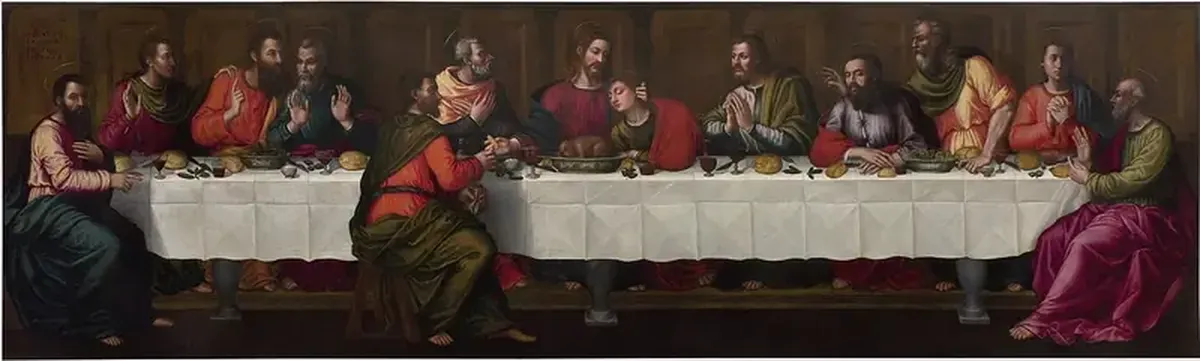
“The Last Supper” by Plautilla Nelli
Myths and Principles of Mother Plautilla
Some myths about Plautilla Nelli don’t hold up. One is that she was self-taught. Vasari wrote that Nelli “had little practice in her art” and suggested she learned from copying the works of Fra Bartolomeo and from treatises by later painters. Fra Bartolomeo left many drawings at the Santa Caterina convent, which the nuns could study.

“The Lamentation of Christ”
Anyone who’s spent time in an art studio knows you can’t reach that level by merely copying and reading theory. Nelli’s work shows evidence of a solid artistic education, however rudimentary. At that time such training would most likely come from being the daughter of an artist or from a progressive humanist family that did not see painting as exclusively male. Perhaps Plautilla’s father was such a figure and later turned fervently religious—in that case, both her training and her religious life would fit together.
Another persistent myth says Nelli couldn’t paint men and that her male figures look “feminine” from lack of anatomical study. But compare her “Last Supper” with Leonardo’s: it is Leonardo’s apostles who often seem bodiless and uncertain, while Nelli’s apostles appear corporeal and muscular. Fra Bartolomeo left wooden models at the monastery that the nuns could use to study anatomy.
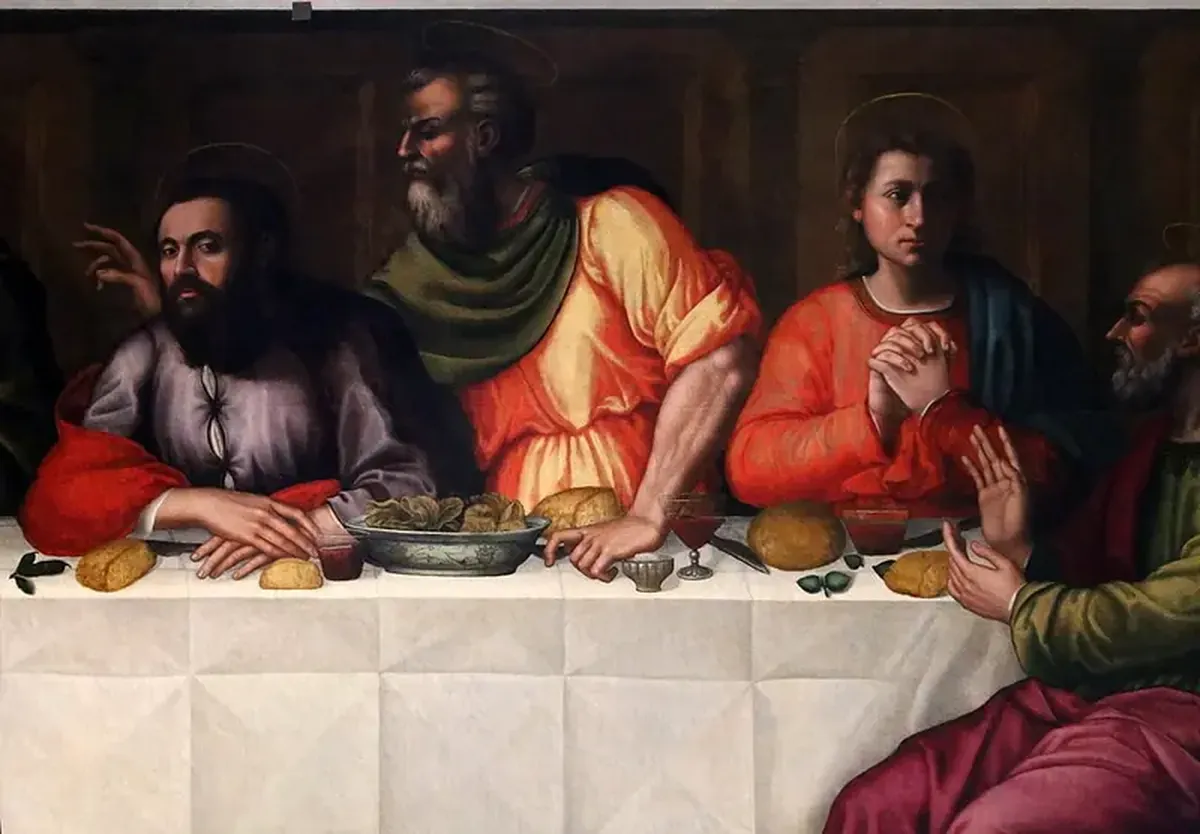
Male figures in Plautilla Nelli’s “The Last Supper”
Critics have labeled her style old-fashioned or medieval, treating it as a mark of secondary status. But that style, shared with her teachers and students, may have been a deliberate rejection of the high Raphaelesque Renaissance, which Savonarola’s followers saw as too worldly. Amid the wave of Raphaelism, they upheld Quattrocento ideals—a harmony of tradition, spirit, and flesh in the service of faith.

St. Dominic Receives the Rosary
Centuries later, each party found its place in history: the Nelli family in prayers and remembrance, Savonarola and the Medici as chapters in the textbook. Each loved Florence in their own way. And the humble nun of Santa Caterina became an unlikely banner for women’s creative ambition—a legacy that still resonates.
