
 Gaby
Gaby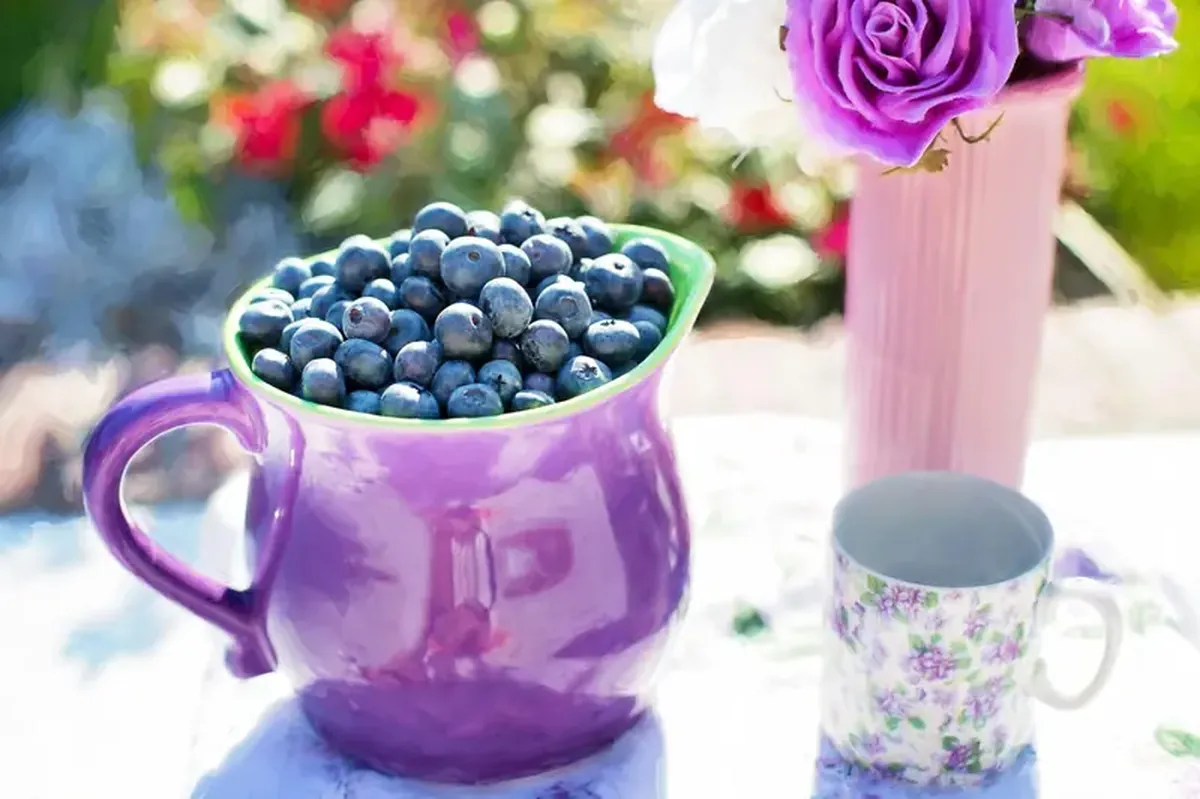
A team at the University of Bristol uncovered why blueberries look blue even though their skin contains a dark red pigment. Their findings also help explain the coloring of other fruits, including prunes, sloe berries, and juniper.
The blue color comes from tiny structures in the berries’ waxy coating.
What the Scientists Explained
The color results from how chaotically arranged crystalline structures in the waxy coating interact with light.
Even though blueberry skins contain a dark red pigment, a waxy surface layer gives them their blue hue. That wax contains tiny structures that scatter blue and ultraviolet light. That’s why the berries look blue to humans and some birds.
“The blue color of blueberries cannot be ‘extracted’ by crushing them, as it is not present in the pigmented juice you can squeeze from the fruit. That’s why we hoped there was something unusual about this color,” said Dr. Rox Middleton, a research fellow at the Bristol School of Biological Sciences.
To investigate further, the scientists removed the wax and recrystallized it on cardboard, creating an entirely new blue UV coating in the process. They noted that embedding the full functionality of this natural wax into synthetic materials remains a dream.

“It was truly fascinating to discover an unknown coloring mechanism right under our noses in fruits that we grow and eat regularly. Even more interesting was reproducing this color by collecting the wax and creating a new blue coating that no one had seen before,” Dr. Rox Middleton said of the experiment’s results.
This colored layer is incredibly thin — about two microns thick. It produces a striking blue color and effectively reflects UV radiation, which could open the door to new dyeing methods.
As Dr. Middleton pointed out, nature has evolved a clever trick: an ultra-thin layer that produces a vivid dye.
Most plants are covered with a thin layer of wax that serves multiple functions, many of which scientists still don’t fully understand. These coatings can be very effective for self-cleaning and water retention.
Until recently, the team didn’t realize how crucial the coating’s structure is to the berries’ visible color. Now the researchers plan to explore ways to reproduce and apply that coating. That could lead to sustainable, biocompatible — even edible — paints that reflect ultraviolet and blue light.
The findings of the study were published in the journal Science Advances.
