
 Gaby
GabyA team of researchers from the Massachusetts Institute of Technology has developed an AI tool that restores time-damaged paintings in just a few hours. The technology has significantly reduced the time and cost of restoring works of art.
How does it work?
Time leaves its mark on paintings. Wear and natural aging change the colors and cause cracks and stains. It can take years for restorers to fix the damage. Therefore, they usually focus their efforts on the most valuable paintings.
But now a new technology will help expand the range of paintings that need restoration. It uses artificial intelligence and other computer tools for the digital reconstruction of damaged works. During the restoration process, a digital “mask” is created: the image is printed on a transparent polymer sheet and carefully placed over the painting.
To demonstrate the method, lead researcher Alex Kachkin restored a damaged 15th-century work attributed to one of the lesser-known Dutch painters. The extremely detailed piece was divided into four strips.
The painting showed numerous tiny cracks. In many places, the paint had flaked off. The team said a significant portion of the damage was concentrated on small, intricate details. Traditional restoration of the canvas would have taken about 200 hours, The Guardian reported.
The team began the restoration by scanning the painting to determine the size, shape, and location of the damaged areas. A total of 5,612 individual sections were identified that required restoration.
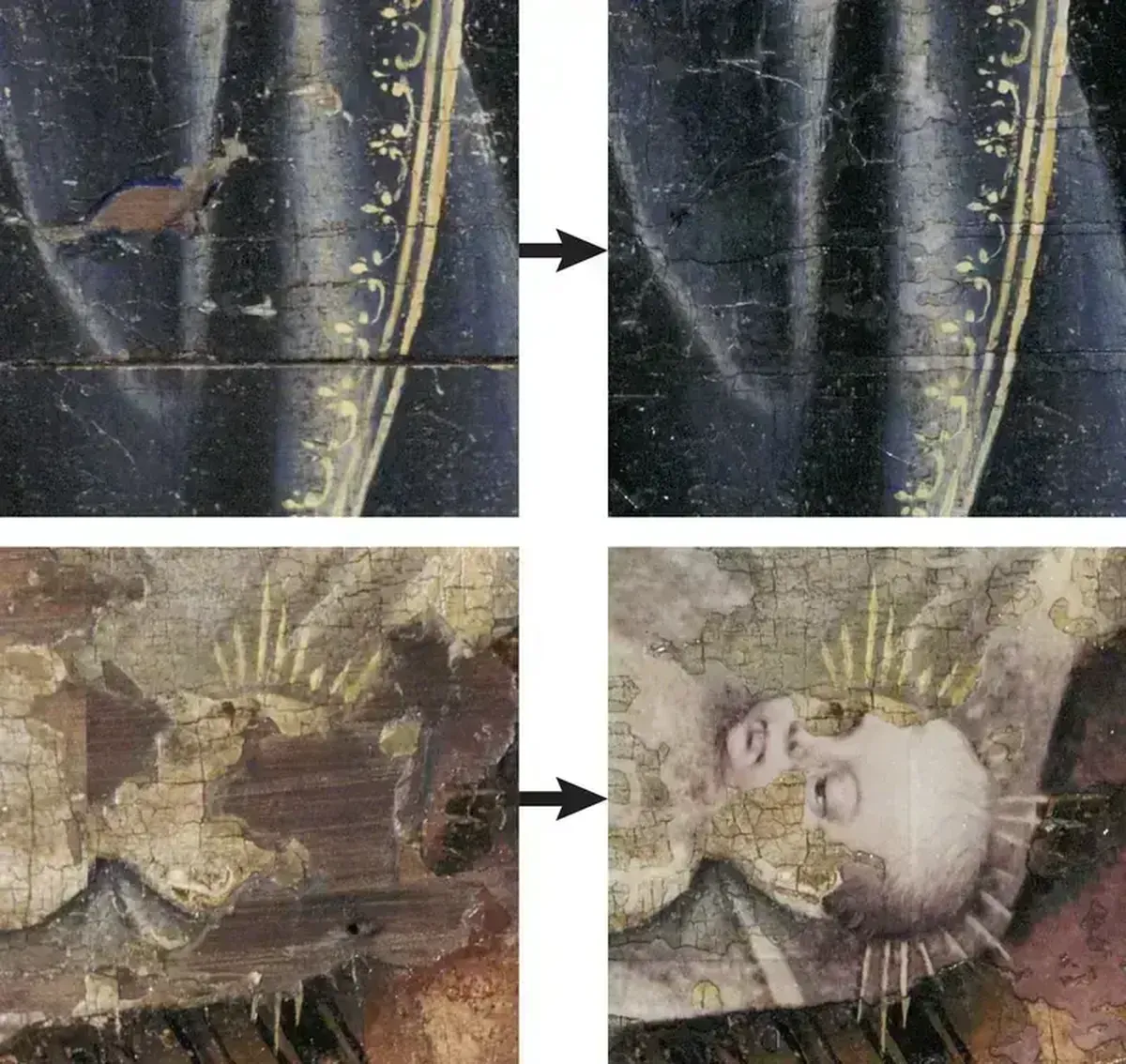
Then the researchers created a digital “mask” in Adobe Photoshop. Initially, the team restored the missing paint spots by carefully selecting shades. They recreated patterned areas that had suffered from time by copying similar patterns from other parts of the painting. The baby’s erased face was copied from another canvas by the same artist.
After completing the work, the “mask” was printed on polymer film, coated with varnish to prevent the paints from smudging, and applied to the painting. In total, the team used 57,314 colors to fill in the damaged areas.
The process took 3.5 hours, about 66 times faster than traditional restoration.
The team said this AI-based technique can only be used on lacquered surfaces that are smooth enough for the film to adhere to. The “mask” can be removed using special solvents employed by restorers, leaving no traces on the artwork.
The team hopes this method will let galleries restore and exhibit dozens of damaged paintings that aren’t considered valuable enough to justify costly traditional restoration.
The results of the study were published in the journal Nature. In a related article, Professor Hartmut Kutzke from the Museum of Cultural History at the University of Oslo said this AI-based technology can restore damaged paintings faster and more cheaply than traditional methods.
He said the method is likely to be widely applied to lower-value paintings. These works often get little attention and have collected dust for decades in museum storage. After this kind of restoration, more art enthusiasts will be able to see them.
