
 Carlos Solis
 A team of researchers from Francisco Marroquín University in Guatemala has examined three samples of jade-inlaid teeth from the ancient Maya. The researchers discovered that this dental decoration was not just for adults.
In pre-Columbian Maya society, dental accessories were highly prized. During the Classic and Postclassic periods (250–1550 AD), people typically adorned their teeth with decorative inlays, fillings, and engravings. To achieve the desired effect, dentists used stone tools to carve cavities in the teeth. They then placed a polished gemstone or mineral, such as obsidian, into the cavity and sealed it with organic cement.
Previously, archaeologists had found such decorated teeth on adults and teenagers, as reported by Popular Science. However, in this new study, the researchers analyzed three jade-inlaid teeth that, it turned out, belonged to children. The team suggested these might be among the youngest known bearers of the practice.
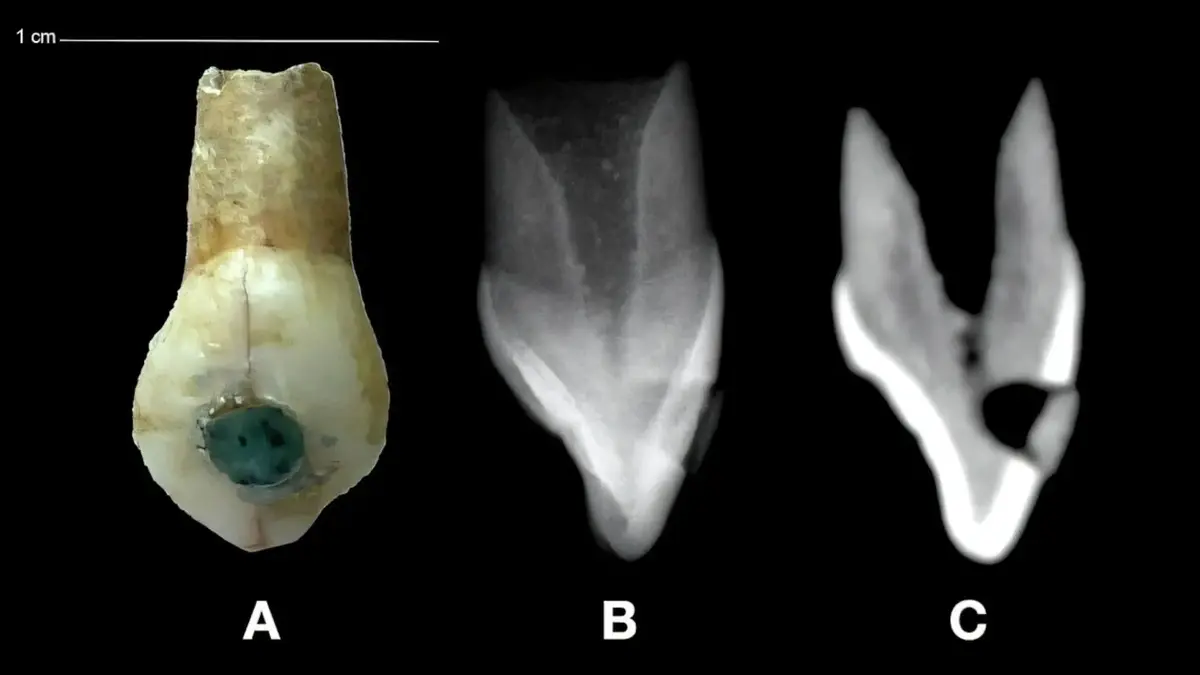
Until now, the only known dental inlay on a child had been discovered in Belize. Experts concluded that the inlay was placed posthumously as part of burial goods. Reflecting on that example, bioarchaeologist Andrea Cucina, a co-author of the study, suggested the recent findings might reflect a different practice. It’s possible jade inlays signified a child’s transition into a more adult life.
“Given the lack of archaeological data on tooth inlaying in young children in Mesoamerica — tooth decoration typically began around age 15 — I believe we are looking at a local or regional tradition,” Cucina said.
Cucina’s hypothesis is supported by the fact that remains of pre-adolescent Maya are rare in the archaeological record. According to the authors of the study, the teeth came from several children. One child may have died at 9 or 10, while another tooth came from a child aged 8–9; however, the team leans toward the idea that the three teeth belonged to three different children.
The analyzed samples showed variations in the skill of the ancient dentists. The most precise work appears on the left lateral incisor, where the craftsman cut a cavity confined to the enamel. Meanwhile, the cavity in the left central incisor of the upper jaw penetrated deeper — into the dentin layer — though it did not reach the pulp chamber.
So far, the social context behind these children’s teeth remains an archaeological mystery. Researchers hope to fill that gap in knowledge.
The findings of the study were published in the Journal of Archaeological Science: Reports.
Photo: Unsplash
