
 Gaby
Gaby
A team from the University of York argues that the mask’s pierced ears suggest it was meant for a woman or a high-status child. They say it might even have been intended for Queen Nefertiti, Tutankhamun’s stepmother, whose burial has never been found.
The team suggests Tutankhamun’s sudden death at 18 may have forced burial workers to adapt a mask that wasn’t originally made for him.
Professor Joanne Fletcher pointed out that the mask doesn’t match an adult male pharaoh and that it’s made from a different gold than other artifacts linked to Tutankhamun.
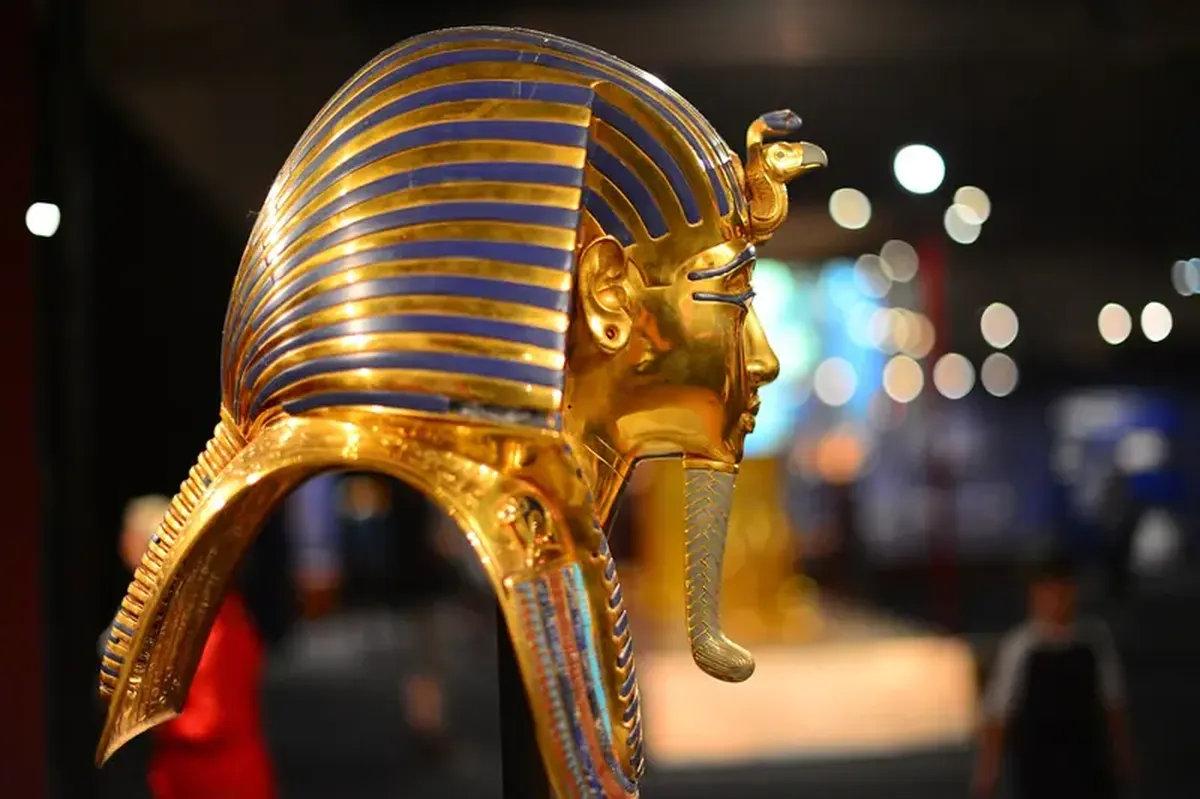
Her team reached these conclusions after re-examining records from the 1922 excavation. Fletcher was struck by a document that described the mask as having “clearly pierced ears.” Pharaohs did wear earrings, but funerary masks typically did not have pierced ears.
The idea that the mask wasn’t meant for Tutankhamun was first proposed in 2015 by Egyptologist Nicholas Reeves. He believes the golden artifact was made for Queen Nefertiti, the young pharaoh’s stepmother, whose tomb has not yet been found.

In 1922, British archaeologist Howard Carter discovered the mask in Tutankhamun’s lavish tomb in the Valley of the Kings on the Nile’s west bank. Archaeologists were surprised to find the burial site much smaller than expected for a pharaoh’s tomb. The mask featured a wide collar of semi-precious stones and colorful beads, and a false golden beard was attached to it.
Ancient Egyptians made funerary masks for both pharaohs and commoners. Pharaohs’ masks were crafted from gold or silver, while masks for ordinary people were made from wood or clay. The Egyptians believed these masks helped the deceased’s soul return to the body so it could be judged by the god Anubis.
Famous pharaohs like Amenhotep III and Ramses II were also buried with funerary masks. Their masks did not have pierced ears, the Daily Mail reported.
Professor Fletcher suggested the pierced ears are another sign the burial was rushed. Paint on the walls of Tutankhamun’s tomb hadn’t even dried before the chamber was sealed.
Tutankhamun became pharaoh at about nine years old and ruled from 1332 to 1323 BC. Scholars believe his health problems were linked to close inbreeding: his father, Akhenaten, and Akhenaten’s sister were closely related and produced Tutankhamun.
Researchers say Tutankhamun likely had a clubfoot, a cleft palate, bone disease, and scoliosis. Some experts suspect he was murdered; others attribute his premature death to those health issues.
