
 Gaby
Gaby
Beneath the Mediterranean lies Heracleion, a sunken Egyptian city lost for more than a thousand years and often compared to the legend of Atlantis.
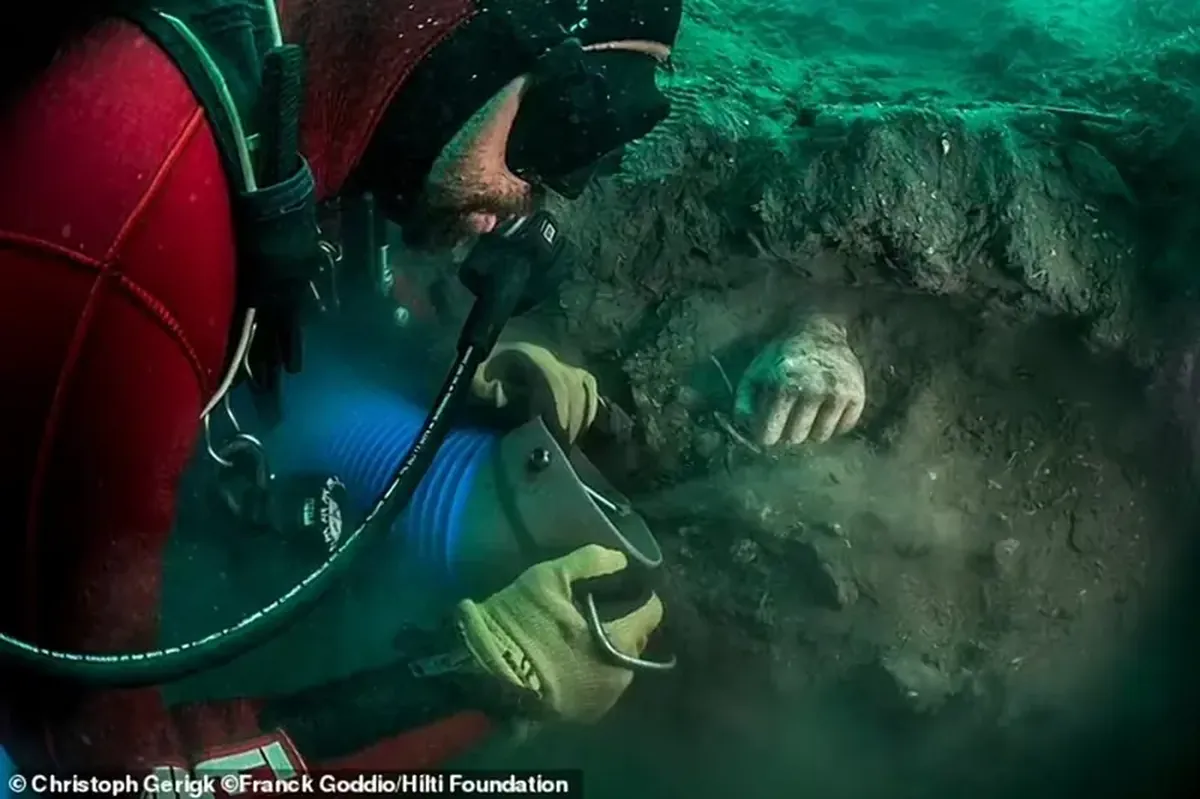
Among the recent discoveries shared by French marine archaeologist Franck Goddio are gold jewelry, silver vessels, and a peculiar bronze container shaped like a duck. The Franco-Egyptian search team led by Franck Goddio also uncovered a lapis-lazuli djed pillar — an upright symbol of stability decorated with Egyptian hieroglyphs. To top off the haul, archaeologists found a “creepy” ceramic hand sticking out of the sediment.
Background You Should Know
For centuries, Heracleion was Egypt’s largest Mediterranean port until Alexander the Great founded Alexandria in 331 B.C.
Scholars have often called Heracleion Egypt’s version of Atlantis, even though opinions about the mythical island-state varied.
Heracleion, however, was real. It was established around the 8th century B.C. and became a mandatory port for ships arriving from the Greek world to Egypt. Over time, the city suffered repeated earthquakes and tsunamis. After another quake, it sank into the Mediterranean, most likely in the 8th century A.D. The ruins now sit underwater about 7 kilometers off Egypt’s coast, according to the Daily Mail.
Franck Goddio rediscovered Heracleion in 2000 and described his initial finds as “precious” and “moving.” Now, new geophysical exploration technologies have helped his team uncover cavities and previously unknown objects buried beneath several meters of clay.

What Goddio’s Team Unearthed
Recent excavations in July focused on the southern canal of the lost city. The archaeologists concentrated on the remains of a large temple dedicated to the Egyptian air god Amun.
Goddio says the massive stone blocks of the temple collapsed during a catastrophic event dated to the mid-2nd century B.C.
At the temple site, the team found silver ritual tools, gold jewelry, and delicate alabaster containers likely used for perfumes.
Two ritual vessels for libations to the gods were made of silver, a metal considered extremely valuable in ancient Egypt.

To the east of the Temple of Amun, the team also discovered a Greek sanctuary dedicated to Aphrodite, the ancient Greek goddess of love and beauty. There, archaeologists found imported bronze and ceramic items, including a 4th-century B.C. bronze vessel shaped like a duck, resting among ceramic pots. It may have been used for pouring wine.
These artifacts support the idea that Greeks — who were allowed to trade and settle in the city during the Saite dynasty in the 7th–6th centuries B.C. — built their own sanctuaries in Heracleion.
Previous finds from Heracleion, such as statues of pharaohs and deities, were once exhibited at the British Museum in London.
