
 Gaby
Gaby
Italian papyrologist Graziano Ranocchia from the University of Pisa has announced that he and his team have discovered the long-lost burial site of the famous Greek philosopher Plato.
To do this, the researchers deciphered the charred Herculaneum scrolls. This task had eluded scholars since 1752, when workers first uncovered the scrolls at a villa near the Bay of Naples. The villa was thought to have belonged to Julius Caesar’s father-in-law. The papyri were too fragile to be unrolled.
Their contents have only now come to light, thanks to Ranocchia and his team’s use of artificial intelligence.
Herculaneum is an ancient Roman city in the Campania region. Like Pompeii and Stabiae, it was buried under pyroclastic flows during Mount Vesuvius’s eruption in 79 AD.
What the team found
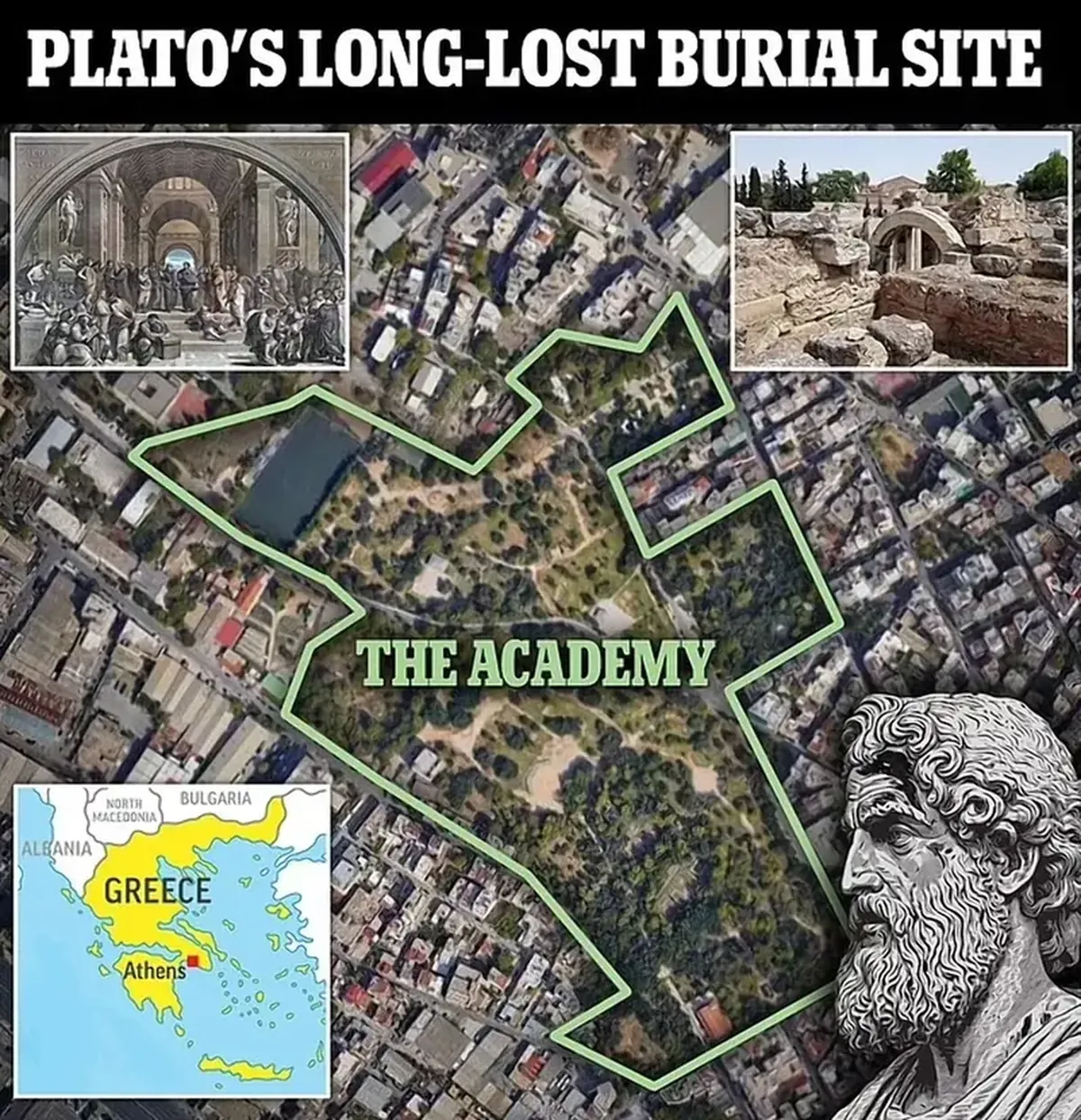
Until recently, scholars only knew that Plato, who died around 347 BC, was buried at the Academy in Athens. That institution was founded by Plato in 387 BC.
In the scrolls, researchers found information indicating that Plato’s grave was located in a garden near the Mouseion — a small building dedicated to the Muses.
A few years ago, Ranocchia and his colleagues set up a laboratory at the National Library of Naples, which gave them access to more than 1,800 Herculaneum scrolls housed there.
Recently, the team used artificial intelligence tools to help decipher the ancient documents. The researchers took hundreds of images of the burnt papyrus and then analyzed them with an algorithm. According to Science.org, they used infrared imaging, which let them read text on both the front and back of the scroll.

Overall, Ranocchia and his team read approximately 1,000 words using “bionic eyes,” which corresponds to about 30 percent of the scroll. The team hopes to read the entire scroll by 2026.
“Compared to previous editions, the text has changed almost radically, revealing a number of new and specific facts about various academic philosophers,” Ranocchia said. “Among the most significant news, we read that Plato was buried in a designated garden of the Academy in Athens, near the Mouseion or sanctuary dedicated to the Muses. Until now, it was only known that he was buried at the Academy.”
Plato is regarded as one of the greatest Greek philosophers. Along with his mentor Socrates and his student Aristotle, he laid the foundations of Western philosophy and science, as reported by the Daily Mail.
The Academy stood on the outskirts of Athens, on land Plato bought in 387 BC. It is recognized as the first institution of higher learning in ancient Greece.
According to the new analysis of the scrolls, Plato may have been sold into slavery in 399 BC, after Socrates’ death, or in 404 BC during the Spartan conquest of the island of Aegina.
“It was previously believed that Plato was sold into slavery in 387 BC while he was in Sicily at the court of Dionysius I of Syracuse,” Ranocchia said.
