
 Carlos Solis
This discovery challenges current models of galaxy formation during the early stages of the Universe. By combining observations from the ALMA radio telescope in Chile’s Atacama Desert and the James Webb Space Telescope (JWST), the team gained a clearer view of the galaxy dubbed “Cosmic Grapes.” They identified about 15 massive clusters of star formation inside a single rotating disk.
This galaxy formed just 930 million years after the Big Bang. Previous observations from the Hubble Space Telescope depicted “Cosmic Grapes” as a typical galaxy with a smooth stellar disk. But new, deep, high-resolution observations from JWST and ALMA revealed that the galaxy actually consists of numerous compact star clusters embedded within a smooth, rotating gas disk.
Studying galaxies from the early Universe has been difficult because of observational limits, as Popular Science reported. Even the Hubble Space Telescope showed “Cosmic Grapes” as a homogeneous, disk-like structure. Now, astronomers have witnessed a very different sight.
A report from the National Radio Astronomy Observatory said the structure of “Cosmic Grapes” was “perfectly magnified by a foreground cluster of galaxies through gravitational lensing.” After about 100 hours of high-quality observing time, the team reported that this is one of the most thoroughly studied galaxies from the early Universe.
Instead of the single disk seen in Hubble’s images, JWST and ALMA — which offer orders-of-magnitude higher resolution — showed a rotating galaxy dotted with gigantic, clumpy star-forming regions that look like a bunch of grapes.
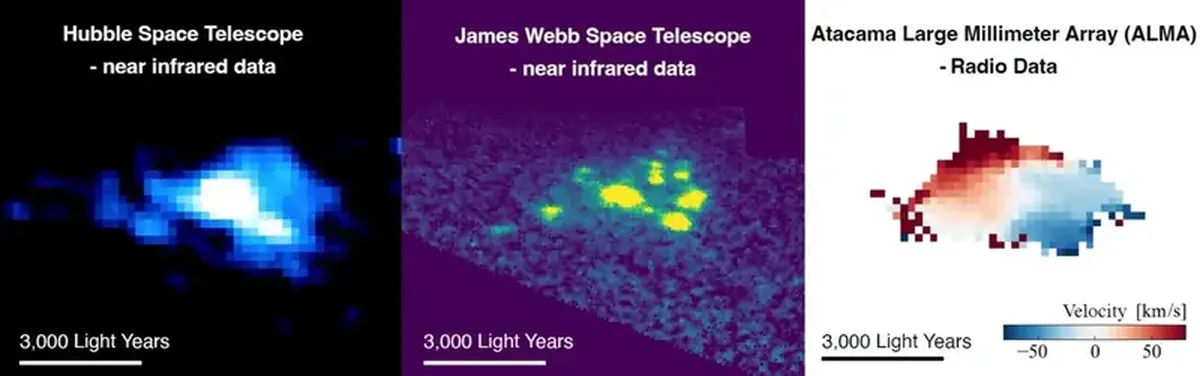
This is the first time astronomers have successfully linked smaller internal structures of an early galaxy to that galaxy’s overall rotation.
The team emphasized that “Cosmic Grapes” is not an unusual or extreme example based on current measures of star formation, mass, chemical composition, and size. Instead, the galaxy fits within the expected population of young galaxies. That raises the possibility that many galaxies from that era—previously thought to be smooth—may actually be clumpy and dynamically active, a detail JWST and ALMA can reveal.
The study’s authors wrote that the discovery suggests “understanding the processes of feedback and structure formation in young galaxies may require significant revision.”
The results of the study were published in the journal Nature Astronomy.
Photo: NSF / AUI / NSF NRAO / B. Saxton
