
 Carlos Solis
A team of paleontologists led by Professor Nicholas Longrich of the University of Bath (UK) focused their new study on the tibia of a giant tyrannosaur. Researchers found the bone in the 1980s in New Mexico’s Kirtland Formation, which dates to the late Cretaceous period (about 75–73 million years ago).
The bone is roughly 74 million years old, placing the tyrannosaur in the late Campanian, ScienceAlert reported. That means this predator roamed the Earth long before most later tyrannosaurs, which lived closer to the end of the age of dinosaurs.
What made this giant tyrannosaur stand out?
The tibia under study measures about 84 percent of the length and 78 percent of the width of Sue’s tibia. Sue, the most famous T. rex specimen, measured 12.3 meters. Sue’s nearly complete skeleton was found in South Dakota. Only the Canadian tyrannosaur nicknamed Scotty, at about 13 meters, is known to have been larger than Sue.
By estimating the bone’s dimensions, the team determined the prehistoric predator’s weight at roughly 5.2 tonnes. That makes it the largest tyrannosaur known from its era, though it wouldn’t match some later, better-known tyrannosaurs in overall mass and size.
Beyond its size, the fossil matters for questions about where tyrannosaurs originated. Some paleontologists argue the group arose in Asia. Others say their homeland was the ancient continent Laramidia, which existed from about 86 to 72 million years ago and later became the western portion of North America.
“Here we describe a giant tyrannosaur roughly 74 million years old from the late Campanian of New Mexico. This is the oldest known giant tyrannosaur from North America,” the scientists wrote in their report.
The team dated the fossil using argon isotopes preserved in the volcanic ash that buried it millions of years ago, in a layer known as Hunter Wash.
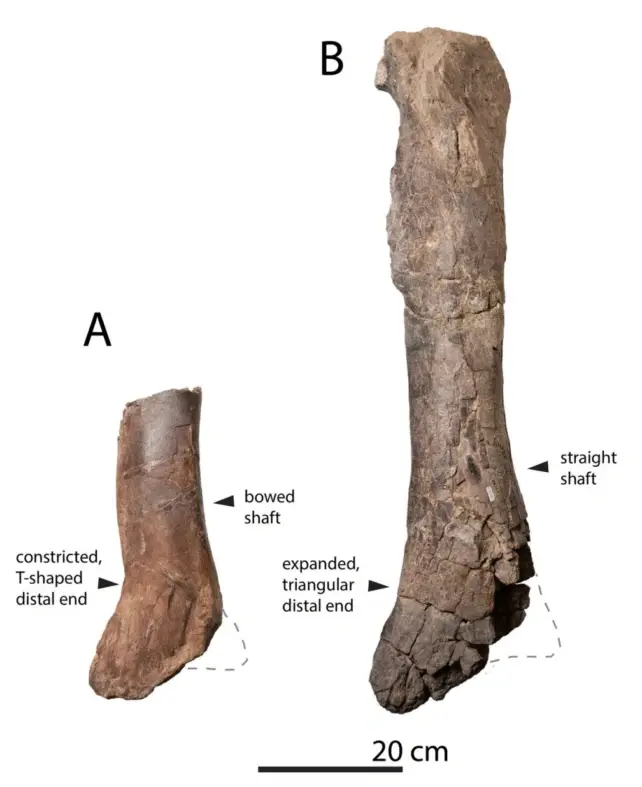
The fossil’s exact place on the tyrannosaur family tree remains unclear because researchers have only a single tibia. While a lone bone isn’t as informative as a complete skeleton or DNA, the team can still learn a lot from its size and features.
The tibia is massive and straight, ending in a broad triangular shape. That terminal feature is absent in Bistahieversor, another tyrannosaurid that lived in the same region and at the same time.
The unusual size of the Hunter Wash tyrannosaur suggests a previously unknown coexistence of large tyrannosaurids in the late Campanian and indicates these giants evolved earlier than previously thought.
To pin down the animal’s full size and evolutionary relationships, paleontologists need additional remains—isolated teeth or bones, ideally found together and associated with one another.
The results of the study were published in the journal Scientific Reports.
