
 Gaby
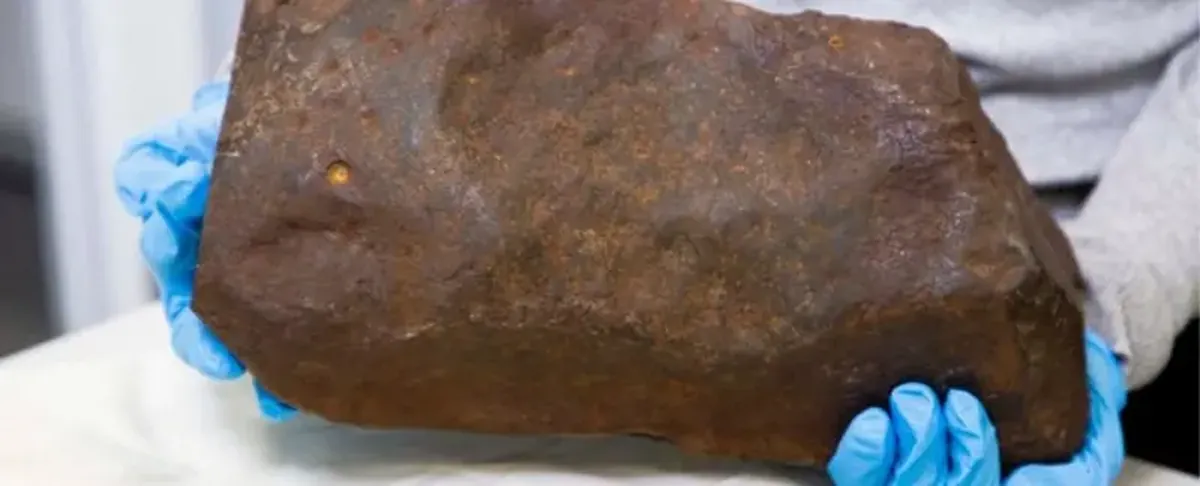
GabyFor years, a man kept a mysterious boulder he discovered in Maryborough Regional Park with a metal detector. David Gould hoped the stone hid a gold nugget.
What did the discovery turn out to be?
Back in 2015, when Gould brought the stone home, he tried every possible way to break or cut it. His persistence makes sense: Maryborough sits in the Goldfields region, famous for a 19th-century gold rush.
Gould tried to reach the insides of the stone using a special saw, an angle grinder, and a drill. He even poured acid on his find. A sledgehammer couldn’t crack it either. That’s because it wasn’t a terrestrial rock. Also, there was no gold nugget inside.
Years passed, and the rock’s extraordinary durability kept Gould restless. Eventually he took the boulder to the Melbourne Museum for identification.
There, the prospector learned that the object he’d been trying to open was a rare meteorite.

How did the experts comment on this surprise?
“The stone was sculptural, with dimples. Such features usually form when they pass through the atmosphere; they melt on the outside, and the atmosphere shapes them,” said Dermot Henry, the museum’s geologist, describing his first impression of the cosmic find.
He added that in his 37 years at the museum, he’s seen many stones people thought were meteorites. Out of thousands of samples, only two proved to be genuine — and this one, brought in by David Gould, was the second, according to Science Alert.
What have scientists learned about the meteorite?
Researchers published an article on their analysis of the stone. It states that the meteorite, named Meriboro, is 4.6 billion years old.
Despite its modest size, it weighs 17 kilograms. That’s also evidence of its extraterrestrial origin. “If you saw such a stone on Earth and picked it up, it wouldn’t be this heavy,” noted Bill Birch, a museum geologist and researcher.
By cutting a small piece from the meteorite with a diamond saw, scientists found it has a high iron content, classifying it as an ordinary H5 chondrite.
After the “dissection” of Meriboro, scientists also observed tiny crystallized inclusions called chondrules.
“Meteorites are the cheapest form of space exploration. They take us back in time, providing clues about the age, formation, and chemistry of our Solar System, including Earth,” Henry said.
“Some of them allow us to glimpse into the depths of our planet. Some meteorites contain ‘stardust’ older than our Solar System,” he added. He said rare meteorites may contain organic molecules, such as amino acids — the building blocks of life.
Although researchers do not yet know exactly where Meriboro came from or how long it may have been on Earth, they have some guesses.
Our Solar System was once a swirling mass of dust and chondritic rocks. Eventually gravity gathered most of this material into planets, while the remnants ended up in a vast asteroid belt.
“This particular meteorite most likely came from the asteroid belt between Mars and Jupiter, and it was ejected from there by several colliding asteroids before it crashed into Earth,” Henry said.
Analysis showed the meteorite had been on Earth for between 100 and 1,000 years. Between 1889 and 1951, several meteorites were recorded, one of which could have been Meriboro.
Researchers say this meteorite is much rarer than gold, making the find highly valuable for science.
“It’s only the 17th meteorite found in Victoria, while gold nuggets have been discovered there by the thousands,” Henry noted. “Considering the chain of events, this is literally an astronomical discovery.”
The results of the study were published in the journal Proceedings of the Royal Society of Victoria.
