
 Gaby
Gaby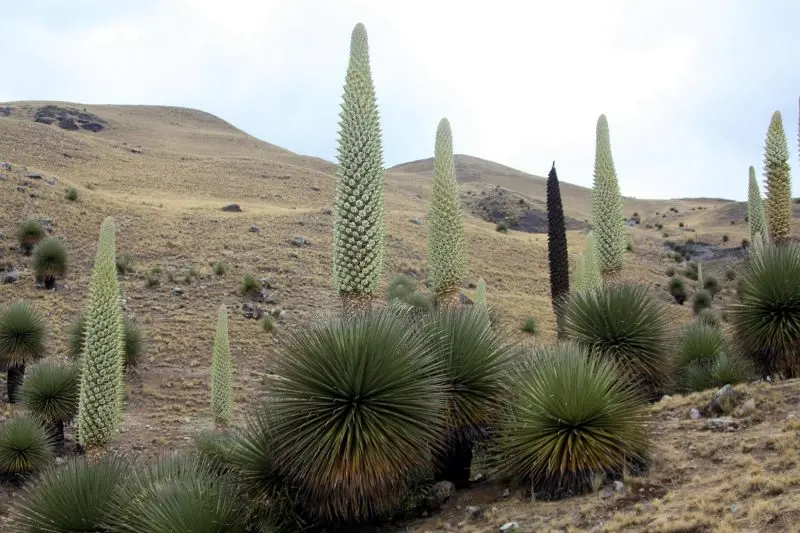
Who is the true ruler of the Andes? One might assume the majestic mountains of South America are governed by the seven countries through which they stretch. But that’s not the case: researchers consider the real queen of the Andes to be the charismatic, massive plant Puya raimondii. This remarkable species is covered in countless flowers, blooms only once a century, and lives a very long time. So, what exactly is Puya raimondii? It’s a monocot flowering plant and the largest member of the bromeliad family (Bromeliaceae), which also includes pineapples. But P. raimondii is no pineapple. The plant’s enormous inflorescence can reach up to 40 feet tall. The species was first described in 1830 by French naturalist Alcide d’Orbigny, but it wasn’t classified until 1874, when Antonio Raimondi named it Pourretia gigantea. In 1928 scientists moved it into the genus Puya, and the species name raimondii honors Raimondi, according to IFLScience.
Where can you find Puya raimondii? As noted earlier, this plant grows in the Andes, the world’s longest continental mountain range. It is endemic to a relatively small area: found only in Peru and Bolivia, at elevations from 9,800 to 15,700 feet. More than half of the P. raimondii population is concentrated in the Titankayoc Regional Reserve in Peru, which contains over 450,000 specimens. The rest are scattered across the Andean mountains.
What makes the Queen of the Andes so special? Its appeal isn’t just size or rare blooming. Researchers suspect it may be “proto-carnivorous,” meaning its leaves or structure can trap and kill small animals, though the plant probably can’t digest them. There are even reports that another species in the genus, Puya chilensis, can ensnare sheep. But scientists need more research to confirm those claims. Another sign of Puya raimondii‘s uniqueness is its long lifespan: its life cycle typically lasts 80 to 100 years, longer than many humans. The Andean giant blooms only once, at the end of its life—and what a show: it becomes covered in countless white flowers and can produce up to 12 million seeds. After it dies, the stalk often remains standing upright for several years.
