
 Gaby
Gaby
The discovery by archaeologists from France and Saudi Arabia sheds light on the gradual transition from a nomadic lifestyle to urban living thousands of years ago.
The ruins of a city known as Al-Natah were hidden for centuries behind the walls of the Khaybar oasis—a lush, fertile area surrounded by desert in the northwestern Arabian Peninsula.
What Did the Researchers Report?
A study led by French archaeologist Guillaume Charleux notes that an ancient wall measuring 14.5 kilometers in length had been found in this area. The team has now presented evidence that this wall protected the ancient city of Al-Natah.
The team says the city, which housed around 500 residents, was built around 2400 BCE during the early Bronze Age. Approximately a thousand years later, the population abandoned the city. “No one knows why this happened,” said Guillaume Charleux.
When Al-Natah was constructed, many cities were thriving in the Levant—the region along the Mediterranean from modern-day Syria to Jordan.
For many years, scholars believed that northwestern Arabia was a barren desert, roamed by nomadic herders and dotted with burial sites. That view shifted 15 years ago when archaeologists discovered Bronze Age mounds in the oasis of Tayma, north of Khaybar.
Charleux says this was “the first significant discovery” that prompted archaeologists to take a closer look at these oases.
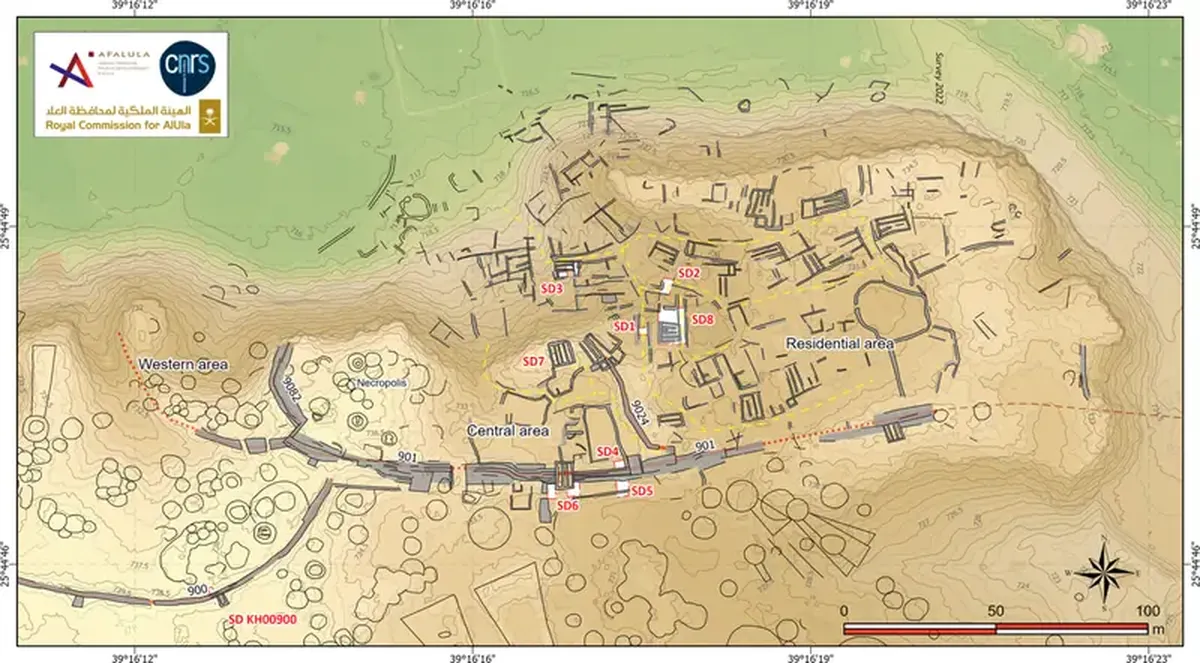
Map of the Al-Natah site with a layout of architectural features marked on the surface (black lines), reconstructions (gray lines), and a model of the wall (dashed red line).
Slow Urbanization
The black basalt rocks typical of this region had long concealed the walls of Al-Natah, protecting the city from illegal excavations. However, images obtained through LiDAR helped archaeologists identify potential streets and house foundations and gave them clues about where to dig, as reported by Science Alert.
Charleux said the team discovered foundations “strong enough to easily support one- or two-story houses.” The researchers concluded that the city covered an area of 2.6 hectares and contained around 50 buildings. All the buildings sat on a hill and were enclosed by a separate wall.
The team carefully studied the urban necropolis. In the tombs, they found metal weapons (primarily axes and daggers) and precious stones, including agate. The pottery they uncovered was well-crafted but simple in style. Taken together, these finds point to a relatively advanced society in the Arabian oasis 4,000 years ago.
The 5-meter-high fortification walls suggest a powerful local authority in ancient Al-Natah. The team says these findings illustrate “slow urbanization”—a gradual shift from a nomadic to a settled way of life.
The researchers suggest these fortified settlements may have interacted with one another amid a landscape largely populated by nomadic herding groups. Those interactions could have helped lay the groundwork for trade routes, including the famous “Incense Route,” which carried spices, frankincense, and myrrh from southern Arabia to the Mediterranean.
Al-Natah was smaller than the city-states of Mesopotamia or Egypt at the time. But the newly uncovered city followed “a different path to urbanization,” Charleux said: “more modest, significantly slower, and very characteristic of northwestern Arabia.”
The results of the study were published in the journal PLOS ONE.
