
 Gaby
Gaby
A team of researchers from the University of Barcelona and the National Institute of Archaeology in Morocco may have just rewritten history. Their recent discovery at the archaeological site of Kach-Kush challenges the belief that the Maghreb was empty until the Phoenicians arrived from the Middle East around 800 B.C. The excavations revealed a much richer, more complex history for the region.
The Maghreb is the northwestern part of Africa, west of Egypt, between the Mediterranean Sea and the Sahara Desert.
Materials from the Kach-Kush hill indicate that during the Bronze Age—more than 3,000 years ago—agricultural settlements already existed along North Africa’s Mediterranean coast. That was the same era when societies like the Mycenaeans thrived in the eastern Mediterranean.
The team’s findings expand our view of North Africa’s prehistory and reframe the region’s ancient connections with the rest of the Mediterranean, The Independent reports.
What Did the Scientists Discover?
The archaeological site of Kach-Kush was first identified in 1988 and excavated in 1992. At that time, researchers dated the site to between the 8th and 6th centuries B.C., based on Phoenician pottery found there.
Nearly 30 years after the site was discovered, a new generation of archaeologists ran two excavation seasons. They used drones, differential GPS, and 3D modeling. Analysis of the finds helped reconstruct the settlement’s ancient economy and environment.
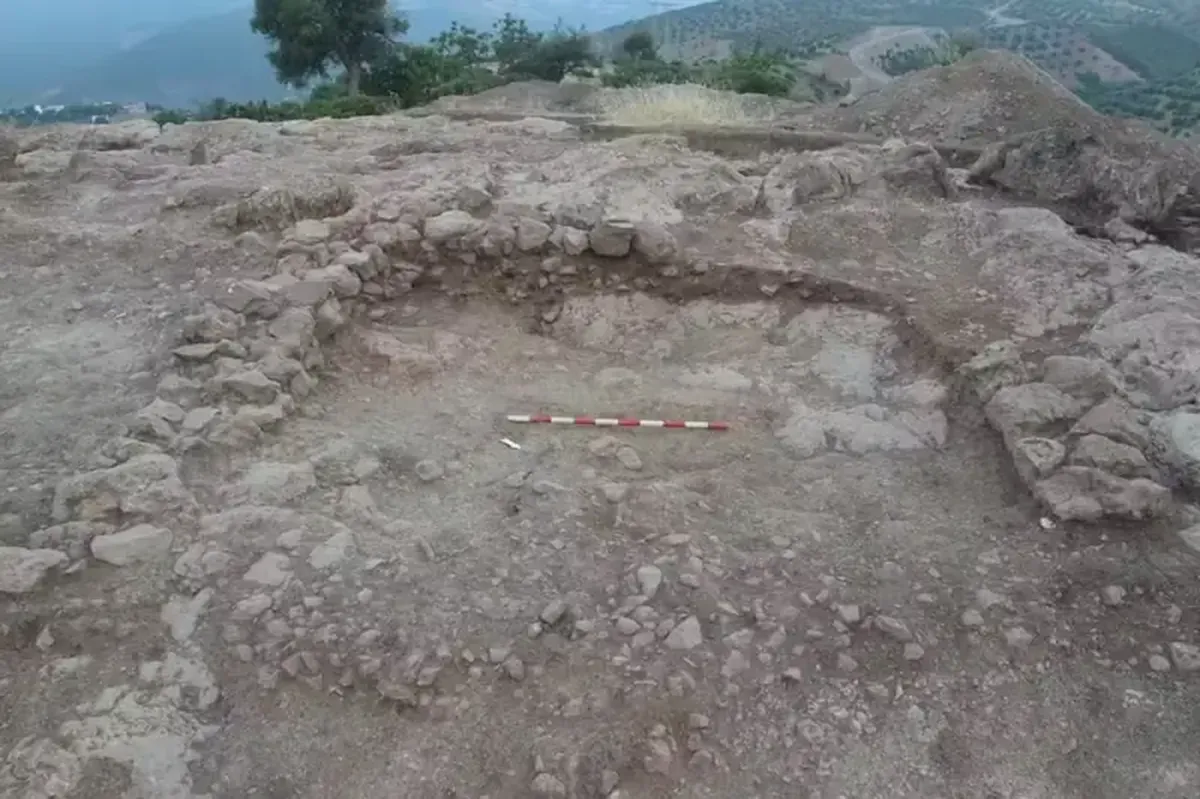
Radiocarbon dating revealed that the Kach-Kush site experienced three phases of settlement between 2200 and 600 B.C.
The earliest documented remains (2200–2000 B.C.) were scarce: three unpainted ceramic shards, a flint flake, and a cattle bone. This modest assemblage may reflect erosion or temporary habitation of the hill during that period.
During the second phase, following a period of abandonment, Kach-Kush was continuously inhabited starting around 1300 B.C. The residents, likely no more than a hundred people, practiced agriculture and animal husbandry. They lived in round dwellings made of mud and clay.
Analysis showed that the inhabitants cultivated wheat, barley, and legumes, and raised cattle, sheep, goats, and pigs. They also used grinding stones to process grain, made flint tools, and produced decorated pottery. Additionally, the team documented the oldest known bronze artifact found in North Africa (excluding Egypt): a fragment of metal removed from a mold after casting.
Between the 8th and 7th centuries B.C., the residents of Kach-Kush kept the same material culture, architecture, and economy. However, interactions with Phoenician communities settling in nearby areas introduced new cultural practices to the population.
For instance, round dwellings began to coexist with square houses built of stone and mud and coated with clay.
The locals also started cultivating new crops—grapes and olives. Evidence of new materials appears in artifacts such as Phoenician pottery, amphorae, plates, and iron objects.
By around 600 B.C., the population abandoned Kach-Kush, possibly because of social and economic changes. Its inhabitants likely moved to nearby settlements.
For a long time, scholars portrayed the Maghreb as empty and isolated until the Phoenicians arrived. As a result, the region was mostly absent from discussions of Mediterranean prehistory. The team’s discovery is a breakthrough for archaeology and calls for a reevaluation of dominant historical narratives.
