
 Gaby
Gaby
A connoisseur of beauty and paradoxes urged us not to destroy legends: they reveal the true essence of humanity. Here’s a biography and some intriguing facts about the life of the Irish poet, writer, essayist, playwright, journalist, wit, dandy, and key figure in European modernism—whose life was both brilliant and tragic.
Bohemian Atmosphere
Oscar Wilde was born on October 16, 1854, in Dublin, Ireland. He had Dutch roots on his father’s side and Italian on his mother’s. One branch of his family settled in Ireland in the late 17th century, while the other arrived a century later. Before marrying Oscar’s mother, Sir William Wilde had three illegitimate children whom he educated but did not raise. In his marriage to Jane Wilde, three more children were born; the youngest girl died at ten from meningitis, a fate that would later claim Oscar as well. Oscar was two years younger than his brother. The sons of a prosperous doctor and philanthropist were born with a figurative “silver spoon.” They not only lacked for nothing but also had the best opportunities for development.
William Wilde, Oscar’s father, was even knighted: he served as a medical advisor and assistant to the Commissioner of the Irish Census. A leading physician, he treated wealthy patients and also provided charitable care to the city’s poor at his own dispensary on the grounds of Trinity College in Dublin. Meanwhile, the head of the family found time to research peasant folklore and Irish archaeology. His wife, Jane Wilde, was equally accomplished. She raised their three children amid poetic evenings attended by many gifted guests and prominent Europeans. Mrs. Wilde was an Irish nationalist who published revolutionary poetry under the pseudonym Speranza (Italian for “Hope”).
From birth, the children were immersed in literature, poetic imagery, and beauty in all its forms. Those high aesthetic standards shaped Oscar, who grew up surrounded by Hellenistic art. In the summers, until he turned 20, Oscar would travel to his father’s country villa, where his playmate was the future writer George Moore.

Little Oscar in a dress
The Sacred Text of Beauty
A French governess taught Wilde French, while a German tutor taught him German. Lively, sociable, and wry, Oscar had a knack for reading from an early age and gave the impression of someone for whom learning came easily. He graduated from Portora Royal School with a gold medal and a prize for his work on the Greek text of the New Testament. Next came a scholarship to Trinity College in Dublin, an esteemed institution where he continued to feel intellectually fortunate.
In lectures on ancient history and culture, Wilde again showcased his aptitude for ancient languages. He also attended lectures on aesthetics that transformed his thinking. During this period he solidified his Hellenistic preferences and sympathies for the Pre-Raphaelites. He went on to Oxford to study classics as an aesthete, dandy, and philosopher. Professors admired his talent, and at Oxford he won the prestigious Newdigate Prize for his poem “Ravenna.”
Wilde quickly identified key models for his art. He drew his philosophy of art—known as aestheticism—from the writings of John Ruskin and Ruskin’s disciple Walter Pater. Ruskin praised beauty together with goodness, while Pater embraced beauty even when it mingled with darker elements. Wilde found both ideas compelling.
Visits to Italy and Greece while at Oxford exposed him to artistic layers he had not considered before. He shed some earlier beliefs and acquired an eloquence, impeccable pronunciation, and a growing disdain for convention and taboo. As he had hoped, Oscar earned a reputation as a brilliant, vividly alive presence.

Oscar Wilde, London, 1881
The Star Attraction
After university, Oscar Wilde moved to London. By 1878, the trendsetter of British fashion was already recognizable on the streets of the capital. It was hard to miss the tall (6’3″) young man in a short velvet jacket trimmed with braid, a thin silk shirt with a wide collar, a soft green tie, knee-length satin trousers, black stockings, patent leather shoes, a voluminous cloak, and a picturesque cap. He often wore a green carnation in his lapel and carried a lily or sunflower—flowers the Pre-Raphaelites prized as the peak of perfection for an art movement that rejected the academic traditions of late 19th-century English painting and poetry.
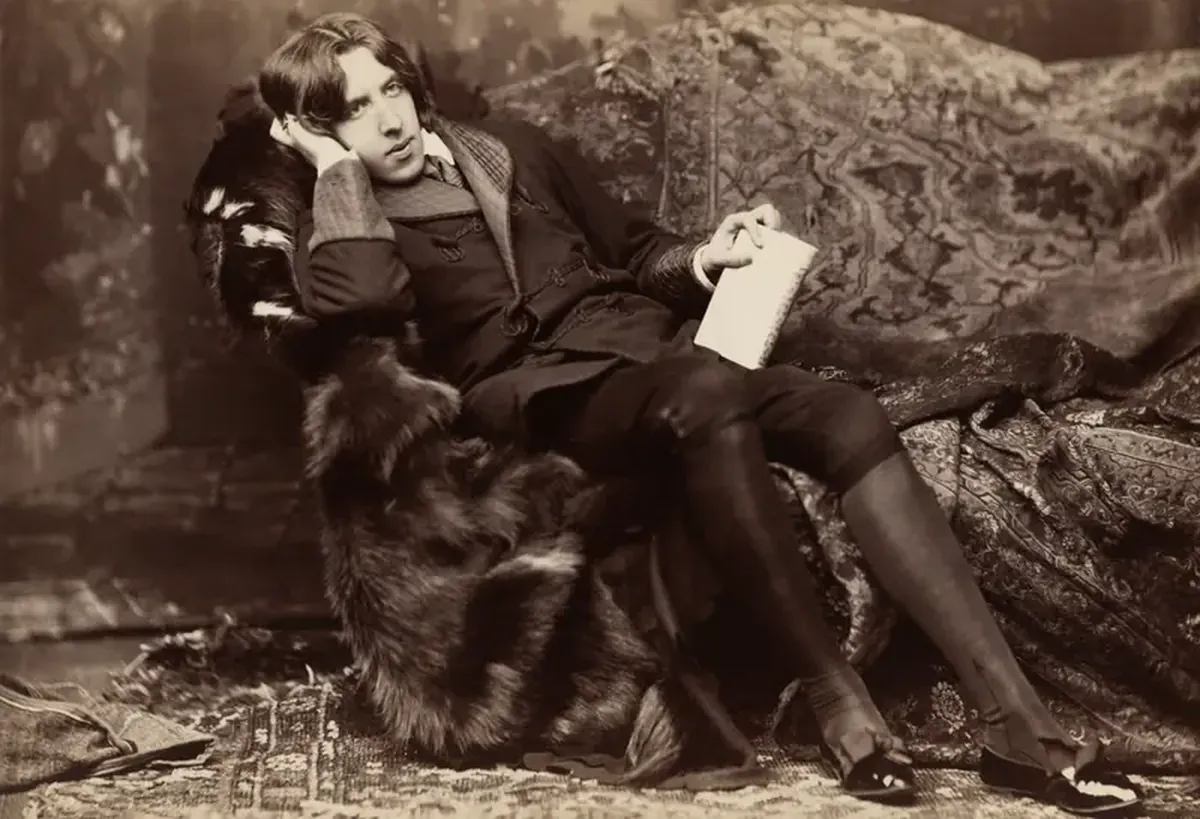
Oscar Wilde, 1882
When students from Harvard University showed up at one of his lectures in similar dress, Wilde joked, “For the first time, I ask God to rid me of followers.” It was no wonder he was called the “Irish wit”: self-irony often rescued him when his outrageous antics were misunderstood. His affected behavior and artistic image made him a frequent target for caricature, but they also made him a popular figure in social circles. Wit and a knack for commanding attention were among Oscar’s undeniable gifts; salons invited him to entertain guests. The “star attraction” not only tossed off jokes and banter but also read vivid, impressionistic poems.
In 1882, he sailed from London to New York and amused American reporters with a mock “press confession”: “Ladies and gentlemen, I am disappointed with the ocean—I expected more from it.” At customs he quipped, “I have nothing to declare but my own genius.” American audiences were captivated by his speech and style, though some critics disapproved of his self-promotion. Still, Wilde couldn’t resist boasting in a letter: “I have already civilized America—only the sky remains to conquer.”

Postcard commemorating Oscar Wilde’s visit to San Francisco, 1882
The Game of Wit
After a year in America, Wilde made a name for himself in Paris, where he easily won the admiration of Paul Verlaine, Émile Zola, Victor Hugo, and Anatole France.
In 1884, Wilde met Constance Lloyd, who became his wife and the mother of his two sons: Cyril, born in 1885, and Vivian, born in 1886. Oscar wrote stories for his children, which later filled two collections.
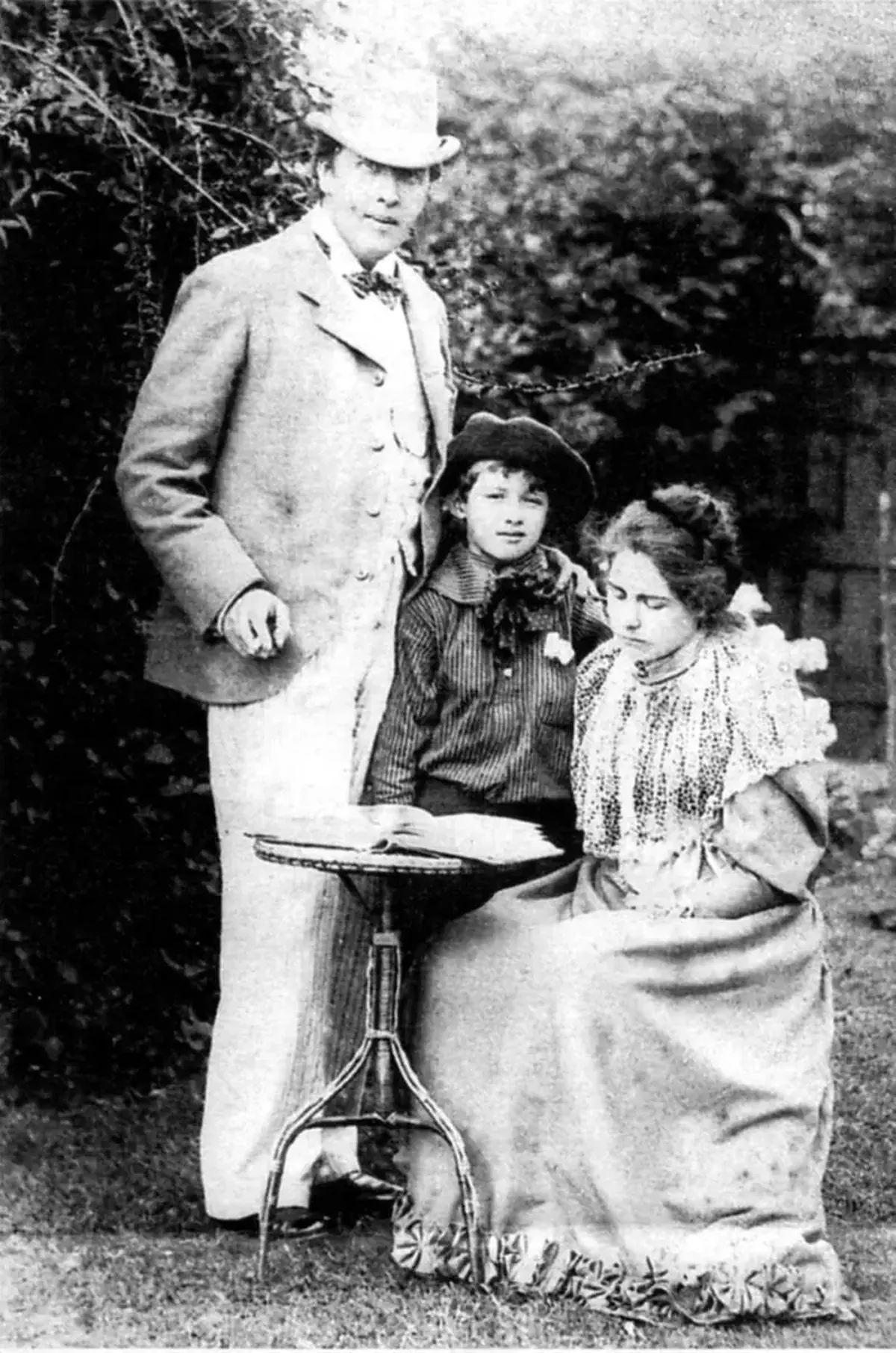
Oscar Wilde with his wife Constance Lloyd and son Cyril
Feeling a sense of responsibility toward his family, the young father took the role of editor for the magazine Woman’s World; his sociability and connections helped with journalism and fundraising for the publication. Although Bernard Shaw acknowledged his editorial successes, Wilde soon lost interest and returned to literary creation.
Many saw Wilde as a sybarite known mainly for one controversial novel. In response to accusations of immorality, he argued that art does not depend on conventional morality, while some critics found a moral lesson in his best-known book: you cannot kill your conscience without consequence. Beyond The Picture of Dorian Gray, he wrote successful plays, comedies, poems, essays, short stories, and theoretical works—his essay “The Soul of Man Under Socialism” rejecting marriage, family, and private property is one example.

In 1892, after the premiere of the comedy Lady Windermere’s Fan, Wilde stepped forward for a bow—cigarette in hand. “Ladies and gentlemen,” the self-styled “apostle of beauty” told the audience, “do not consider it rude that I am smoking before you: it is equally impolite on your part to distract me from my occupation.”
After An Ideal Husband and The Importance of Being Earnest, critics called Wilde “the best contemporary playwright.” Their only real complaint was that his dazzling wit sometimes seemed to become an end in itself.
A singular work in his oeuvre is the one-act play Salomé, written for Sarah Bernhardt. British censors banned its production because of its biblical subject matter. This censorship was one of several restrictions that later shadowed Wilde and his family.
“Love That Hides Its Name”
Wilde tried to keep his humor even during the humiliating trial on charges of sodomy. Homosexual acts were taboo in respectable circles, but his personal situation turned that taboo into a public scandal. Wilde ignored warnings from the father of his lover, who demanded that he end the relationship.
Lord Alfred “Bosie” Douglas, the son of the Marquis of Queensberry, was 16 years younger than Wilde and eager for a wealthy patron. Wilde was known for lavish gestures and never denied his young lover, who had left Oxford and who did not hide the connections that opened him to blackmail.

Oscar Wilde and Alfred Douglas
Wilde’s miscalculation was suing Bosie’s father for libel after an accusation of “practicing sodomy.” That legal battle set off events that led to Wilde’s prosecution. The libel case collapsed, and prosecutors then charged Wilde with violating public morality. They combed his writings for signs of homosexuality and pressed him about lines like “the love that dare not speak its name.” His frank replies did him no favors. The outcome cost him two years in prison for “gross indecency” and shattered his family.
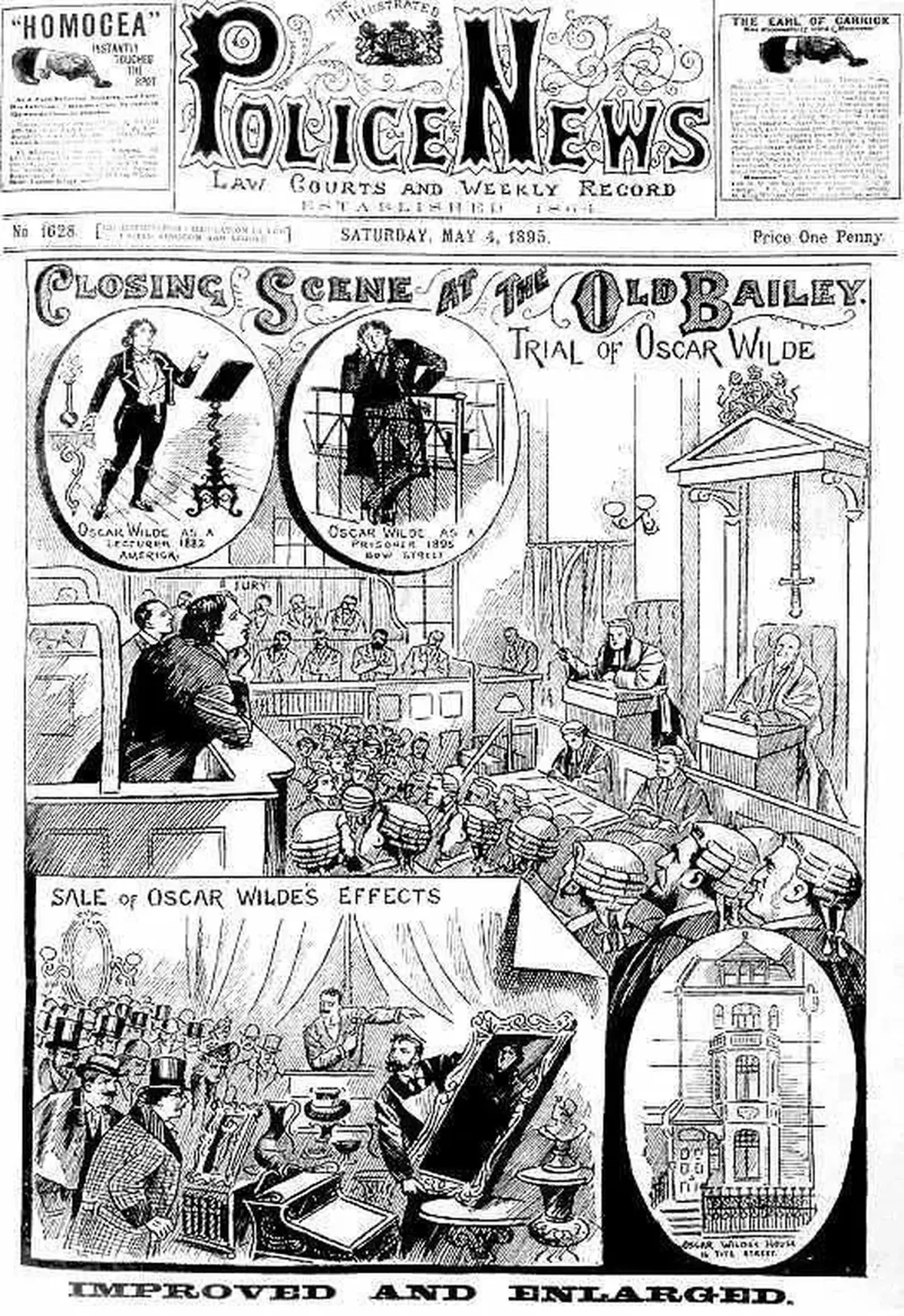
Oscar Wilde on trial, illustration from The Illustrated Police News, May 4, 1895
“The Drama of the Final Act”
Neither Douglas nor other libertines involved in the affair were prosecuted. Instead, Wilde lost everything. Prison broke him. Malnutrition and harsh conditions ruined the health of the still‑young writer. His treatment included injuries, among them a perforated eardrum, which later contributed to the illness that ended his life. The exposure of prison conditions helped spur discussion about reform, particularly after the publication of The Ballad of Reading Gaol under a pseudonym.
Many friends distanced themselves, and Alfred Douglas never visited the man who had once lived luxuriously on his patronage. Douglas went abroad and sold or pawned expensive gifts and letters from Wilde. At one point he sent the prisoner a reproachful letter: “When you are not on a pedestal, no one cares about you.”
Only Constance visited Wilde in prison, twice: once to tell him his mother had died, and later to bring papers for him to sign that gave her custody of their children. Afterward, Constance changed her and her sons’ surname and never showed the children to their father again. She continued to send him money after his release but refused to meet him.
After his release, Wilde moved to France and adopted the name Sebastian Melmoth, borrowing the surname from his great-uncle’s novel Melmoth the Wanderer. He hid from acquaintances, drifting from place to place and resembling that literary wanderer. Bernard Shaw described the period: “Wilde greatly simplified his life so that nothing would hinder him from feeling the drama of the final act.” Before he died, Wilde remarked that his countrymen would not tolerate his continued presence.
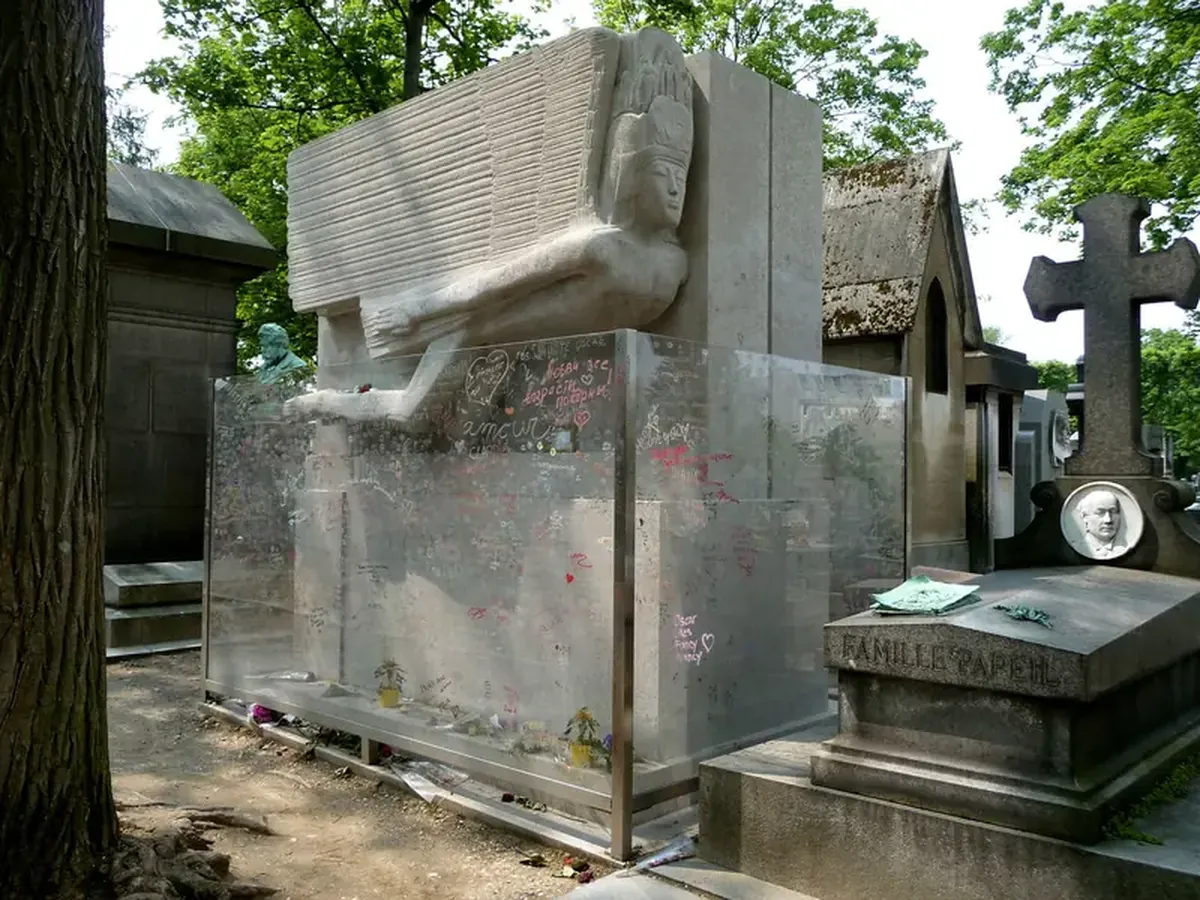
Oscar Wilde’s grave at Père Lachaise Cemetery
Wilde died after an eight-hour struggle on November 30, 1900. The immediate cause was acute meningitis brought on by an ear infection. He died in exile at the age of 46. His grandson, who holds the rights to the writer’s creative legacy, regards the family as victims of homophobia.
