
 Gaby
Gaby
The creator of philosophical tales about a girl named Alice became a writer by chance, but it’s fitting that he’s remembered as the founder of “paradoxical literature” — paradox was central to his identity.
A connoisseur of Euclidean geometry, an advocate of logical symbolism, and a master of artistic cryptography all coexisted in the pedantic Oxford professor. In literature he was Lewis Carroll; in mathematics he was Charles Dodgson.
The shy son of a clergyman was at once a deacon and a scholar, an artist and a photographer, a romantic poet and a lifelong bachelor. He was also left-handed, hard of hearing, a stutterer, a habitual opium user, and his personal diaries have repeatedly sparked scandalous speculation among sensationalist writers.

24-year-old Lewis Carroll, 1856
Born from Childhood
Charles Lutwidge Dodgson (the family pronounced the name without a “j” sound) was born on January 27, 1832, into a clergyman’s family in Cheshire. He was the third of eleven children of a parish priest from Daresbury. He spent his childhood entertaining three brothers and seven sisters with original games, homemade magazines, and stories he invented for them.
Being left-handed was treated as a defect in Victorian England. Harsh corrections and attempts to retrain him left him with childhood trauma and contributed to unilateral hearing loss, stuttering, and chronic migraines — ailments he later sought to ease with regular opium tincture. Some psychoanalysts have even suggested that his preference for solitude may point to autism.
By age 12 he had been educated at home, then attended a local private grammar school and Rugby School, where theology and mathematics were taught, before enrolling at Oxford University. He won a competition and soon began lecturing on mathematics at Christ Church, earning a position at his alma mater at 23. Dodgson found the teaching tedious but well paid, and he kept the post for more than 25 years. He was also ordained as a deacon, at a time when religion and science were closely linked in 19th-century England.

Posthumous portrait of Lewis Carroll by Hubert von Herkomer, based on photographs. This painting now hangs in the Great Hall of Christ Church in Oxford.
The Backstory of “Alice”
In 1856 a new dean arrived at Christ Church and brought his family: Henry Liddell, his wife, and their five children. The solitary Dodgson became a longtime friend of the family and a close friend of one of the dean’s daughters, Alice Liddell. He first met the child who would inspire his heroine when she was just four years old.
When Alice was 10, on a boating trip with her two sisters, she asked Dodgson for another story. He improvised one that included the girls as characters, and from that spontaneous tale came the plot of Alice’s adventures — starting, famously, with the White Rabbit’s burrow. Dodgson had long been fascinated by exploring abandoned mines and shared a child’s curiosity about hidden places.
Alice was afraid of forgetting the story, so she asked him to write it down. After a few prompts, he gave her a manuscript of the underground adventures. That manuscript became his first cult classic, Alice’s Adventures in Wonderland, published in 1865, with a sequel, Through the Looking-Glass, appearing six years later.

The Logic of Absurdity
He signed his literary work Lewis Carroll — a pseudonym formed by Latinizing and rearranging his given names (Charles and Lutwidge) and then anglicizing them again.
In daily life and professional work he remained Dodgson. As a mathematician he was ahead of his time: he developed an original graphical technique for solving logical problems that many found more convenient than the standard diagram methods, and his method for calculating determinants is known as “Dodgson condensation.” His algebraic puzzles appeared in publications such as Mathematical Curiosities. That numerical mindset also shaped Lewis Carroll’s writing, which is full of mysterious allegory and layered meanings that no one had quite used the same way before.
That mastery of absurdity came from a rare combination of sharp logical thinking, a rich inner life, and creative imagination. Dodgson also regularly used opium tincture and did not draw a strict line between fantasy and reality, sometimes seeming to peer into realms beyond contemporary scientific understanding.

One of Carroll’s illustrations for the book “Alice’s Adventures in Wonderland”
Even if hallucinogens contributed to some of the vivid images, the ideological depth of his texts comes from the storyteller’s developed mind. The apparent absurdity never stops the reader from finding subtle allegories and layered subtext, and generations of scholars have hunted for the hidden meanings beneath the surface.
Beyond Alice, Carroll published seven other works featuring different characters, and his philosophical tales — after more than a century — continue to be mined for quotable lines, astonish readers with thoughts about the universe, and pose questions aimed at children rather than adults.
“The Man with Whims”
Carroll’s hobbies included chess and staged photography that used negative montages. He collected genre photographs by other artists and took many images of his own; among the photographs he collected and produced were images of children in the nude. Colleagues and friends commonly allowed their daughters to visit him, and at 59 he recorded in his diary his appreciation for the companionship of young people.
Over time, his fondness for spending time with children affected his public image. After his death from pneumonia on January 14, 1898, twentieth-century Freudian readings of his life prompted some exposés that accused him of being a “child admirer” and even suggested, without strong evidence, links to Jack the Ripper.
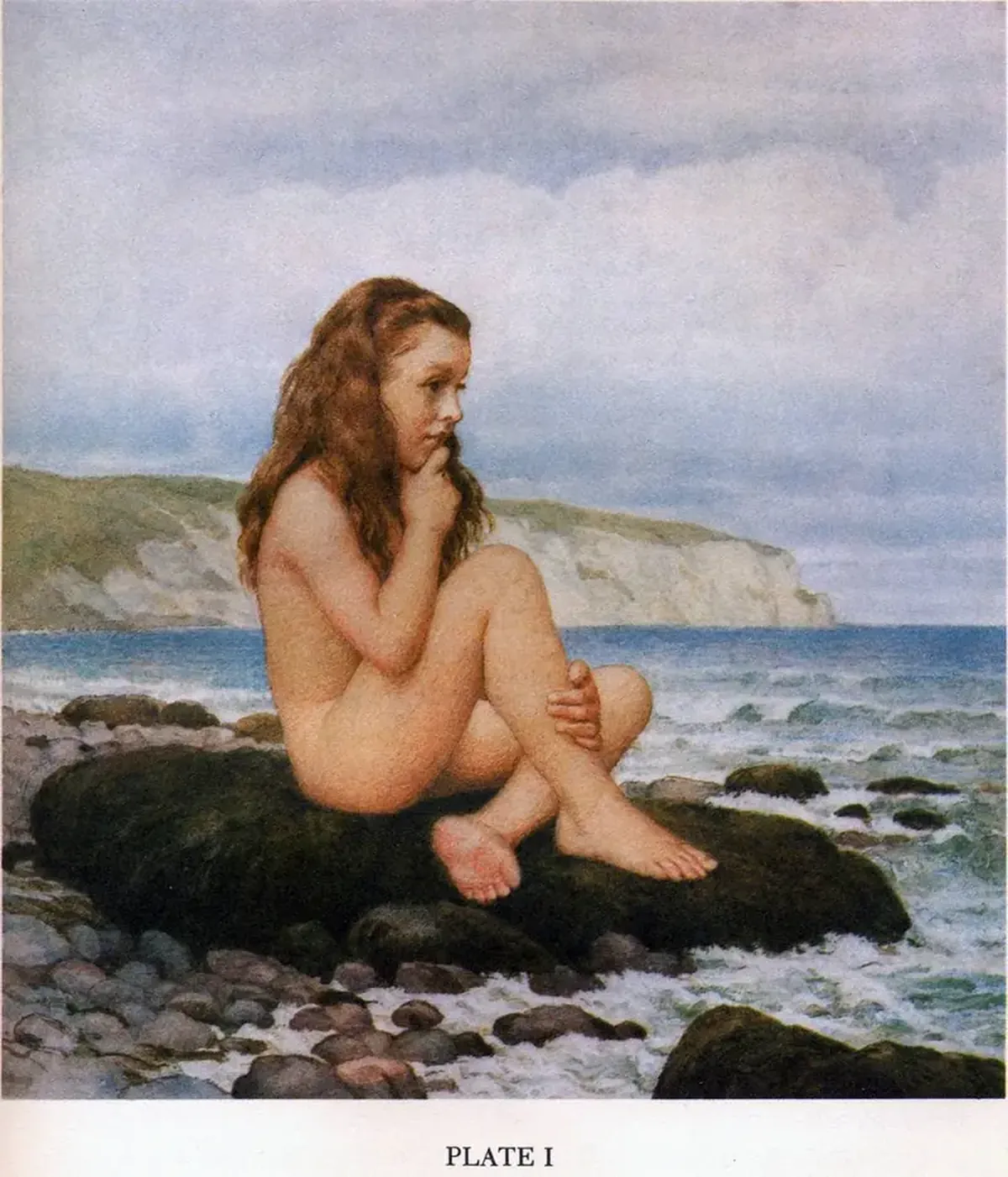
Portrait of Beatrice Hatch, created by Carroll
Those who actually spent time in Carroll’s home did not report misconduct, and the most sensational allegations were eventually discredited. People who knew him described him as eccentric — “a man with whims” — rather than the sinister figure some later commentators tried to make him out to be.
