
 Gaby
Gaby
O. Henry, with his characteristic humor, once wrote, “The art of storytelling is to conceal everything people are eager to know until you’ve laid out your cherished views on unrelated matters.” His own “cherished thoughts” could serve as epigraphs for a life story: “Fate flings you like a cork in a bottle of wine opened by a waiter you didn’t tip,” “Life is what we value most and guard least,” and “It’s not the path you choose, but the inner need for that choice.”
Orphanhood and Tuberculosis
William Sydney Porter, the future O. Henry, was born on September 11, 1862, in Greensboro, North Carolina. His mother died of tuberculosis when he was three, and his father moved with him to live with relatives. The family traced its roots to English and Dutch colonists, and at the time his uncle had just become governor of the state. Porter was raised by an aunt who ran a private school and took a close interest in his education. After graduating from Evelina Maria Porter High School in 1876, he continued his studies at Lindsey Street High School.
At 15 his aunt became his legal guardian, and by 16 he had started his first job. In 1879 Porter worked as an accountant, and a year later, at 19, he earned a pharmacist’s license. While selling medicines in his uncle’s pharmacy, he sharpened his observational eye by sketching caricatures of customers. When he began showing symptoms of his mother’s illness, he had to give up the job and change climates. He traveled with a family friend, Dr. James Hall, to the Hall family’s ranch in Texas, where plenty of outdoor work helped ease his persistent cough.
The young man tended sheep, cooked for cowboys, delivered mail, cared for animals, looked after children, and read widely while picking up Spanish and German from immigrant workers. When his health improved, Porter moved with ranch owner Richard Hall to Austin. The energetic young bachelor did everything: he worked as a pharmacist, bank teller, draftsman, and journalist; wrote his first pieces; joined vocal and drama clubs; played guitar and mandolin; sang in the church choir; and became known for his sharp wit and sociability.

Between the Castle and the Court
During this period Porter met 17-year-old Ethel Estes — biographers believe the meeting took place on March 2, 1885, during the laying of the Texas Capitol’s cornerstone. Ethel also suffered from tuberculosis, and her mother forbade the relationship. Porter ignored that obstacle: on July 1, 1887, he and Ethel eloped and married in the parlor of the Presbyterian minister’s home, of which she was a member.
The newlyweds performed together in amateur groups, and Ethel encouraged her husband’s writing. In 1888, just hours after their first child was born, the baby died. Soon after, Ethel became pregnant again and in 1889 gave birth to a daughter, Margaret. Supporting the family became easier when Richard Hall — the same ranch owner — offered Porter a job as a cartographer at the General Land Office of Texas after Hall became state commissioner. That position paid $100 a month in 1887, and the office building resembled a castle.

O. Henry with his wife Ethel and daughter Margaret
Richard ran for governor in 1890 but lost. The day after the new governor took office, in January 1891, Porter resigned and accepted a position at the First National Bank of Austin. For the same pay, he became an accountant and cashier. That job proved dramatic: in 1894 Porter was fired because the bank reported a significant shortage of funds. Whether the shortfall stemmed from negligence or intentional embezzlement would later be decided by the courts. For the moment, he was simply dismissed without formal charges.
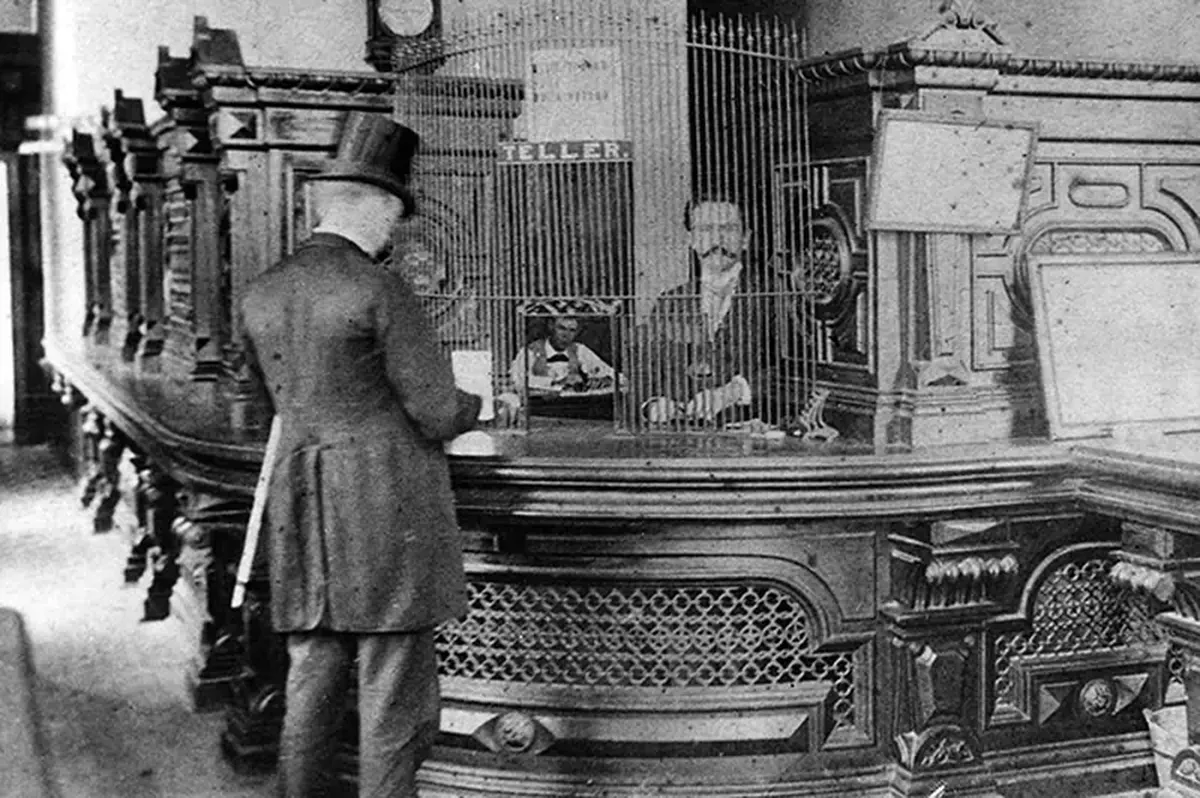
O. Henry – bank clerk
Jail, Exile, and Poverty
While working at the bank, Porter launched a satirical weekly, The Rolling Stone, so he would have a project to focus on. He both wrote and illustrated the paper, which caught the attention of an editor at the Houston Post. When The Rolling Stone folded in 1895 due to low circulation (at most 1,500 copies), the Houston Post offered him a job.

Houston Post page dedicated to the memory of O. Henry
Porter moved his family to Houston and wrote a column, often gathering ideas in hotel lobbies — eavesdropping as a technique that served his fiction well. The Post paid him $25 a month, far less than he had once earned. Worse, an audit of the First National Bank in Austin revealed a large shortage, and the dismissed Porter was federally charged with embezzlement.
He was arrested, and his father-in-law posted bail. Before his court hearing, Porter fled. On July 7, 1896, he failed to appear in court and escaped via New Orleans to Honduras. He spent six months in a hotel in Trujillo working on his only novel, Cabbages and Kings. Among O. Henry’s collected works (the complete edition runs to 18 volumes), that book stands out — and it was there he coined the now-familiar phrase “banana republic.”

Prisoner No. 30664
In Latin America, Porter met the notorious train robber Al Jennings, who later wrote about their friendship. A writer who studied the quirks of human life would be drawn to someone like Jennings, and Porter used impressions of survival in a money-driven country in many of his morally edged short stories.
O. Henry’s favorite protagonists are petty thieves and small-time schemers who inspire ironic sympathy as they battle life’s disappointments. And who can forget “The Gift of the Magi,” the Christmas parable about a young couple: the woman cuts and sells her long hair to buy a gold chain for her husband’s pocket watch, while the man sells that very watch to buy her a set of combs.
Separated from his wife — who had gone to her parents’ home with their daughter — Porter waited in Honduras, unaware that Ethel’s health was worsening. After a telegram informed him that his wife was dying of tuberculosis, he returned to Austin on January 23, 1897, and surrendered. The court showed leniency and took family circumstances into account. Ethel Estes died six months later, on July 25, 1897. Porter lived quietly with his in-laws and only began writing again that fall. In February 1898 he was convicted of embezzling $854 and sentenced to five years in prison.

In March 1898 Porter was sent to the Ohio Penitentiary in Columbus. Prisoner No. 30664 accepted his fate despite lingering questions about the case. The bank’s bookkeeping had gaps, and employees could remove cash without the cashier’s knowledge. Of the roughly $6,000 missing, $5,500 was returned by the bank owners, who testified on Porter’s behalf (friends and supporters raised another $500). His pharmacist’s credentials let him work in the prison hospital, and the prison gave him a small room where he wrote 14 stories.
No Happy Ending
It was in prison that Porter adopted the pen name O. Henry, which first appeared in 1899 in a magazine story titled “The Christmas Stocking of Dick Swiveler.” A friend in New Orleans submitted his pieces under that name so publishers would not learn of Porter’s legal troubles. For good behavior he earned early release after three years and four months. In July 1901 he reunited with his 11-year-old daughter Margaret in Pittsburgh; his wife’s parents had moved there with her after his conviction. Margaret was not told where her father had been — she believed he had been on a long business trip.
After prison came the most productive stretch of O. Henry’s career. In 1902 he moved to New York to be closer to publishers and went on to publish more than 380 stories collected in ten volumes. Critics dubbed him the “American Gogol,” “American Chekhov,” or “American Maupassant,” praising the unusual, soulful quality of his fiction. But his personal life continued to exact a toll. In 1907 he remarried his childhood love, Sarah Lindsay Coleman (known as Sally), who also wrote. Porter, however, quickly squandered his health through alcohol.

O. Henry and his second wife Sarah
Sally also wrote short stories, but their shared literary interests did not bring domestic happiness. In 1909 she left him, and in 1910 William Sidney Porter died. The 47-year-old writer succumbed on June 5, 1910, to cirrhosis of the liver, an enlarged heart, and complications from diabetes. His daughter Margaret later died of tuberculosis in 1927 — the same disease that had claimed her mother and grandmother — and was buried beside her father in Riverside Cemetery in Asheville, North Carolina. Her family life never flourished, nor did her attempts at writing. O. Henry, the man who gave readers consoling endings and bittersweet hope, did not live to see such an ending for himself.
