
 Gaby
Gaby
For a century, the deaths that followed the discovery of Tutankhamun’s tomb have fueled rumors of a curse. For a long time, people believed the so‑called curse claimed the lives of anyone who entered the pharaoh’s burial chamber. The idea has inspired countless books and films.
However, researcher Ross Fellowes argues that the real cause of the archaeologists’ misfortunes was purely biological. His work suggests the excavation team was exposed to dangerous radiation. He says the sources of that radiation were inside the hermetically sealed tomb, possibly even placed there intentionally.

The study concluded that the cause was “radiation poisoning from natural elements containing uranium and toxic waste.”
What Ross Fellowes Revealed
On the walls of the surprisingly intact tomb of Tutankhamun, the team found inscriptions. Ancient texts warned of misfortunes awaiting anyone who opened the sarcophagus. Despite the threats, the scientists went ahead. In the years that followed, more than 20 researchers died relatively young.
According to Fellowes’ new theory, the tomb was indeed “cursed,” but not in a supernatural way; it was “biologically” cursed.
The burial site of Tutankhamun in the Valley of the Kings registered very high radiation levels. Over time, people who entered the tomb suffered from radiation exposure. In a paper published in the journal Scientific Exploration, Fellowes said several tombs in Saqqara and Giza also showed dangerous radiation levels caused by the radioactive gas radon. Specifically, he identified two basalt chests in the tomb of Osiris at Giza as strong sources of radioactivity.
Radon gas is a decay product of uranium with a half‑life of 3.8 days.

Thousands of pots excavated beneath the Step Pyramid in the 1960s contained up to 200 tons of unidentified material.
What Happened to the Expedition Members
Radiation exposure can increase the risk of certain cancers, including lymphomas like the Hodgkin’s disease Howard Carter reportedly battled before his death. Carter was the first to enter Tutankhamun’s tomb in 1922. He died in 1939, likely from a heart attack after a long battle with Hodgkin’s lymphoma, a disease that affects the immune system.
Lord Carnarvon, who financed the expedition and also inspected the tomb, died of blood poisoning five months after the opening. English Egyptologist Arthur Weigall, who took part in the excavations and later helped spread the pharaoh’s curse story, died of cancer at 54.
Other expedition members died prematurely over the years from asphyxiation, stroke, diabetes, heart failure, pneumonia, poisoning, malaria, and X‑ray exposure.
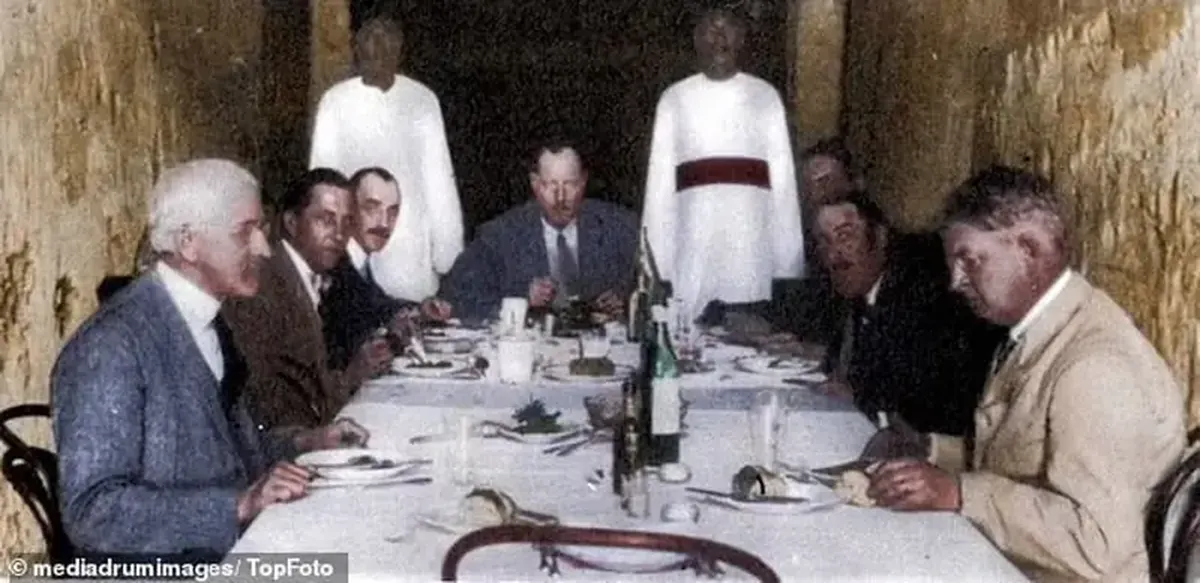
A meal in the tomb, attended by J. H. Breasted (who died from X‑ray exposure), Harry Burton (who died from diabetes), A. Lucas, A. R. Callender (who died due to health issues), and Arthur Mace (who died from poisoning).
They Made History as Pioneers of a Remarkable Discovery
On November 4, 1922, Carter’s team discovered hidden stairs that led to Tutankhamun’s tomb and spent several months cataloging the antechamber. In February of the following year, the archaeologists opened the burial chamber and uncovered Tutankhamun’s sarcophagus, as reported by the Daily Mail.
The small size of Tutankhamun’s tomb, given the pharaoh’s high status in Egyptian history, has puzzled scholars for many years.
Still, the tomb is regarded as one of the most lavish ever found. It was filled with priceless artifacts intended to accompany the young pharaoh into the afterlife. The burial trove contained about 5,000 items, including ritual sandals made of solid gold, statues, board games, and figurines of unusual animals.

Reconstruction of Tutankhamun’s face and body
What We Know About the Boy Pharaoh
Tutankhamun was an Egyptian pharaoh of the 18th dynasty who ruled between 1332 and 1323 BC.
He was the son of Pharaoh Akhenaten. According to various researchers, he ascended to the throne at nine or ten. Upon becoming king, he married his half‑sister Ankhesenamun. Tutankhamun died around the age of 18 for reasons that remain unclear. Some scientists think hormonal imbalance may have contributed to his early death.
Throughout his short life, Tutankhamun faced multiple health problems. The most thorough examinations of his remains found uneven teeth, a clubfoot, and hip features that appeared atypical for a male. Reconstructions of his face and body highlighted the ailments he may have endured.
A “virtual autopsy” made up of more than 2,000 computer scans, combined with a genetic analysis of Tutankhamun’s family, confirmed that his parents were siblings. That close inbreeding likely contributed to the young pharaoh’s health issues.
Rather than racing in chariots, the pharaoh moved with the help of a cane. Remarkably, 130 canes were found in his tomb.
Other theories propose Tutankhamun was murdered or died in a chariot accident; fractures were found in his skull and other parts of his skeleton.
Recently, scientists have also suggested that Tutankhamun might have died from a hereditary disease.
