
 Gaby
GabyKeep Your Chin Up, Lennon Jr!
Weybridge is a small, cozy town in Surrey that long offered peace and solitude. By the late 1960s it had about 10,000 residents, and oddly, many people associate it with the American company Procter & Gamble, which has an office there.
To reach Weybridge by car from London you have to take a little detour: the town feels set apart from noisy civilization and busy highways. From the house where Paul McCartney was living in the late sixties to the place he was headed, it was a little over an hour’s drive, so Paul’s sudden visit in June 1968 surprised Cynthia Lennon—then still John Lennon’s wife—and her young son Julian. “Uncle Paul” turning up unannounced was equally unexpected for five-year-old Julian. The Lennons were going through a dramatic period: the couple was separating, John had been living with Yoko Ono, and Julian was feeling the strain.

John and Cynthia Lennon
As a family friend, McCartney stopped by to support Cynthia and Julian. Even on short drives in his 1964 Aston Martin, Paul often turned off the radio to concentrate, hoping to come up with a new song. At one point he sang in the car, “Hey, Jul, don’t make it bad, take a sad song and make it better.” He was addressing Julian (nicknamed Jul), telling him not to be sad about his parents’ split; things would get better.
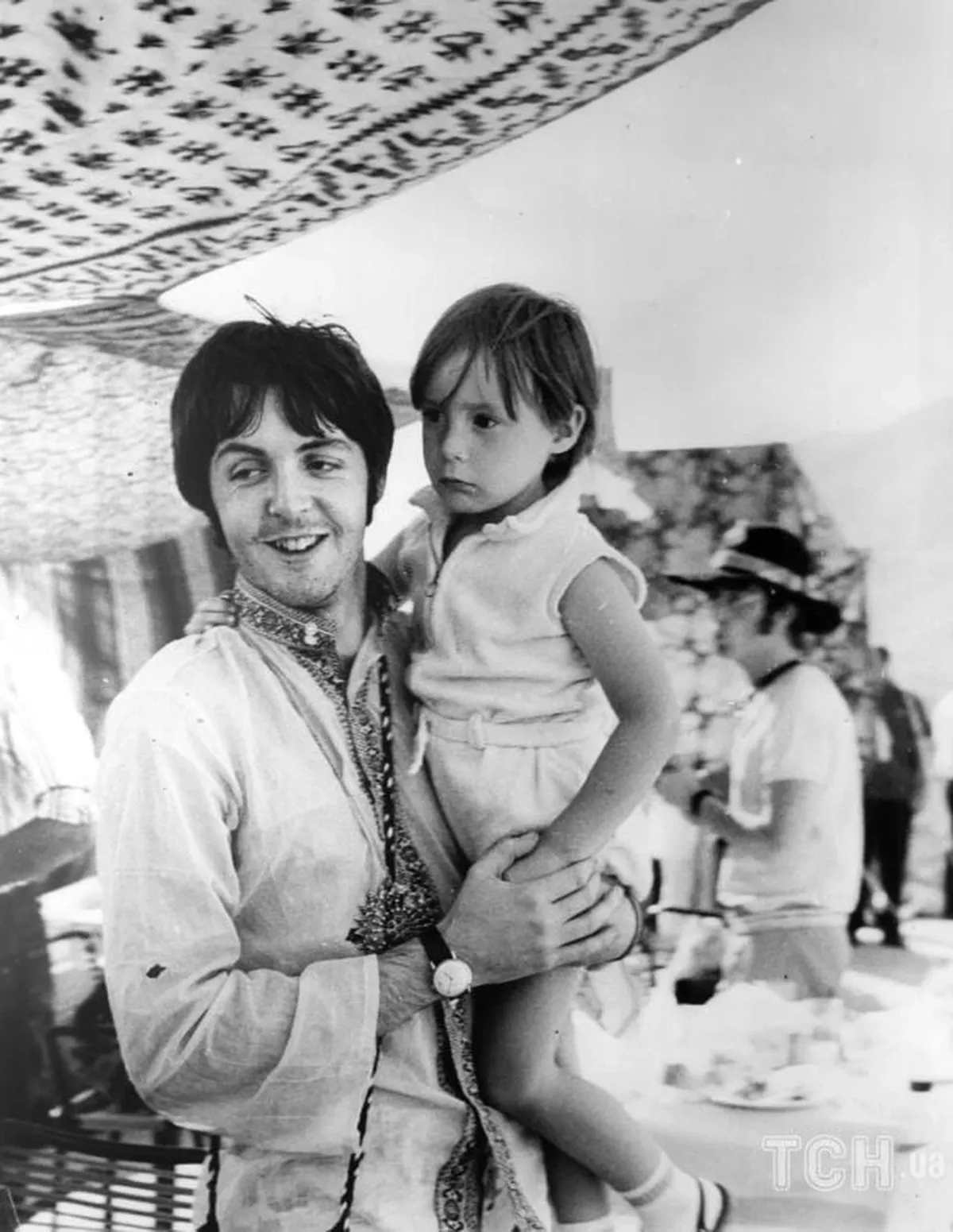
Paul McCartney and little Julian Lennon
Cynthia later said she was touched by Paul’s gesture and would never forget the visit. Paul later changed “Jul” to “Jude” because he thought it sounded better and because he remembered a character named Jude from the musical Oklahoma!, which he liked.

How a Graffiti Mix-up Sparked a Controversy
After the Six-Day War in June 1967, tensions in the Middle East continued to shape the global agenda, and anything that even hinted at a national or religious slur was bound to raise alarms.
This song might never have been linked to Jews or an “Israeli subtext” if not for one small incident in central London. Paul McCartney, still something of an eternal teenager, was walking along Baker Street—yes, the same street associated with Arthur Conan Doyle’s Sherlock Holmes—when he scrawled “Hey Jude/Revolution” on a freshly whitewashed shop wall. It was the sort of graffiti people put up all the time.
It was simply promotion for the Beatles’ single, released August 26, 1968 (with “Revolution” on the B-side). The shop owner saw it differently: he thought his wall had been defaced and read a national slur into the words. He called McCartney, threatened him, and said he would send his son to “teach him a lesson” over what he saw as an antisemitic inscription. McCartney spent time convincing the outraged shopkeeper that “Hey Jude” had nothing to do with Jews and that he hadn’t realized “Jude” meant “Jew” in German.
McCartney said, “I had no thought about Jews, but if you watch footage of Nazi Germany, there are scenes where on whitewashed windows next to the Star of David there is the inscription ‘Judenraus,’ which meant ‘Jews out.'”
The episode changed how some people perceived the song and spawned rumors and conspiracy theories that the lyrics contained a hidden message to Jews. Or perhaps the shop owner was just looking to make trouble—or money—off a rock star.
If there was any hidden message in the song, John Lennon insisted it was aimed at him. In an interview with Playboy he said, “Paul claimed that this song was about Julian, but it always seemed to me that it was about me, like he was saying: ‘Hey John.’ Yoko had just appeared in my life at that time. On a subconscious level, Paul did not want to let me go; the angel in him said ‘I bless you,’ but the dark side did not like it because he did not want to lose his partner.”

Paul McCartney, Julian and John Lennon
“DJs Don’t Bother Me Much”
The recording featured a 36-piece orchestra—including ten violins, three violas, and three cellos—and the “na-na-na-nanana…” coda repeats 19 times. Almost all the orchestra players joined the final singalong and the hand-clapping. Producer George Martin recalled there was confusion in the studio: one violinist protested that he hadn’t been hired as a singer, got up, and dramatically left. Martin asked if anyone else wanted to go; everyone stayed and later received overtime pay.
There was another real headache for the producers: the song ran over seven minutes. Martin warned that radio DJs wouldn’t play such a long track and that the length wouldn’t fit on a standard 45 rpm single. John Lennon brushed that off: “What’s going to happen to those DJs? They’ll play any single if it’s a Beatles single.”
That turned out to be true. Radio hosts were cautious at first, but stations were soon flooded with calls and letters complaining, “Why does ‘Hey Jude’ play so rarely on the air?” Engineers managed to squeeze the seven-minute track onto one side of a 45, which was a feat of recording technology at the time.
“Hey Jude” became one of the few Beatles songs Elvis Presley performed. He sang it in Memphis in 1969, and a four-and-a-half-minute live version appeared on his 1972 album Elvis Now.
Judy, This Song Is For You
Fans of the Premier League know Brentford, the London club that climbed back to the top division in 2021 after a 74-year absence from the First Division. In their return season they beat Arsenal 2-0 in the opening match, and the crowd at Griffin Park sang a version of the Beatles’ chorus that sounded like the club’s name.
🔥🐝🙌 Absolute SCENES here at Brentford.
Fans and players celebrate a famous win against Arsenal on their Premier League debut.
Just listen to this! Wow. #BrentfordFC #BREARS pic.twitter.com/7lICSy5elB
— Joe Prince-Wright (@JPW_NBCSports) August 13, 2021
If you listen closely, fans sing “Brentford” instead of “Hey Jude.” The Beatles’ hit has been the club’s unofficial anthem for years. Peter Gilham, a local who started working at the stadium in 1969 and was still there in 2019 when Brentford returned to the top flight, played the song from his small booth behind the stands. Among Gilham’s friends was a girl named Judy Kaufman, nicknamed Jude, and he liked her, so he played the Beatles’ song as a bit of affection. Fans picked it up quickly; no match went by without it, and the renditions became a moving ritual.

The Beatles hit used in FC Brentford promo
The opening ceremony of the 2012 London Olympics was a spectacular, emotional show. A children’s choir performed “Imagine” alongside archival footage of John Lennon, Freddie Mercury energized the crowd, and Paul McCartney appeared on stage to play one of his best-known songs at the piano. The “na-na-na” chorus rang out over the Olympic flame as athletes from around the world filled the stadium, and for those seven minutes the moment felt like something close to a miracle.
Remember how in 2012 many people joked about the “end of the world”? Looking back now, those were good times.

