
 Gaby
Gaby
Beloved by women and respected by men, he once gave his Oscar to a friend’s son, coped with the loss of love by going to war, refused to sign autographs, avoided society’s performative obligations, and couldn’t hold a grudge. He married five times, raised other people’s children, and never got to see his own son — he died in the same hospital where that child was born four months later.
In the Spotlight
Millions of women’s hearts were shattered by the rugged hero of Margaret Mitchell’s cult bestseller “Gone with the Wind.” It seemed the portrait of Rhett Butler was tailor-made for Clark Gable — the actor who created one of world cinema’s most iconic characters in that adaptation. The role earned him a nomination, but he won his Oscar for a different film where he was “just being himself,” and he considered his final role — the one that cost him his life — to be his best. “The King of Hollywood was the most masculine man I knew, yet he remained a little boy at heart, and it was this combination that attracted women to him,” an actress who knew him in the 1930s and ’50s recalled.

His dominance on screen as a boldly masculine romantic hero stood in stark contrast to his early days as a faceless extra, ignored by directors and fellow actors. Few would have guessed that the awkward, lanky young man, poorly coordinating his 185 centimeters, would become a superstar. But history proved otherwise: Clark Gable’s filmography would eventually include more than 60 films, and he would even count presidents among his acquaintances. Who turned a former oil worker, farmer, and tie salesman into a screen idol, and what personal qualities let him play leading roles for 30 of his 37-year career?
A Jack of All Trades
The only child of an oil-well driller from Ohio, William Clark Gable was born on February 1, 1901, in Cadiz. His ancestry included Germans, Belgians, and Pennsylvania Dutch. He never remembered his mother, Adeline Hershelman; she died when he was less than ten months old. He was raised by his widowed father and stepmother, who introduced him to Shakespeare and taught him to play piano. By 13, he was the only underage musician “blowing brass” in the city orchestra. His father also taught him traditionally “manly” skills, taking him hunting and showing him the hard physical labor of drilling and farming.

From childhood, Gable learned how machines worked, becoming adept at fixing, building, and painting things. He chopped wood, cared for horses, grew alfalfa, and disassembled and reassembled engines, eventually repairing his own cars and many other machines — from household appliances to military aircraft. The actor explained his habit of doing his own mechanical work by saying a film career could end at any time, but a car should run regardless of box office receipts. Guests at the Gable farm often found it normal to see the athletic man in a kitchen apron, canning the fruits of his garden.
No Such Thing as Coincidence
William Clark’s father had intended to make a living from farming: facing financial trouble in 1917, William Henry moved the family to Palmyra. Three years later, after becoming a widower again, Gable Sr. returned to the oil business and took his son to Oklahoma. For a time, the future actor worked with his father, cleaning oil wells in Tulsa. At 21, he received $300 in inheritance from his maternal relatives and set off for the Pacific Northwest to find his place in the world. He wanted to try something interesting, and that new venture turned out to be working in traveling shows — just as random as the temporary dock jobs he later took.
Traveling across the country, William Clark found work as a tie salesman in Portland. By a twist of fate, he met a theatrical actor in an Oregon department store who was the nephew of one of the future actresses from “Gone with the Wind.” That friend introduced Gable to a member of his acting troupe. The pair began performing together, but the troupe soon went bankrupt, and Gable had to look for work again. By day he worked for a telephone company, and by night he studied drama. His acting coach became the mentor who shaped his starry fate and set him on the artistic path.

Gable’s Muse
When 22-year-old William Clark met Josephine Dillon, she was nearly 40. A modest, intelligent woman who had studied at Stanford, Josephine came from a family of artists — one sister was a composer, another an opera singer, and Josephine became an actress. She had performed on Broadway and later became a theatrical manager devoted to discovering young talent. “I saw a quiet, deep, and insightful young man, ready to face challenges alone,” the mentor recalled about her first impressions of her new student, toward whom she gradually developed tender feelings.
Josephine noticed that their long conversations in studios and cafes were always about the future and never about the past. She sculpted the future star like an artist at work. Josephine not only taught him the basics of acting but also reshaped his image: at her own expense she fixed Clark’s imperfect teeth, gave him a better haircut, trained his “manly” voice, taught him manners, and helped him relearn how to walk with good posture. She even changed his awkward first name, Willie, to the more respectable Clark. After these transformations, her creation was ready for a film career.

Clark Gable and Josephine
“I Am Grateful to Her”
In 1924, Clark and Josephine, now married, moved to Hollywood. At first they could afford only one movie ticket, which “Mrs. Gable” would give to her husband. Starting with crowd roles in silent films alongside Clara Bow and Pola Negri, Clark failed to land significant parts in cinema for two years and returned to the theater, where he found both audience affection and the sympathy of a leading actress. After the theatrical star Jane Cowl spent time with Clark, Hollywood’s femme fatale Pauline Frederick — whose fame helped make Gable’s name appear in the press — also crossed paths with him.
Familiar with the artistic world, Josephine accepted the inevitable romances of her 17-years-younger husband and did not demand fidelity. Eventually Gable left her — one day he simply moved out. From then on their relationship was purely professional. They did not discuss their past or explain the reasons for their divorce. Still, it was clear the man whose photo his first wife kept framed for the rest of her life no longer needed her support. “I am grateful to her,” Clark said briefly when the press asked about “the first Mrs. Gable.” That was all the Golden Hollywood sex symbol felt he needed to say about his mentor.

In the play Machinal (1928) with Zita Johann
“A Lumberjack in Evening Attire”
A few days after his official divorce in 1930, Gable married Texas socialite Ria (Maria Franklin Prentice Lucas Langham). The second marriage was formalized twice because of differing state laws: a second ceremony took place a year later after the couple moved to California. By then Gable had worked on stages in Houston and New York, and after successful theatrical seasons, Pathé Studios offered him his first sound film role: he played a villain in the low-budget western “The Painted Valley” (1931). His part in the Warner Bros. film “The Night Nurse” was similar.
A studio executive once said, “Clark Gable has big ears and looks like a monkey.” But in film the inner essence of a performer often matters more than looks. Gable fit the bill when Hollywood faced a shortage of male stars. MGM’s publicity manager Howard Strickling described Gable’s image as “a lumberjack in evening attire.” MGM promoted new actors by pairing them with established actresses: in eight films Gable starred with Joan Crawford, in seven with Myrna Loy, in six with Jean Harlow, in four with Lana Turner, and in three with Norma Shearer and Ava Gardner.

Gable with Jean Harlow in “Red Dust” (1932)
A Star Rises
Gable’s first leading role opposite Joan Crawford in the 1931 film “Dance, Fools, Dance” prompted studio head Louis B. Mayer to cast the pair in seven more films. Many considered Gable Crawford’s natural screen partner, and Mayer even replaced another actor with Gable in already-filmed material. “A star has risen that will outshine all others,” critics wrote after the release of the 1931 film “A Free Soul,” where Gable’s portrayal of a gangster made producers realize he should be cast only in leading roles.

Clark Gable with Joan Crawford
In 1931, the films “Susan Lenox,” in which Gable starred with Greta Garbo, and “Possessed,” opposite Joan Crawford, were released and ignited a romance between him and Crawford that critics called “an affair that nearly scorched Hollywood.” Gable then turned his attention to his co-star from “Polly of the Circus,” Marion Davies. That same year, “Strange Interlude” with Norma Shearer featured Gable in another major romantic role. His work in the melodrama “Red Dust” made Jean Harlow’s leading man the biggest male star at Metro-Goldwyn-Mayer.
Essence and Image
The romantic comedy “It Happened One Night” (1934) earned Gable the Oscar for Best Actor; his co-star Claudette Colbert won Best Actress, and Frank Capra’s film took five Oscars in total. Gable’s role as a newspaper reporter even boosted sales of men’s undershirts — the image of a man who didn’t wear underwear under his shirt was striking. At the same time, the quirky, good-natured character Gable played on screen did not match the usual sex-symbol template and resembled the “real” Gable.

A scene from the film “It Happened One Night”
Those who knew him said the man offscreen had little in common with his romantic leads. Clark had no pomp and could get along equally well with ordinary people and high-ranking officials. Yet at the “dream factory” he was rarely allowed to be himself on screen. When MGM didn’t have a project that fit his established image in 1934, the studio still paid him $2,000 a week under contract without assigning him work. When that forced leave dragged on, MGM rented him out. Once Louis Mayer “shared” him with Columbia Pictures for $2,500, netting $500 a week in profit from the rental.
Gave Away His Oscar
Clark Gable was the most commercially successful actor in pre-war Hollywood. From 1934 to 1942, when his film career was interrupted by World War II, his name consistently topped box-office charts. His steady popularity offset the studio’s expenses. Films like “Manhattan Melodrama” (1934), “San Francisco” (1936), “Saratoga” (1937), “Test Pilot” (1938), and “The Misfits” (1961) did well with audiences and critics. During this period he also received two more Academy nominations: for Fletcher Christian in 1935’s “Mutiny on the Bounty” and for Rhett Butler in 1939’s “Gone with the Wind.”
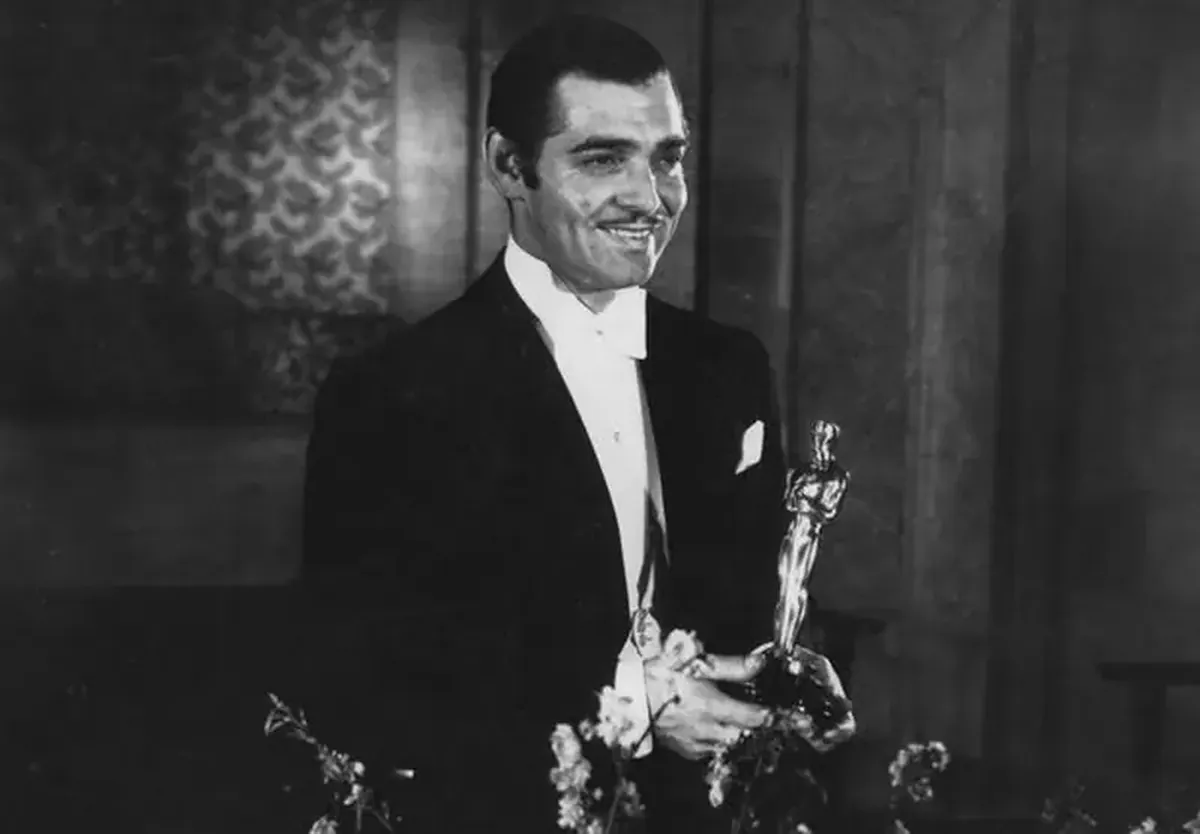
After receiving an advance for his work on the film adaptation — a project to which even F. Scott Fitzgerald contributed — Gable finalized his divorce from socialite Ria Langham; they had long stopped living together. That marriage had left him tired of performative social obligations: he had had enough of cameras and publicity both at the studio and in public, and he saw little point in wasting his life on meaningless appearances where deals were made. At that stage, Clark preferred to conserve his energy for the work he loved. He never boasted about past achievements or indulged in pride. When a friend’s son asked about his Oscar, he simply handed over the statuette and said, “Here, this is a gift from me to you!”
Doubts and Principles
Gable at first did not want to play Rhett Butler, even though fans had been sending letters to the studio asking that he be cast in the role. Those expectations made him uneasy: he feared being trapped by other people’s preconceived images. After some thought, he accepted the role and found a way to handle potential failure — if critics complained, he could always say, “You wanted this!” He battled nerves from the first day of filming through the premiere.
The lead actor nearly derailed the shoot by threatening to leave over separate restrooms for Black and white people. He was also outraged when the studio planned a premiere in Atlanta without inviting Hattie McDaniel, the Black actress who played Mammy. Gable had championed her casting — that role attracted as many contenders as Scarlett O’Hara’s part — and he supported McDaniel’s work. Only McDaniel’s own request that people not boycott the premiere kept audiences from missing the chance to see Gable at the film’s presentation; she would go on to win an Oscar for her performance.

A scene from the film “Gone with the Wind”
Ma and Pa
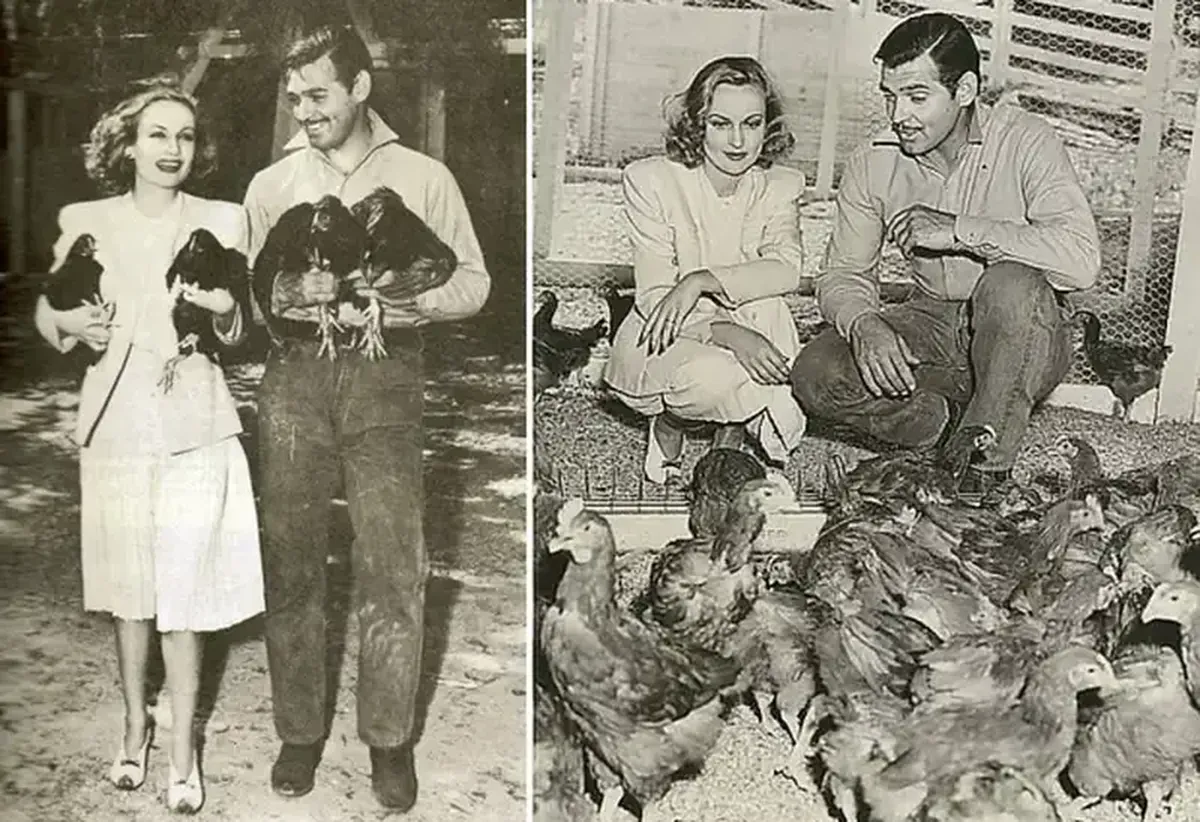
At the start of filming “Gone with the Wind,” producer David O. Selznick released the actor playing Rhett Butler for his wedding. Gable’s third wife was actress Carole Lombard — his great love. They met in 1932 on the set of “The Tough Guy” and initially showed no interest in each other. When they met again four years later they even quarreled; as a peace offering Lombard sent Gable a pair of white doves, which became the first of many birds that later lived on their ranch. Exchanging pairs of birds as gifts became a charming tradition for them. “You could trust this little crazy one with your weaknesses and dreams,” Gable later said, feeling at ease with a woman for the first time.

Carole Lombard and Clark Gable
They bonded over jokes and pranks. Lombard was a cheerful, easy-to-talk-to comedienne. To register their marriage they borrowed someone else’s car and drove away from Hollywood. The civil clerk in a small Arizona town, surprised to see the stars, smeared the document with ink in her excitement. The newlyweds settled on a farm near Los Angeles, where Ma and Pa raised horses, kept cows, and tended poultry. Gable rode the property on a mule while Lombard, under the farm manager’s supervision, cared for the birds and harvested crops.
Worse Than War
The couple’s happiness was short-lived. In 1942 Carole Lombard was in Indiana raising funds for military needs by promoting War Bonds. The plane carrying Lombard, her mother, and her press agent crashed in the Nevada mountains due to pilot error. All passengers and crew perished. The widower joined rescuers in the search for bodies.
Afterward, Clark Gable enlisted in the United States Army Air Forces, even though he was too old for the draft. He wanted to fill the psychological void and drown out his grief.

The popular actor was assigned to the First Motion Picture Unit, which made propaganda and training films for the U.S. armed forces. In 1943 he was attached to an active air squadron to shoot documentaries about air gunners. With a camera, Gable filmed the work of fire controllers on military bombers. He completed 25 combat missions, serving two years as an aerial gunner and bombardier in Europe. After his participation in the war became known, Hitler reportedly offered a reward to anyone who captured him.
Rushed to Live
During one mission, Gable’s plane was attacked by fighters; the stabilizer was blown off and an engine was disabled. The crew suffered injuries in a second attack: one was killed and two were wounded. Gable narrowly escaped being hit by anti-aircraft fire — a bullet pierced his boot and nearly hit his head. In June 1944, Captain Ronald Reagan signed the documents that discharged Clark Gable from the army. Major Gable returned with medals and a commendation cross, and his combat footage was shown in theaters. His military service added a new dimension to his public image: fans would have been “torn to pieces for souvenirs” had they not known he refused to give autographs.

Gable married two more times after the war, choosing women who reminded him of Carole. He later admitted one marriage was a mistake: he divorced British model and actress Sylvia Ashley after three years. In 1955 he married longtime friend Kay Williams, whose previous husband had been the heir to an American sugar fortune. Gable grew fond of the adopted children from both of his wives. Kay became pregnant but lost the pregnancy, and Gable did not live to experience fatherhood — he died before the birth of his heir.
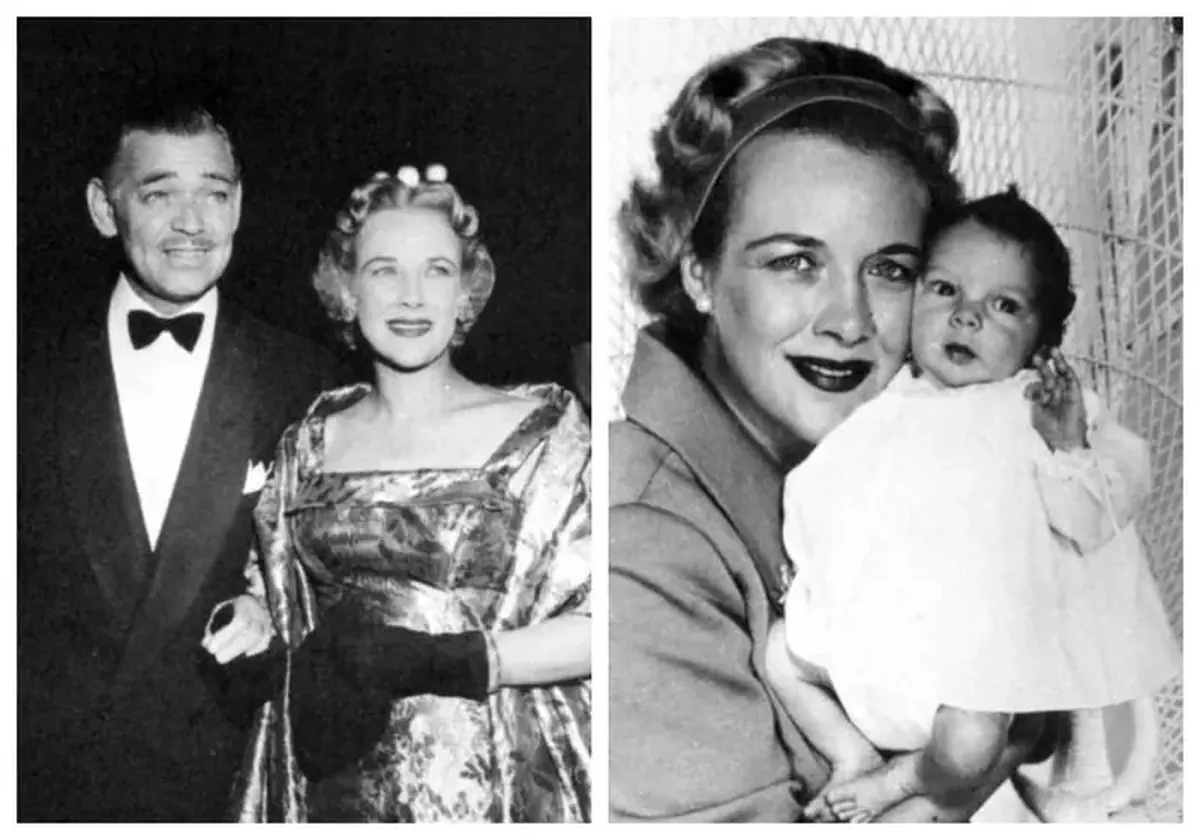
Clark Gable and Kay Williams
A Heart of Gold
After the war, Gable continued acting, appearing opposite Grace Kelly in “Mogambo,” Sophia Loren in “It Started in Naples,” and Marilyn Monroe in “The Misfits.” His work with Monroe would be the last for both stars. Harsh filming conditions hastened Gable’s decline: the movie, written by Arthur Miller, was shot in a scorching desert, and Gable — suffering from coronary thrombosis — had to ride a mustang in the heat without a stunt double, which contributed to the strain on his health. He also endured delays while Monroe dealt with personal issues, yet he still found the strength to encourage her through that difficult time.

Clark Gable with Grace Kelly (“Mogambo”), Sophia Loren (“It Started in Naples”), and Marilyn Monroe (“The Misfits”)
“Clark had a heart of gold; he couldn’t get angry or hate, and his behavior never contained a hint of resentment,” Arthur Miller said. Gable died from complications following a heart attack and additional heart events in his final days. On November 16, 1960, the 59-year-old actor passed away at the Hollywood Medical Center in Los Angeles — the same hospital where his son, John Clark Gable, was born four months later. Gable’s last film was released posthumously in 1961. He had seen working footage of that psychological western, and he felt he had poured his soul into the aging cowboy he played — the role he considered his best and the only one he truly played.
