
 Gaby
GabyPerhaps you already feel that the day is dragging on unbearably long? Likely, it’s not just your boring job to blame. The reason lies in the inner core’s behavior — more precisely, in its slowed rotation.
A new study from the University of Southern California confirms that changes in the Earth’s inner core can increase the length of days.
After analyzing seismic data from one region of the planet, the university team found the inner core began to slow around 2010. It is now rotating slightly backward relative to Earth’s surface, which subtly affects the planet’s rotation. Scientists say this could lengthen Earth’s day by fractions of a second, though the change is too small to notice.

What do you need to know about the Earth’s inner core?
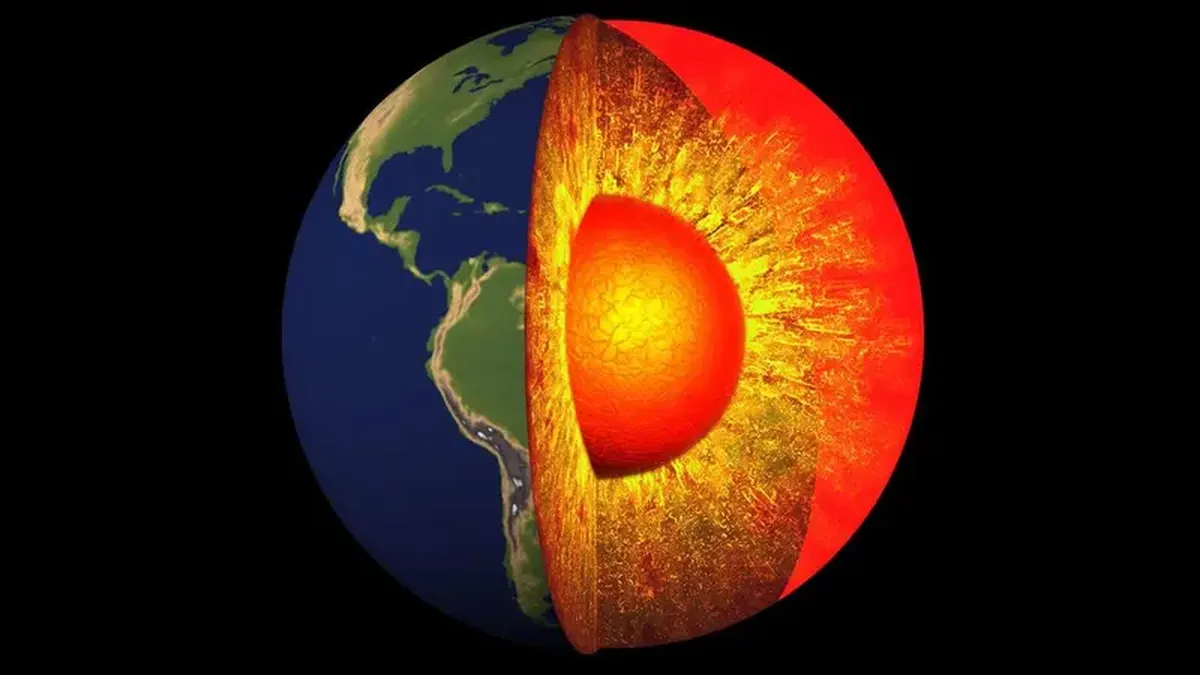
The inner core of our planet is a solid sphere of iron and nickel roughly the size of the Moon. It is surrounded by a liquid outer core of iron and sits at the very center, about 4,800 km beneath Earth’s surface.
Because the outer core is liquid, the solid, dense inner core can rotate somewhat independently under the influence of Earth’s magnetic field and the gravitational pull of the layers above.
For years, scientists thought the inner core rotated slightly faster than Earth’s surface, the Daily Mail reported. But Professor John Widdale, a geoscientist and the study’s lead author, says the core has now reversed direction and slowed.
“The inner core’s dance may be livelier than we previously thought,” he said.
How did the scientists find out about this?
Because researchers can’t observe the inner core directly, they relied on data from seismic events.
Widdale and his colleagues focused on repeating earthquakes — seismic events that occur at the same spot and produce nearly identical seismograms, so any deviations are telling. The South Sandwich Islands — a sub-Antarctic archipelago in the South Atlantic — caught their attention. Alongside 121 such local events from 1991 to 2023, the researchers also analyzed data from Soviet nuclear tests conducted between 1971 and 1974.
Widdale said he was puzzled when seismograms showed the inner core slowing around 2010. “When we found two dozen more observations showing the same pattern, the result was confirmed: the inner core has slowed for the first time in many decades,” he said.
The team suggested the slowdown could be caused by sloshing in the liquid outer core — which helps generate Earth’s magnetic field — and by gravitational forces from very dense regions of the mantle.
