
 Gaby
GabyA new study investigated whether technologically capable intelligent life is more likely to arise in oceans or on land. The authors conclude that such beings may be more likely to develop in oceanic environments, though life on land still has factors that can favor the rise of technology.
Where to search for intelligent life in the Universe — on land or in water?
Nature and the qualities of intelligence are often debated and raise plenty of questions. For example: are humans the only intelligent — or the smartest — species on Earth? It’s tempting to think so. But animals such as dolphins, crows, and elephants show high intelligence from a human perspective, even if they don’t build complex societies the way humans do (as far as scientists know).
In astrobiology, this question matters a lot. Many researchers want to know where the best chances of finding other intelligent life lie — on land or in water — and a new study adds an interesting twist to that debate.

Manasvi Lingam, an associate professor of aerospace physics and space sciences, argues that technological intelligence is more likely to develop in oceans than on land. But how does that square with the fact that humans are a terrestrial species?
The researchers used Bayesian analysis to compare the probability that intelligent species would emerge in terrestrial versus oceanic environments. They argue that if all other factors were equal, oceanic environments would be more conducive to the emergence of technological species because oceans are so diverse and cover about 71% of Earth’s surface.
Developing technology in water is more complex than on land.
The team focused on tool development as a measurable sign of intelligence. They concluded that one reason intelligent life isn’t more common in the oceans is that developing tools and complex technologies underwater can be harder than doing so on land.
Lingam explains that the emergence of intelligent life in the ocean may require much longer timescales because of various biophysical constraints, such as differences in sensory capabilities between land and water. He adds that although life likely originated in aquatic environments, the ocean may actually hinder the development of technology. Another possibility is that factors like available energy sources make oceans less suitable for technological species than they first appear.
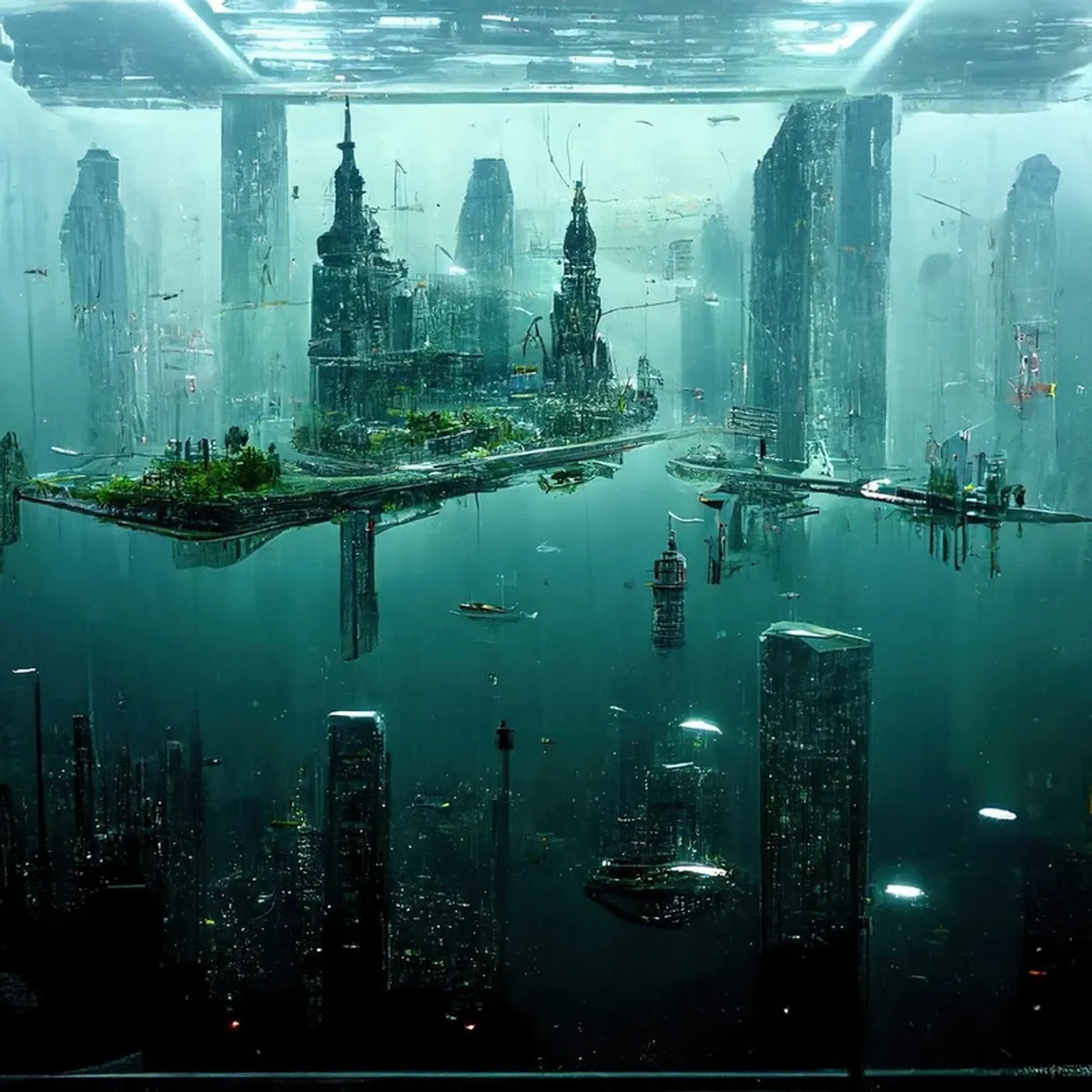
To carry out the research, the team used data from life on Earth to compare different kinds of intelligent animals — from primates to octopuses and cetaceans such as dolphins. They also applied mathematical and physical models, specifically Bayesian probability theory, to estimate the likelihood that intelligence would emerge in water rather than on land. The study drew on telescopic observations, field studies of animal behavior, and work on the role of oxygen in the evolution of complex life.
Technological intelligence as a measure of comparison among intelligent beings.
Journalists at the publication InterestingEngineering spoke with Manasvi Lingam to learn more about the research and the team’s conclusions. Lingam says intelligence is a fuzzy concept, so the researchers focus on species that fall in a similar category to humans — that is, species capable of developing extensive and intensive technologies. For that reason, they use the term “technological intelligence.”
Lingam also says he doesn’t consider humans to be the single “smartest” species, since that’s hard to quantify. But he believes humans are uniquely adept at creating technologies. Oceanic species show many signs of advanced cognition — such as theory of mind, complex communication, and the use of simple tools — even if those signs don’t yet translate into large-scale technology.
Just an assumption, not a statement.
The team’s analysis suggests a potential advantage for the development of technological intelligence in oceans. That raises a key question: why did humans emerge on land instead of in the sea?
Lingam says the apparent advantage for oceans comes mainly from the fact that there are far more aquatic worlds than worlds with significant land. In other words, if all other factors are equal (a crucial assumption), technological intelligence is more likely to develop in oceans.
But Lingam cautions that we cannot assume all other factors are equal. His team is exploring ways in which land could be a much more favorable environment than oceans for the emergence of technological intelligence.

According to Lingam, oceans offer more habitat area overall, which might seem to favor aquatic life. Still, when you compare the physical properties of oceans and land, land has important advantages for technology: moving on land requires less energy, vision works better in air than water, and land allows the use of fire — all of which can accelerate technological development.
Recent studies indicate that (sub)surface ocean worlds — that is, worlds without large land masses or continents — are common in the Milky Way. Those worlds may also have conditions suitable for life, which raises the possibility that life and technological intelligence could arise in such aquatic environments.
