
 Carlos Solis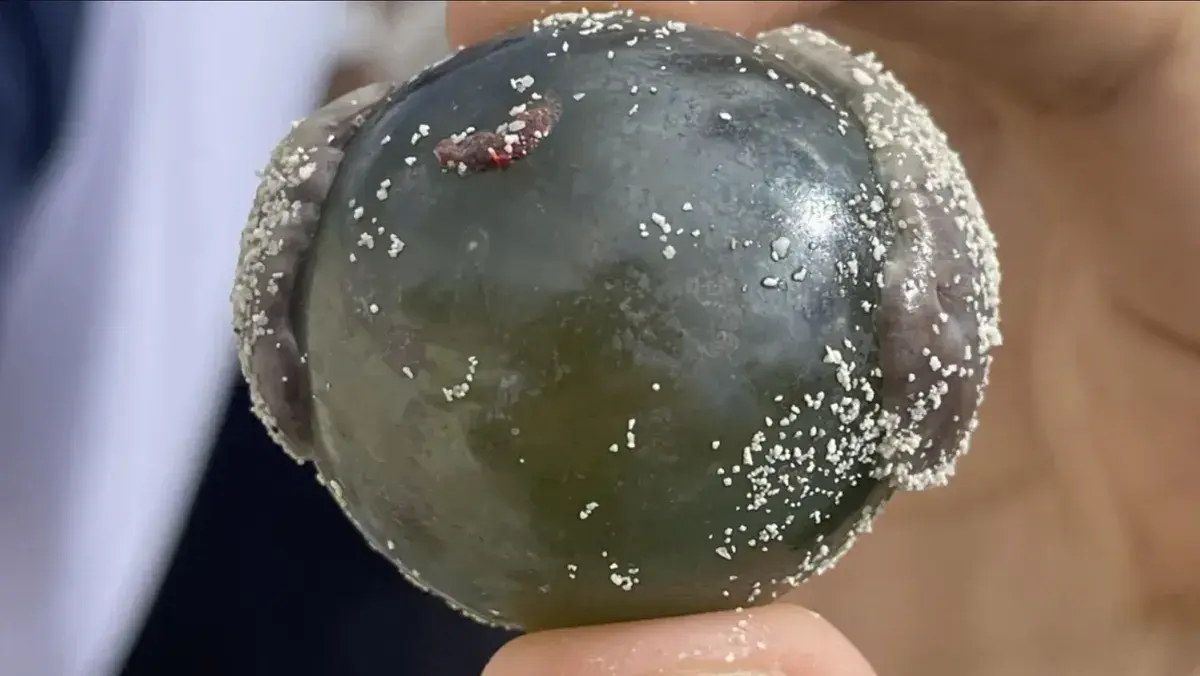
Meet Valonia ventricosa, a green alga — a single-celled, multinucleate organism known for its unusual size. It goes by nicknames like ‘sailor’s eyeball,’ ‘sea jelly,’ and ‘marine pearl.’ Valonia ventricosa lives in tropical intertidal zones worldwide, at depths down to about 80 meters, often tucked among coral reefs, as reported by IFLScience.
This organism has a surface as shiny as a mirror and can appear bright green, turquoise, silvery, or even dark depending on how many chloroplasts it contains. Those chloroplasts are organelles that carry out photosynthesis, capturing energy from sunlight.

The ‘sailor’s eyeball’ ranges in size from the diameter of a pinhead up to about 5 centimeters, depending on how full its central vacuole is — the large fluid-filled compartment inside the cell. Valonia ventricosa lacks capillary pores in its membrane, so water moves into the cell by simple diffusion.
V. ventricosa is a single cell that contains many nuclei. It is coenocytic: a single mass of cytoplasm with numerous nuclei that are not separated by cell walls.
If the alga is punctured, fragments can give rise to new individuals because a single nucleus is enough to regenerate a whole organism.

Researchers in Connecticut likened Valonia ventricosa to a Tesla plasma ball — a glass sphere filled with rarefied gas that emits a glowing light.
Recently, the NOAA Ocean Exploration mission found another mysterious glowing sphere on the ocean floor near Alaska, nicknamed the ‘golden egg.’ It was spotted at about 3.1 kilometers depth, attached to a rocky surface. The enigmatic object had a hole in it. One of the researchers said, “Something was trying to get inside or escape from it.”
