
 Gaby
Gaby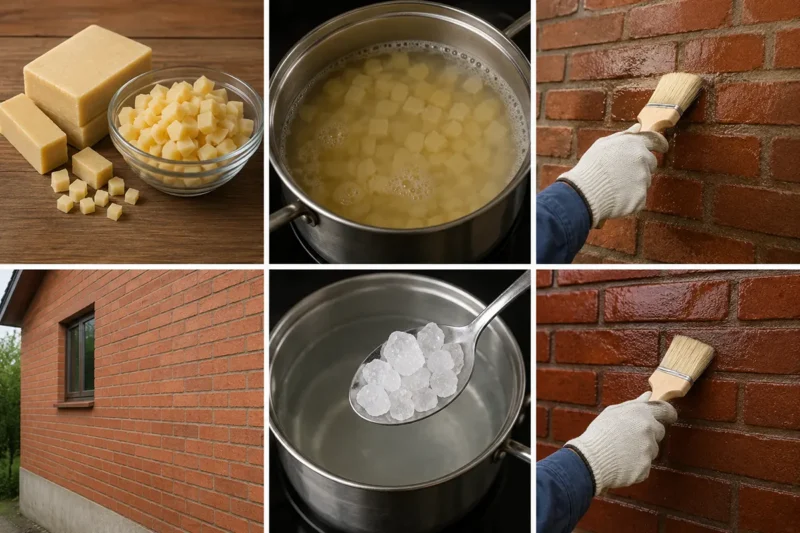
Moisture is the biggest threat to brick masonry. It seeps into the pores, freezes in winter, expands, and slowly destroys the wall from within. Efflorescence, cracks, crumbling plaster — all of these trace back to the same process. There is, however, a cheap and straightforward solution that has been around since the 19th century: treating walls with soap followed by an alum solution. The method creates an insoluble substance inside the brick’s pores that physically blocks water from entering.
Why Brick Absorbs Water
Fired clay brick is a porous material. Depending on the grade and manufacturing process, its water absorption ranges from 6 to 16% by weight. That means a saturated brick weighs 6–16% more than a dry one. Water enters through a network of capillaries — tiny channels that draw liquid upward and inward, much like a wick.
In summer rain this seems harmless enough: the wall gets wet and dries out. But when temperatures drop below freezing, water trapped inside the brick freezes and expands by roughly 9%. The brick cannot yield — microcracks form. After dozens of freeze-thaw cycles those cracks widen until the brick begins to spall and crumble.
Persistent moisture also promotes moss, algae, and fungal growth on the wall surface. Organic matter releases acids that attack both the brick and the mortar joints.
How the Soap-and-Alum Treatment Works
The method relies on a chemical reaction between soap and alum taking place inside the brick’s pores. Soap is essentially a salt of fatty acids and an alkali (sodium or potassium). Alum is potassium aluminium sulfate. When the hot soapy solution penetrates the pores and the alum solution follows, a reaction occurs that produces aluminium salts of fatty acids — compounds that are insoluble in water.
These insoluble salts precipitate directly inside the pores, partially filling the capillary space. Water can no longer penetrate as easily — its surface tension is too high for the narrowed passages. In effect, a hydrophobic barrier made of natural fatty acids forms within the brick itself.
The treatment does not seal the wall completely, which would actually be undesirable since walls need to breathe and allow vapour to escape from the inside. It reduces capillary water uptake while maintaining vapour permeability, which is why the method works well on residential buildings, not just outbuildings.
Materials and Tools
The list of materials is short. One or two batches of each solution are usually enough for one side of a standard house, but it is better to prepare fresh as you go rather than storing the mixed solutions.
For the soap solution:
- Household soap (72% fat content) — 2.2 lbs
- Water — 2.4 gallons
- A pot or bucket suitable for heating
- A knife or grater to cut the soap
For the alum solution:
- Potassium alum (KAl(SO₄)₂·12H₂O) — 10.5 oz
- Water — 2.4 gallons
Tools:
- A wide whitewash brush or a long-pile roller
- Protective gloves and safety glasses
- A stepladder or scaffolding for working at height
- Buckets for carrying the solutions
Potassium alum is available at hardware and building supply stores. It is sometimes sold in pharmacies under the name “alum crystals.” For construction purposes, ordinary unburned alum in crystal form is the right product.
Step-by-Step Instructions
Step 1. Prepare the Wall
Before treatment the wall must be dry and clean. If moss, lichen, or efflorescence is present, remove it first. Scrub moss off with a stiff brush. Efflorescence (white salt deposits) can be dissolved with diluted vinegar or a dedicated efflorescence remover; rinse the wall afterwards and allow it to dry completely.
Open cracks in the mortar joints should be raked out and filled with fresh cement mortar before you start. Treating a wall with open cracks is pointless — water will still enter through them. Allow the repair mortar to cure for at least seven days.
Work in dry weather at temperatures between 40°F and 77°F. On a very hot day, lightly dampen the wall before applying the soap solution to improve absorption.
Step 2. Prepare the Soap Solution
Cut the soap into small pieces or grate it so it dissolves faster. Place the pieces in a pot, add 2.4 gallons of water, and leave to soak for several hours or overnight.
Put the pot over low heat and warm it until the soap dissolves completely. Do not stir — this is the key point. Stirring a hot soap solution causes heavy foaming, and foam prevents even application and reduces the solution’s ability to penetrate the pores. Heat slowly, occasionally tilting the pot gently to check that the liquid is uniform.
The finished solution should be clear or slightly cloudy, with no lumps. Use it hot — a cooled solution penetrates the pores much less effectively.
Step 3. Apply the Soap Solution
Apply the hot soap solution to the brick wall with a wide brush or roller, working from the bottom upward so that any drips run onto already-treated surface and leave no gaps. The wall should be thoroughly wet but without puddles or heavy runs.
Pay particular attention to the mortar joints — they are more porous than the brick face and absorb water more readily. Work the brush over the joints several times to ensure good saturation.
After application, leave the wall to dry for a full day. During this time the soap solution penetrates deep into the pores and sets. Protect the treated surface from rain while it dries — if the forecast looks uncertain, postpone the work.
Step 4. Prepare the Alum Solution
Dissolve 10.5 oz of alum in 2.4 gallons of water. Alum dissolves readily in hot water — at 140–160°F the crystals disappear quickly and without residue. Prepare the solution shortly before use, while it is still warm.
A cold alum solution will also work, but a hot one penetrates deeper into the pores already saturated with soap, which is where the reaction needs to take place.
Step 5. Apply the Alum Solution
Once the soap layer has dried for a full day, apply the hot alum solution using the same technique: brush or roller, bottom to top, generously, without skipping the joints. Apply to a dry surface.
When the alum contacts the soap already present in the pores, the reaction begins and an insoluble precipitate forms. You may notice slight whitening on the surface — this is normal; the surface deposit washes off with rain over time.
Leave the wall to dry again after applying the alum. The brick reaches full protection within 3–5 days of completing the treatment.
Safety Precautions
Hot solutions can cause burns — always wear rubber gloves. A soap solution can splatter when applied with a roller at height, so eye protection is worthwhile. Alum causes mild irritation on skin contact; rinse with water if that happens.
When working on a ladder or scaffolding, place buckets of hot solution on a stable surface and do not lean out past the guardrail. Spilled soap solution on paving or steps makes surfaces slippery — sprinkle sand on any spills or rinse immediately with a hose.
The alum solution is not toxic, but avoid draining it into ornamental ponds or over garden beds — the aluminium concentration may harm plants.
How Often to Reapply
The lifespan of the soap-and-alum treatment depends on brick quality, climate, wall orientation, and whether roof overhangs protect the surface. As a general rule, the effect lasts between 5 and 10 years. To check whether protection is still active, splash a glass of water on the wall. If the drops bead up and run off, the treatment is still working. If water soaks in quickly, it is time to reapply.
North-facing walls that receive less sun and stay damp longer may need more frequent treatment. South- and west-facing walls with good overhangs can sometimes go twice as long without attention.
Comparison with Other Waterproofing Methods
The modern market offers silicone and siloxane water repellents in water-based or solvent-based formulations. They are more expensive but easier to apply — no heating required, and results are more predictable. Their service life is typically 10–15 years.
The soap-and-alum method is less convenient: solutions must be heated, a day’s pause is needed between applications, and you need to work quickly before the liquid cools. On the other hand, it costs 10–20 times less and requires no knowledge of polymer chemistry. For outbuildings, garages, garden walls, and older houses where cost matters, it remains a practical and well-proven option.
Linseed oil and boiled linseed oil (oifa) are another traditional approach. They fill pores well but yellow in sunlight, alter the colour of the brick, and require extended drying time — several days per coat. The soap-and-alum treatment does not change the appearance of the wall; after treatment, the brick looks exactly as it did before.
Common Mistakes That Reduce Effectiveness
The most frequent mistake is applying the solutions to a damp wall. Water already in the pores prevents soap from penetrating deeply, and the reaction with alum only happens at the surface. The wall must be genuinely dry before treatment — not just “almost dry.”
The second mistake is using soap solution that has cooled to room temperature. As it cools, its viscosity increases and it can no longer move freely through the capillaries. Work quickly, or reheat the solution as needed.
The third mistake is neglecting the mortar joints. Cement or lime mortar joints have a different pore structure than brick and absorb water faster. Carefully treating the brick face while skipping the joints leaves an open path for moisture.
The fourth mistake is applying only one coat of soap solution to highly porous brick. If the first coat absorbs within 10–15 minutes and the surface dries out quickly, apply a second coat immediately without waiting a full day. Two thin coats applied in quick succession outperform one coat followed by an overnight gap.
If you splash water on a wall treated this way, the drops bead up and run off. That is all the confirmation you need. A couple pounds of soap and a bag of alum crystals — and a wall that has been slowly drinking in rainwater for years stops doing it. The chemistry has not changed since the 19th century, and neither has the result.
