
 Carlos Solis
 For nearly three centuries, the portrait of a modest girl carrying a tray has gathered so many legends, rumors, and conflicting versions that untangling fact from fiction feels nearly impossible. Is it a story of love or cold calculation? A chance encounter or a carefully crafted plan? Or maybe there was no story at all and the artist simply painted a beautiful girl? There are enough versions to fill a television series.
Moreover, this painting survived a world war, became one of the earliest advertising faces in marketing history, and has been one of the most reproduced images for almost three hundred years. The story of the “Chocolate Girl” reads more like a detective tale than an art critique.
Version #1: Cinderella from a Viennese Café
According to the most romantic version, the painting “Chocolate Girl” depicts Anna Baltauf — a girl from a noble but impoverished family. In 1745 she worked in a Viennese café, serving the fashionable drink of the era: hot chocolate, which had only recently appeared in Europe and was treated as a true luxury.
One day Prince Dietrichstein, a descendant of one of Austria’s wealthiest and most influential families, entered the café. When he saw the modest yet graceful girl — impeccable posture, elegant movements, fair skin with a healthy blush, and small feet (a sign that hinted at noble origins) — he fell in love at first sight.
And here the scandal begins. Despite furious protests from his family and society’s shock, the prince married Anna. Before the wedding he commissioned a portrait of his beloved from the fashionable Swiss artist Liotard, asking him to depict her exactly as he had first seen her: in the clothes of a humble waitress. It is a true Cinderella story, only instead of a glass slipper there is a cup of chocolate.

Version #2: The Clever Title Hunter
But there is a very different, more prosaic version.
According to this tale, the girl was not Anna but Charlotte Baltauf, and she did not come from an aristocratic household but from a family of servants. Her mother prepared her from childhood for the only route available to a pretty, poor girl at the time: become the mistress of a wealthy man. There were few other paths to a comfortable life.
Legend says Charlotte first saw the prince not in the café but in the house of an aristocrat where she worked. The determined young woman began deliberately to catch his eye — demonstrating modesty and politeness while drawing attention. The plan worked: she became the prince’s mistress.
Charlotte was not content to be just another name among his affairs. She managed to make the prince introduce her to his guests, to stop seeing other women, and — crucially — to marry her, setting off a true scandal in high society.
When the prince commissioned a portrait of his fiancée from Liotard and told him about his future wife, the artist grimly replied, “Such women always get what they want. And when they do, you’ll have nowhere to run.”
Did the prophecy come true? In part, yes. The prince lived with Charlotte for the rest of his life, kept other women at bay, and died leaving her his possessions. In her later years she enjoyed recognition and respect. She got what she wanted.
Version #3: The Empress’s Maid
There is yet another version: the artist was not working on commission but wanted to paint a beautiful girl who had caught his eye. This girl was said to be a maid in the household of Austrian Empress Maria Theresa named Baldauf, who later became the wife of Joseph Wenzel of Liechtenstein.
Which story is true? No one knows for sure. The identity of the model remains officially unconfirmed. Art historians do agree on one thing: all three versions remain plausible, since none have been conclusively disproven by documents.
The Traveling Artist in Turkish Garb
What do we know about the master who created this work? Jean-Étienne Liotard (1702–1789) was an 18th-century Swiss artist from Geneva. He was a true cosmopolitan: he traveled widely across Europe and lived in Constantinople, where he adopted Eastern clothing and grew a long beard — a look that caused a stir in polite society. For that reason he was often called the “Turkish artist.”

Jean-Étienne Liotard. Self-Portrait
Liotard worked at royal courts, painting monarchs and aristocrats. His signature technique was pastel on parchment — a difficult medium that required virtuoso skill. That pastel technique let him capture the finest details and make the image appear startlingly lifelike.
He painted “Chocolate Girl” sometime between 1743 and 1745 (the exact year is uncertain, though most researchers favor 1745). Concluding that the work would not be fully appreciated in Vienna, where he was based at the time, he took it to Venice. There the painting was purchased by Count Francesco Algarotti, who was collecting works for King Augustus III of Saxony.
Algarotti was thrilled. In a letter he wrote, “I bought a pastel by the famous Liotard. It is executed in subtle gradations of light and with wonderful relief. The nature depicted is in no way altered… This is Holbein in pastels.”
The painting sold for 120 gold ducats — nearly 500 grams of gold, roughly equivalent to about $30,000 today. Not a bad price, especially for the 18th century.
Enchanting Details
What makes this portrait of a servant girl with a tray so special? At first glance she seems ordinary: a girl holding a tray, no dramatic props or lavish setting. But Liotard’s genius is in that simplicity.
The girl wears a modest yet neat outfit: a golden-ochre bodice with a peplum, a gray skirt, a crisp white starched apron, and a silky pink cap trimmed with lace. The colors create a sense of freshness, comfort, and calm.
Her face is delicate and slightly melancholic, with a faint blush. Her eyes are cast down — a traditional sign of modesty. Yet her well-groomed hands, impeccable posture, and small foot suggest a noble background.
Liotard captured an instant: the wrinkles in the apron, the reflections on the glass. The folds of the fabric are rendered so precisely you can almost hear the rustle of the skirt and the click of heels on the floor. The Meissen porcelain cup — likely the first depiction of Meissen porcelain in European art, since its production had only recently begun — gleams as if it were real.

What impresses most is the glass of water. It is so transparent and realistic, with its reflections and refractions of light, that you want to reach out and take it. It is a masterpiece within a masterpiece.
One more detail: the cup sits on a special saucer called a tremblez (from French trembleuse, “trembling hands”). Invented in the 17th century for serving hot chocolate, the saucer had a deep indentation to secure the bottom of the cup and prevent a single precious drop from spilling. These saucers are rare today but were common in the 18th century.

Tremblez
Adventures During World War II
From 1765 the painting “Chocolate Girl” was kept in the Dresden Gallery of Old Masters. But with the outbreak of World War II its fate became uncertain.
The Nazis moved it, along with other priceless works, to Königstein Castle above the Elbe — a fortress on a high cliff that seemed the safest place. There the paintings were stored in damp, cold cellars amid the chaos of war.
How a pastel on parchment — an extremely fragile and delicate medium — survived those horrific conditions remains a mystery. Art historians are still astonished: no cracks, no damage. It seems miraculous.
After the war Soviet troops discovered the collection, and the famous canvas returned to Dresden, where it remains today. Visitors say the Swiss master’s painting draws you in like a magnet — you can stand before it for hours, as if time has stopped along with the girl on the threshold.
The First Brand in Marketing History
And now the most interesting part. In 1862 Henry L. Pierce, president of the American chocolate firm Walter Baker & Company, visited the Dresden Gallery. When he saw the “Chocolate Girl,” he realized he had found the perfect face for a brand.
The company acquired the rights to use the image, and it proved a brilliant move. By the early 20th century the girl’s image appeared on every package of Baker’s cocoa, in advertisements, on postcards, and in recipe booklets.

Baker’s popularized the romantic Cinderella version — it fit neatly with their marketing: tradition, elegance, and true love all associated with the brand.
The “Chocolate Girl” became one of the first trademarks in U.S. history and one of the oldest brand images in the world. The company used her image for more than a century — and the girl from the portrait proved the ideal ambassador: she never ages, never causes scandal, never asks for a raise, and always stands for modesty and refinement.
The Most Replicated Image
The fame of Liotard’s “Chocolate Girl” spread far beyond Dresden and advertising. The painting went on to become one of the most reproduced images in art history.
As early as 1843 — a century after the painting was made — the Meissen porcelain factory released a figurine of the Chocolate Girl as a tribute to Liotard for being the first to depict their porcelain in art. Those figurines are still produced today, and antique examples from the early 20th century fetch between 2,000 and 6,700 euros at auction, depending on size and condition.

Figurine of the Chocolate Girl, 19th century. Meissen porcelain
In the 1900s–1920s special half-dolls inspired by the “Chocolate Girl” were produced in Bavaria and Thuringia — the so-called “tea dolls.” Dressed in fabric and lace, they were used as decorations for pincushions, powder boxes, and teapot warmers. Today those antique dolls are worth about 1,500–2,000 euros.
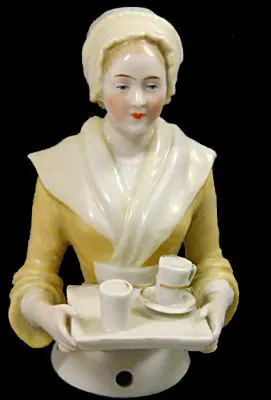
Half-doll
The image appeared on postcards, posters, and reproductions. You can still buy reproductions of the “Chocolate Girl” in many countries, and some coffee-shop chains use the image as a logo.
The Chocolate Girl never made it to the table. She remains frozen on the threshold, bathed in window light with a cup in her hands. Perhaps that is the best fate she could have had: otherwise there would have been an empty cup, a wiped table, and no one left to remember her face.
