
 Gaby
GabyThe Stakes Were Higher Than Life
In winter, the Swiss resort town of Montreux — called the Swiss Riviera and sitting on the shore of Lake Geneva with the Alps rising behind it — is usually cool and rainy. Because of the lake and the mountain plains, the climate is generally mild, but during winter the number of tourists drops a lot. It was an ordinary December day in 1971, the fourth day of a winter that was barely felt.
In the evening, a concert was taking place inside the Montreux Casino. Along with the usual respectable crowd, there were many long-haired, informally dressed people: no surprise — that night the bill was topped by Frank Zappa, the eccentric American provocateur and, above all, an extraordinary musician.
He performed with his new band, The Mothers, and after the Swiss concert they were scheduled to play in France and Belgium. The choice of a somewhat non-rock venue wasn’t accidental: since 1967 the Montreux Casino had hosted an annual world jazz festival, and by the early ’70s the lineup had expanded to include blues and rock acts.

Frank Zappa and The Mothers
The concert was in full swing. The Mothers were playing “King Kong,” and a loud, convincing synthesizer solo filled the room when the music stopped and Zappa calmly said into the microphone, “Ladies and gentlemen, stay calm, we have a fire.” As he later told French journalists, he pronounced the word almost as if announcing Arthur Brown’s hit, since in English “fire” can mean both an actual blaze and an alert.

For a moment it looked like the band might launch into that song. The audience probably would have been confused if sparks hadn’t started falling from the hall’s suspended bamboo ceiling, which then began to smoke. A fire. “Ladies and gentlemen, stay calm and proceed to the exits in an orderly fashion.”
The Rocket That Nearly Killed Rock Music
Everything looked a bit like that old English joke where a butler, trying to convince his master that the Thames was flooding, calmly announces: “The Thames, sir.” Eyewitnesses later said the evacuation was calm and orderly, with no casualties or injuries. The fire started when someone fired a flare gun at the ceiling during the concert, and the police never did identify who did it.
But the wildest twist was that Deep Purple’s classic lineup was in Montreux that night. They had just released the album Fireball and were in Switzerland to record their next album, Machine Head.
Claude Nobs, the founder and longtime director of the Montreux festival, helped get the crowd out of the building. Deep Purple’s bassist Roger Glover later said the fire began small, and during the evacuation he’d even gone back into the hall to check on Zappa’s gear — especially two brand-new synthesizers. Sadly, those synths and most of the equipment, along with the multi-story casino complex and concert hall, burned to the ground. The gear was insured, but the building was gone. The musicians had planned to start recording there the next day; instead, Frank and his band canceled the rest of their European dates, and Deep Purple had to find a new place to record.
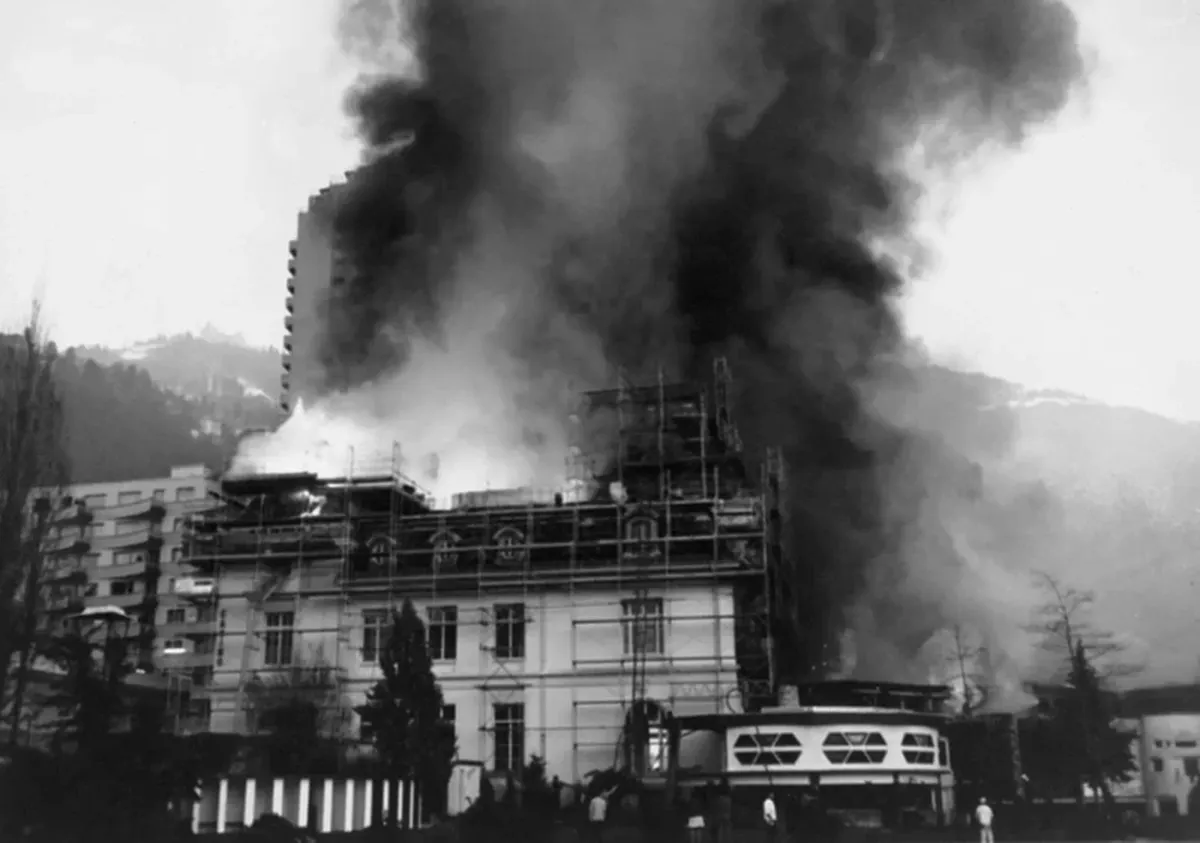
Fire at the casino, December 4, 1971
“Monsieur Blackmore, Open Up, Police!”
Shaken by what they’d seen, the band went to the Europa Hotel. From a restaurant window they watched the casino burn, a strong wind from the mountains driving flames and a huge curtain of smoke over Lake Geneva. Here you can see unique footage of that fire, later used in the documentary Made in Japan.
The twist was this: Deep Purple had also brought a mobile recording studio rented from The Rolling Stones — the Rolling Stones Mobile. Fortunately, it hadn’t yet been used for recording; if it had been, the blaze would have taken out three giants of rock at once.
Thanks to Claude Nobs, the band found the Pavilion Theater in town and moved all their gear there. Those walls heard, for the first time, the legendary guitar riff Ritchie Blackmore would cut into rock history — a riff that would inspire hundreds of beginner guitarists.
At that point the riff was an untitled instrumental marked only as “Title #1.” While the equipment was moved and set up in the theater, they rehearsed that piece. Recording went on late into the night, and when Blackmore finally nailed a take, the police burst into the theater. Neighbors had called about the loud music. The theater staff stalled, arguing that the creative process shouldn’t be interrupted. They were right — and that delay helped save what would become a future classic from being stopped by the Swiss police.

Deep Purple band
Rock Around the Mattresses
With no proper studio and deadlines looming, another small legend was born. One morning, bassist Roger Glover woke in his hotel room with the phrase “Smoke on the Water” in his head. He told vocalist Ian Gillan, who dismissed it as sounding “very druggy,” adding that Deep Purple was a band for drinkers, not smokers. The phrase was put aside for a while.
Pressed for time, Deep Purple ended up renting an entire hotel to record. The Grand Hotel sat on the edge of Montreux; in December it was nearly empty and unheated, so the first thing they brought in was an industrial heater.

Studio in the Grand Hotel
They set up a makeshift studio in the first-floor corridor, even building a wooden screen and covering it with mattresses taken from empty rooms. Ian Paice’s drums were recorded in the corridor because he liked the reverberation in the space between the rooms. Under those odd conditions they recorded the powerful, energetic album Machine Head. The instrumental recorded earlier at the theater was later given lyrics and became “Smoke on the Water.” The song’s lyrics basically tell the story:
We came to Montreux, on the shores of Lake Geneva
Planned to record an album and brought the “mobile” (mobile studio)
Frank Zappa and The Mothers were the best around
But some fool took a flare gun and burned everything down.
Smoke on the water,
Fire in the sky…

One week after the casino fire, Frank Zappa played a concert in London with rented equipment. Misfortune followed: a spectator pushed him during the show, he fell onto the concrete floor of the orchestra pit, suffered multiple injuries, and spent about six months in a wheelchair. The Montreux Casino was rebuilt and reopened in 1975, and jazz festivals are still held there today.

Montreux Casino
In 1966 Brazilian singer Astrud Gilberto, riding the success of “The Girl from Ipanema,” worked with American arranger Gil Evans on the album Look to the Rainbow. The intro to the track “Maria Quiet” on that record bears a close resemblance to the intro of “Smoke on the Water.” Who knows — maybe the Alpine wind carried that motif to Deep Purple’s ears. Here it is shown visually:

Like every big hit, “Smoke on the Water” spawned countless covers, and with TikTok its amateur performances have only multiplied. Almost every other TV singing show features surprising versions of it. In 1989 musicians from Deep Purple, Queen, Yes, Black Sabbath, Pink Floyd, and other bands united as Rock Aid Armenia to record the song and release a single, with proceeds donated to victims of the earthquakes in Leninakan and Spitak.

