
 Gaby
Gaby
This kind of urban landscape exists only in dreams—for now. Its creator, New Delhi–based architect and designer Manas Bhatia, believes his surreal skyscrapers will one day become reality.

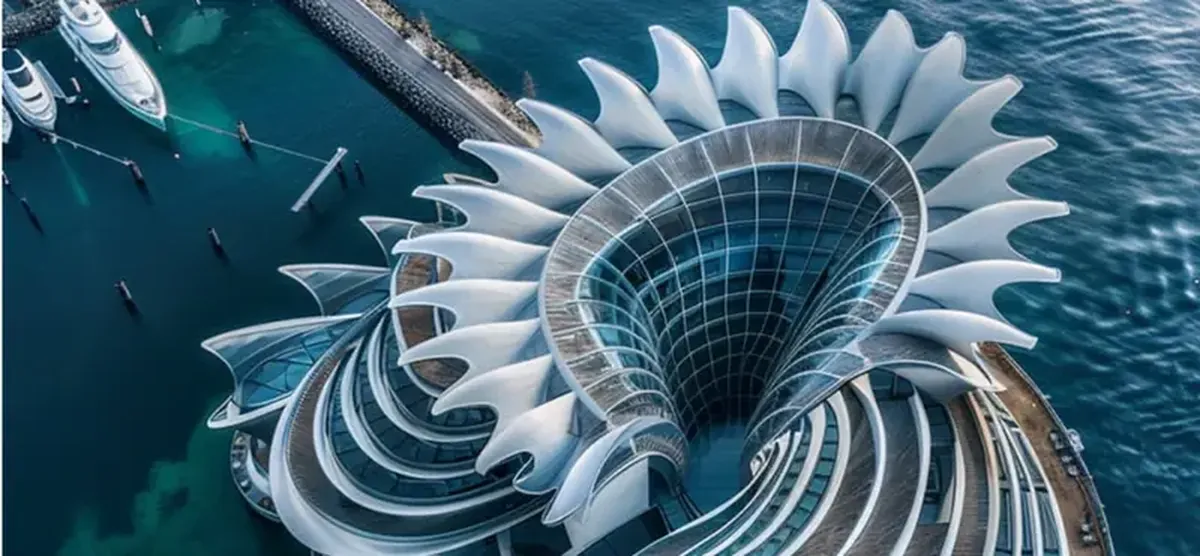
His latest series, Nautilus Bioarchitecture, was visualized using AI tools like Midjourney, LookX, and ChatGPT. Drawing on the golden ratio, Bhatia imagined skyscrapers that resemble nautilus shells. The pearlescent spiral walls of these utopian homes unfold like mollusk shells or intricate flowers. Futuristic structures rise amid lush gardens and green terraces. Some shell-like houses emerge directly from the water, with coral reefs visible below. Bhatia’s ideal bioarchitecture is a green oasis in the middle of the ocean.

What’s the connection between the nautilus and the golden ratio?
The cephalopod nautilus (Nautilus) has long been regarded in Hindu mythology as a symbol of natural beauty. Its shell is one of the most recognized natural forms associated with the golden ratio. That proportion is known as the number phi: 1.618… Its digits continue infinitely after the decimal point without repeating. The golden ratio appears in many organic structures. Embedded throughout the universe, it has served as a guiding principle in art and architecture. Examples of the golden ratio appear in architectural masterpieces of balanced proportion, from the Parthenon in Athens to the Pyramids of Giza.
And what about the ancient number phi and artificial intelligence?
The intricate patterns in Nautilus Bioarchitecture, inspired by the golden ratio, evoke a sense of harmony and proportion that goes beyond mere functionality.

Bhatia has returned to the ancient practice of combining mathematics and aesthetics to imagine tomorrow’s architecture, aiming for a more organic and sustainable built environment. After all, the era of climate change demands buildings that are not only visually appealing but also adapted to new climatic conditions.

With the rise of computational design tools and artificial intelligence, architects now find it easier to tackle those challenges. Designboom reports that these tools facilitate the integration of mathematical relationships into architectural projects and give architects more freedom to experiment with different approaches. Thanks to the AI revolution, Bhatia is exploring the complex geometry of modern urbanism with unprecedented precision, efficiency, and creativity.
