
 Gaby
Gaby
British and Colombian archaeologists and anthropologists have explored a section of a massive series of frescoes that stretch approximately 13 kilometers across rock formations at the archaeological site of Serranía de la Lindosa. This astonishing gallery, located in the Colombian Amazon, was discovered by researchers four years ago. Its numerous scenes, painted in ochre about 12,500 years ago, provide a glimpse into the lives of South America’s earliest inhabitants.
On Cerro Azul hill, scientists closely examined six panels, ranging from one that measures 40 by 10 meters and contains over 1,000 images to a much smaller panel covering 60 square meters with 244 drawings.
“These rock paintings are the earliest evidence of human presence in western Amazonia,” noted Mark Robinson, a co-author of the study from the University of Exeter (UK).
What Scientists Discovered
Studying this ancient gallery has been challenging from the start, requiring strenuous climbing. The team used drones and conventional photography, as reported by The Independent. Ultimately, the researchers documented over 3,200 images that shed light on the daily lives of ancient Amazonians. They revealed details across many aspects of life, from mythology to diet.
The researchers identified at least 22 species of animals depicted in the rock paintings. Among them were deer, birds, lizards, snakes, turtles, bats, spiders, sloths, monkeys, caimans, porcupines, tapirs, and others. The frescoes also feature mythological scenes of people transforming into animals and vice versa. Beliefs in such transformations still exist in modern Amazonian communities.
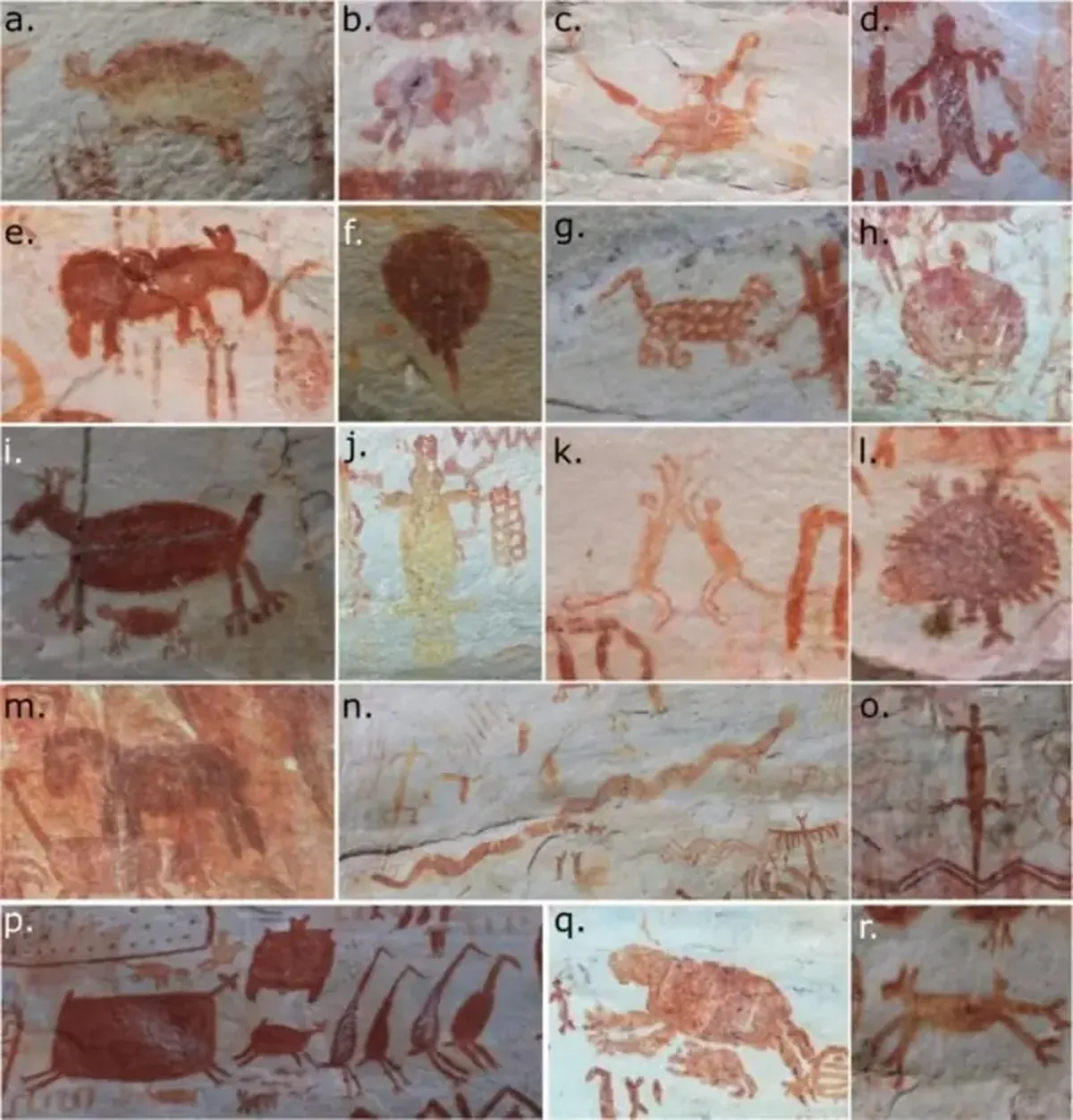
The gallery also revealed how the continent’s earliest inhabitants spent their time: primarily hunting and fishing.
Additionally, the researchers examined animal remains found near the giant gallery and compared them to the creatures depicted in the rock art. They found that the ancient people’s diet was remarkably diverse, including fish, various small and large mammals, and reptiles such as turtles, snakes, and crocodiles.
Although the excavations yielded a large number of fish skeletons, artistic representations of fish were limited to just two panels.
Large cats were almost absent from the scenes in the rock panels, despite their status as apex predators in ancient Amazonia.
“The context demonstrates the complexity of the Amazonians’ relationships with animals, both as a food source and as respected beings with supernatural abilities,” Dr. Robinson remarked.
“The Amazonians had a deep understanding of the various environments in the region and possessed the skills to track and hunt animals, as well as gather plants; thus, they ensured their food supply,” summarized Javier Aceituno, a co-author of the study from Medellín (Colombia).
The findings were published in the Journal of Anthropological Archaeology.
