
 Carlos Solis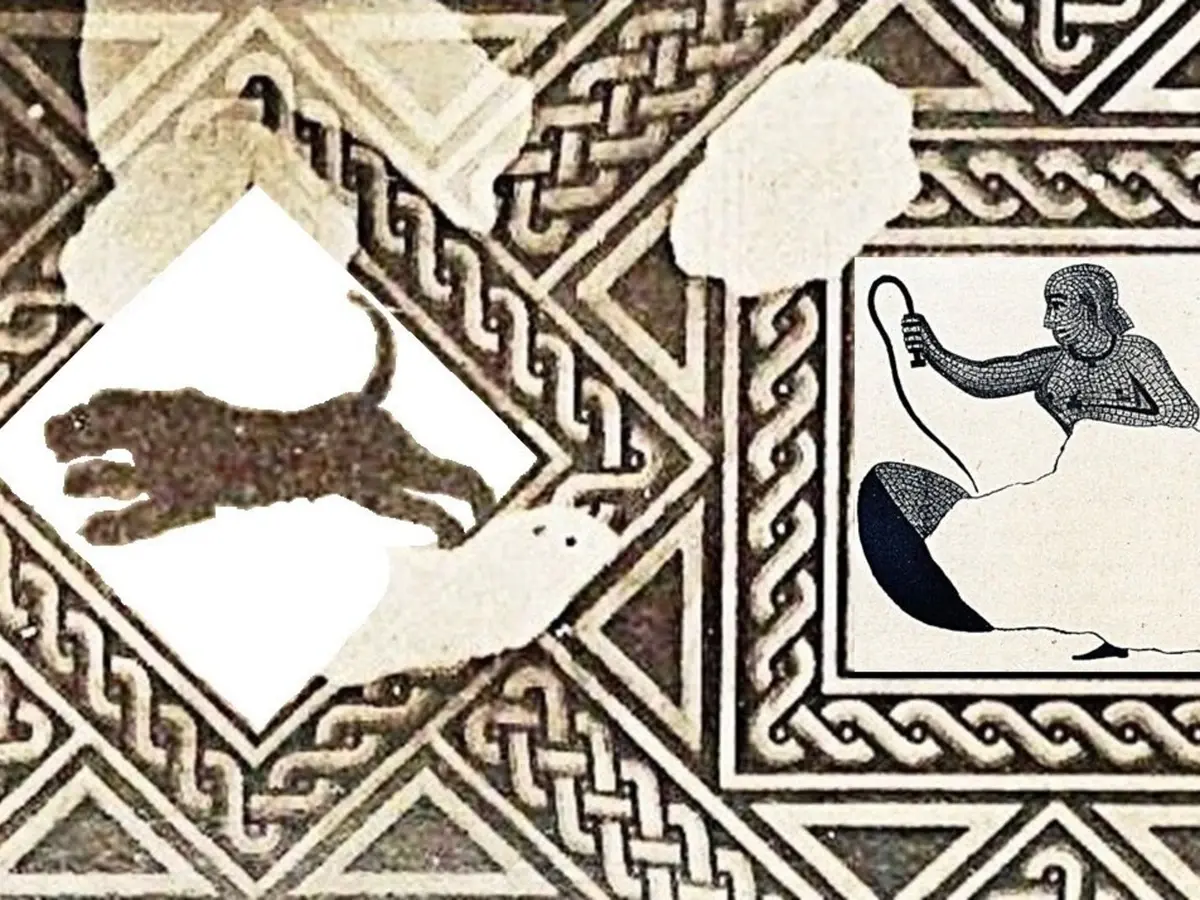
A lost Roman floor mosaic from Reims, France, missing for more than a century, has rewritten the history of women who performed in amphitheaters.
The discovery that drew attention from the global academic community was made by historian Alfonso Manias of the University of California, Berkeley. His research sheds new light on the role of women in ancient Roman spectacles and suggests they took part in those shows for much longer than previously thought.
Manias’s work was based on a sketch of the mosaic that was destroyed during World War I.

A Venatrix Appears on the Reims Mosaic
Archaeologists discovered the floor mosaic in 1860 in Reims, a city known for its ancient monuments, in the villa of a high-status Roman. The artwork, roughly 9 by 11 meters, featured a complex arrangement of square medallions that depicted gladiators, wild animals, and staged hunts.
But the mosaic did not survive. It was destroyed during World War I bombings in 1917. Only sketches of the mosaic’s scenes, made in the 19th century by archaeologist Jean-Charles Loryque, have come down to us.
For more than a century the mosaic faded into obscurity. Interest only revived in recent years. Alfonso Manias, who specializes in the history of sport, noticed one of Loryque’s drawings that researchers had misinterpreted for more than 160 years. Scholars had previously read the figure as a male entertainer or an arena comic.
But Manias rejected those earlier readings of the sketch. He argues the figure is a woman performing in the arena as a hunter of wild animals. Manias published his paper in The International Journal of the History of Sport on the Taylor & Francis Online platform.
On the medallion, a woman drives a large cat toward another arena hunter. The female figure has a bare torso and clearly defined breasts—the clearest visual cue in Roman art for the female body.
That detail, the facial features, and the context all point to a venatrix. The term venatrix designated professional female hunters in the arena who took part in venationes, hunts of wild animals.

A Breakthrough Discovery
Before Alfonso Manias reanalyzed the image, historians argued that the profession of female animal hunters in amphitheaters was short-lived—mainly between Nero’s reign in the 1st century AD and the start of the 2nd century.
Ancient Roman written sources contain references to women’s participation in hunts, but those mentions are rare and clustered in a narrow time window.
Meanwhile, the mosaic from Reims, dated to the 3rd century AD, provides convincing evidence that women continued to take part in arena hunts for at least another century.
That revision is significant because it changes the accepted historical timeline.
The mosaic, forgotten for decades, is now at the center of a major historical reappraisal.
The woman with the whip has no name and no inscription to tell her story. But careful analysis, combined with ancient evidence, has made her a key figure who expands our modern understanding of women’s roles in the ancient Roman world.
